Dr. Arvind Kumar*
The proposed India–EU Free Trade Agreement (FTA) is unprecedented in scale and ambition. Over its implementation period, the European Union is expected to eliminate import duties on roughly 99.5% of traded goods from India, while both partners together will liberalise 96–99% of their mutual goods trade. European exporters stand to save billions of euros annually, while Indian firms would gain preferential access across a wide range of sectors, including textiles, apparel, leather, chemicals, engineering goods, base metals, gems and jewellery, pharmaceuticals and food products. If India’s growth trajectory materialises as projected, this agreement could underpin a free-trade space accounting for nearly a quarter of global GDP and close to a third of world trade within the next decade.

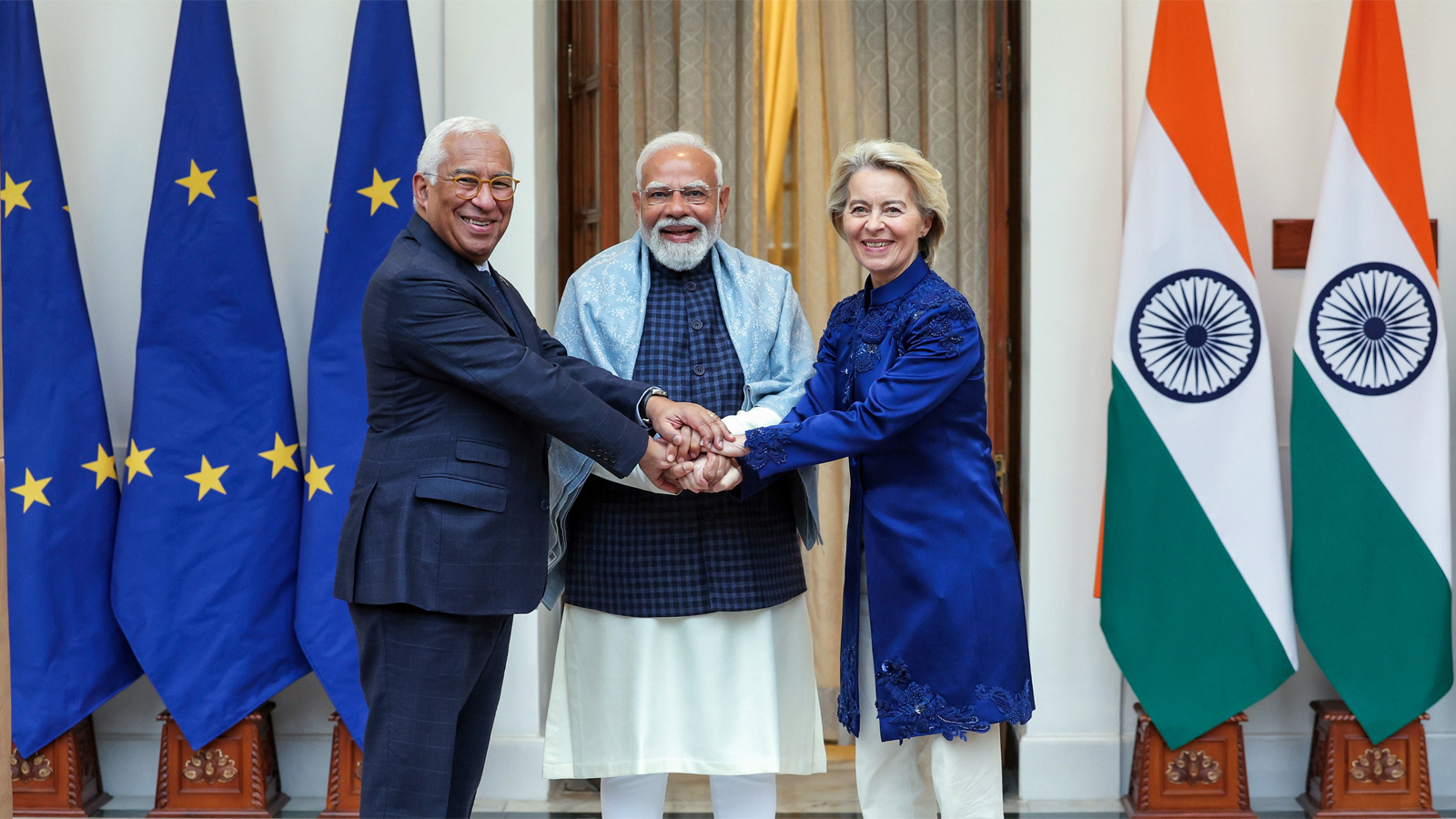
At Davos 2025, the World Economic Forum’s language shifted decisively from abstract “globalisation” to “de‑risking”, “resilience” and “democracy’s competitive advantage”, and within that shift India and Europe were repeatedly framed by policymakers and CEOs as indispensable anchors of a new, more politically conscious globalisation. It is in this Davos framing that European Commission President Ursula von der Leyen’s description of the new India–EU Free Trade Agreement as “the mother of all trade deals” acquires deeper meaning: standing beside Prime Minister Narendra Modi in New Delhi, she hailed it as “a trade deal between giants… a free trade area of two billion people… that benefits Europeans and Indians alike,” while Modi called it “the biggest FTA in India’s history, not merely a trade pact but a roadmap for shared prosperity and security.” When such leaders choose superlatives on a stage already primed by talk of fragmentation, weaponised interdependence and democratic solidarity, are they signalling that this agreement is simply another market‑opening exercise, or a conscious attempt to redraw the geo-economic map in a world where supply chains, technology standards and climate policies have become instruments of power as much as tools of cooperation?
Deeper Integration
Many observers argue that the significance of the India–EU FTA lies less in tariff arithmetic than in its strategic logic. Rather than a conventional trade-creation exercise, the FTA functions as a central economic pillar of a broader geopolitical and geo-economic reorientation. Europe is actively seeking to reduce concentrated dependencies particularly on China in critical sectors such as rare earths, batteries, pharmaceuticals and digital infrastructure. India, meanwhile, aims to consolidate its position as a trusted “China-plus-one” hub for manufacturing and services while preserving strategic autonomy. This strategic rationale raises a fundamental question: does deeper economic interdependence between two large democracies enhance collective resilience by diversifying risk away from dominant partners, or does it generate new asymmetries that leave one side structurally constrained?
From a geo-economic perspective, the agreement reflects distinct but complementary motivations. For Brussels, the FTA serves as a hedge against a more protectionist United States and an uncertain Chinese growth trajectory, while securing early access to what is likely to become the world’s third-largest economy. It strengthens European value chains in automobiles, machinery, chemicals and advanced services, and anchors Europe more firmly in the Indo-Pacific. For New Delhi, the opportunity lies in using preferential access to Europe’s affluent, high-standards market to move Indian firms up the value chain from cost-based production towards design, branding, technology-intensive manufacturing and sophisticated services while attracting European investment into manufacturing, renewables, critical minerals processing and other knowledge-intensive sectors.
Despite this promise, concerns within Indian industry remain acute. Rapid tariff reductions in sectors where European firms enjoy strong competitive advantages such as automobiles, automotive components, chemicals, machinery and premium consumer goods could place intense pressure on domestic producers in mid-technology segments that are still consolidating. Supporters respond that the agreement’s design mitigates these risks. Politically sensitive agricultural sectors, including dairy and selected staples, are excluded or strongly protected. Vulnerable industrial segments benefit from long transition periods and safeguard mechanisms, while rules of origin limit third-country trans-shipment. More fundamentally, they argue that persistent reliance on high tariffs is incompatible with India’s ambition to become a globally competitive manufacturing power. Phased exposure to competition, when paired with targeted industrial policy, skills development and innovation support, can raise productivity and diversify exports rather than trigger deindustrialisation.
The FTA is also embedded in a wider matrix of India–EU cooperation, including a proposed Trade and Technology Council, collaboration on secure digital infrastructure and AI governance, maritime security dialogues in the Indian Ocean, and partnerships on critical raw materials for the green transition. European policymakers increasingly view India as a central pillar of their Indo-Pacific strategy, while Indian strategists see Europe as a crucial third pole that diversifies partnerships and provides high-quality capital with relatively limited political conditionality. Social dimensions further complicate the picture. The agreement is expected to expand mobility for Indian students, researchers, healthcare workers and IT professionals into Europe, addressing skills shortages while generating remittances, skills transfer and deeper human-capital linkages. However without targeted support in finance, skills, market access and fair recruitment, the gains from deeper integration may accrue unevenly, while adjustment costs fall on the most vulnerable.
Sustainability experts emphasise that the agreement’s green and digital chapters could strongly shape how both partners pursue climate and development objectives. Europe is expected to use the FTA to encourage higher environmental standards, climate disclosures and faster deployment of clean technologies within Indian industry. India, in turn, will seek concessional finance, technology transfer and market access for its green exports, ranging from renewable-energy components to green hydrogen and low-carbon services. In this context, the EU’s Carbon Border Adjustment Mechanism (CBAM) looms as a critical variable. If Indian producers fail to decarbonise at pace, CBAM could function as a quasi-tariff on carbon-intensive exports, eroding some of the preferential advantages created by the FTA. Conversely, if India successfully leverages European finance and technology to green its manufacturing base, CBAM could become a catalyst for accelerated structural transformation rather than a trade barrier.
Way Forward
The decisive test of whether this “mother of all agreements” becomes a transformative success lies less in tariff schedules than in the domestic reforms, institutional capacity and political choices that accompany it over the next decade. Equally important is the design of targeted transition support: large-scale skilling and reskilling for workers in exposed sectors; credit, technology and market-linkage support for MSMEs; and social-protection mechanisms that cushion short-term disruption while enabling mobility into expanding sectors such as renewables, electronics, pharmaceuticals and higher-value services.
For Europe, credibility will depend on matching strategic rhetoric with tangible openness. This includes making it easier for Indian firms and professionals to operate in European markets, supporting joint R&D and innovation partnerships, offering predictable and transparent regulatory pathways, and resisting the temptation to weaponize standards or climate instruments in ways that appear discriminatory. Regular, transparent impact assessments and a readiness to deploy safeguard clauses and adjustment funds instead of reverting to ad hoc protectionism are viewed as essential for sustaining public legitimacy. Ultimately, success should not be measured solely by headline trade or investment figures. More meaningful indicators include diversification, inclusion and sustainability and eventually two plural democracies deepening economic integration with social justice, climate responsibility and political accountability in an era of fragmented globalisation.
*Editor, Focus Global Reporter