Dr. Arvind Kumar*

Climate change is widely acknowledged as the greatest challenge facing humanity so why does the response still feel insufficient? We have no shortage of conversations. From United Nations platforms to climate summits, from International day commemorations like Earth Day to World Water Day, the global calendar is saturated with reminders of planetary urgency. As António Guterres has repeatedly stressed, they are meant to “sound the alarm,” pushing systems from awareness to accountability. The real test, therefore, is not observance, but outcomes. And this is where the central contradiction emerges. Despite an unprecedented proliferation of dialogues, institutions, frameworks, and financial commitments, sustainability outcomes remain deeply inadequate. If anything, the gap between ambition and reality is becoming more visible.
The numbers tell a story of progress but also of contradiction. According to IRENA, global renewable power capacity reached about 4,448 GW in 2025, with a record 585 GW added in a single year. Solar alone now accounts for roughly 42% of total renewable capacity, signalling a structural energy transition. Alongside, the IEA estimates that since 2020, governments have committed nearly USD 2 trillion in direct clean energy investment support, alongside additional short-term affordability measures.
Yet this transition coexists with inertia: fossil-fuel consumption and producer subsidies across major economies have still totalled about USD 2.4 trillion since 2022. This duality reflects a system in transition but not yet transformed where decarbonisation accelerates even as legacy dependencies persist. Geopolitics reinforces this tension. The Russian invasion of Ukraine disrupted gas flows and triggered global price volatility, while instability in the Middle East continues to affect oil and LNG markets. Energy security concerns, as highlighted by global institutions, are thus tightly intertwined with climate strategy.
More fundamentally, what we are witnessing is not just policy inconsistency, but a weakening of global consensus. The Paris Agreement symbolised a rare moment of collective alignment. Today, that alignment appears increasingly fragile. Some nations have begun questioning the scale, pace, or even the premise of climate action. Others are recalibrating commitments based on domestic pressures. The emerging undertone is subtle but significant: from “shared responsibility” to something closer to competitive survival. If the science is clear, then why is the consensus weakening? This question becomes sharper when viewed through the lens of interdependence.
Pragmatism or strategic delay?
Within this shifting landscape, India has emerged as a pivotal actor. By November 2025, its installed renewable capacity had reached roughly 254 GW, with a record 44.5 GW added in eleven months almost double the previous year’s pace. Solar capacity crossed 100 GW in early 2025 and rose to about 132.9 GW by November, marking over 40% annual growth. Notably, non-fossil sources accounted for about 51.5% of total installed electricity capacity, enabling India to meet its Paris NDC target of 50% five years ahead of 2030.
However, this energy progress sits alongside growing climate stress in food systems. Warnings from the WM and FAO indicate that extreme heat in 2026 could push agri-food systems “to the brink,” affecting over a billion people. In India, the IMD forecasts a below-normal monsoon at around 92% of the long-period average (±5%), even as food grain output has reached an all-time high of about 354–358 million tonnes in 2024–25.
Despite this production strength, The State of Food Security and Nutrition in the World notes that nearly 6% of India’s population still cannot afford a nutritious diet, while globally 638–720 million people faced hunger in 2025, and about 2.6 billion people cannot afford a healthy diet (down from 2.9 billion in 2020). This illustrates a structural paradox: aggregate abundance coexists with persistent nutritional insecurity. Climate shocks, heatwaves, erratic rainfall can quickly destabilise this balance, making resilience as critical as production.
At the centre of this systemic stress lies water. India’s groundwater data reveals a tightening balance between recharge and extraction, even as per capita availability continues to decline below stress thresholds. These pressures are not isolated. Water scarcity directly amplifies risks across sectors—reducing agricultural productivity, constraining urban supply, and intensifying industrial competition. Yet governance responses remain fragmented. Regulatory interventions, such as mandates on rainwater harvesting enforced by the National Green Tribunal, reflect urgency but often lack robust enforcement and monitoring mechanisms. Without systemic integration, such measures risk becoming compliance exercises rather than transformative solutions.
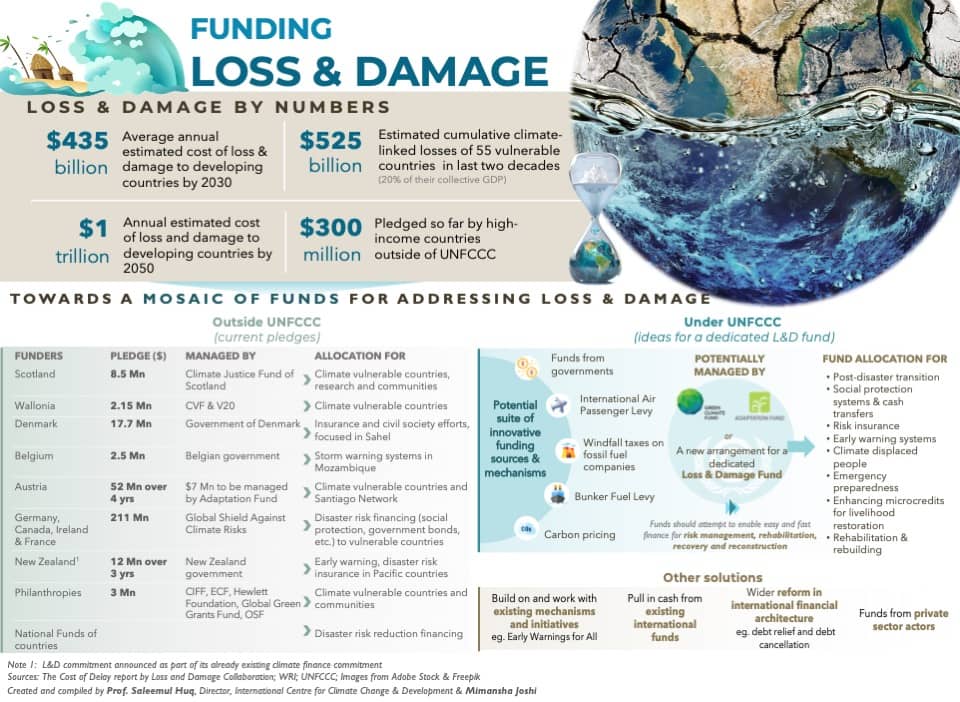
Globally, similar patterns persist. The World Bank’s “Water Forward” initiative, April 2026 aims to improve water security for 1 billion people by 2030, with the Bank itself targeting 400 million people. For India, this presents an opportunity to mobilise finance and expertise in areas like urban water efficiency, wastewater reuse and basin-level planning. However, these solutions are constrained by the broader political economy of climate finance. The Loss and Damage Fund, operationalised at COP28, has received initial pledges of roughly USD 650–700 million, later estimates suggesting USD 700–768 million from about 28 countries by late 2025. This is less than 0.2% of estimated annual climate losses, which exceed USD 2.3 trillion when cascading impacts are included. With disbursements expected around mid-2026, the gap between commitments and needs remains stark.
The gap is not merely financial; it reflects unresolved questions of responsibility, equity, and trust. This brings us to the core dilemma. We have the science. We have the data. We have the institutions. We even have bye-laws & the frameworks. So why are we still falling short? Is it that nations are unwilling to prioritise long-term planetary stability over short-term economic gains? When countries dilute commitments, is it pragmatism—or strategic delay? And when global discourse shifts from cooperation to competition, can sustainability still be achieved at all? These are not rhetorical questions. They are questions that define the future of climate governance. Because what the data ultimately reveals is a single systemic truth: energy transition, food security, water stress, and climate finance are not parallel challenges. They are interdependent variables within the same risk system. Actions in one domain inevitably shape outcomes in another.
And yet, our governance structures continue to treat them in silos.
Way Forward
The need is to shift from fragmented, sector-specific intervention to an integrated governance model where sustainability is treated as a single, interconnected system. This requires institutionalising “transversality” by aligning energy, water, agriculture and financial policies so that gains in one domain do not create vulnerabilities in another for instance, linking renewable energy expansion with supply-chain resilience and water availability, while simultaneously aligning agricultural strategies with climate projections and nutrition outcomes. Climate risk must be embedded into all economic decision-making, from infrastructure and urban planning to fiscal policy, supported by real-time data and adaptive governance frameworks. Water, in particular, must become the central planning variable, guiding choices on crop patterns, industrial use and urban growth through basin-level management. At the same time, domestic action must be reinforced by equitable and predictable climate finance, especially for adaptation and loss and damage, ensuring that vulnerable populations are not disproportionately burdened by transitions. Crucially, this transformation cannot remain state-centric; it demands a whole-of-system approach. The transition ahead is not about incremental improvements but about redesigning systems, because sustainability is not just a technical problem. It is a political one. A question of whether the world is willing to act collectively or retreat into fragmented, self-interested pathways. And that leads to the most uncomfortable question of all: In a world increasingly defined by competition, can cooperation still prevail?
Until that question is answered not in declarations, but in decisions sustainability will remain where it stands today: Everywhere in intent. Nowhere in outcome.
*Editor, Focus Global Reporter