
Dr. Arvind Kumar*
The scale of what the BBNJ Agreement governs is hard to overstate. The high seas constitute roughly two-thirds of the world’s oceans, covering more than 40% of the planet’s surface and over 90% of Earth’s marine habitat by volume. These waters are home to deep trenches, seamount chains, vast midwater ecosystems, and life forms from microscopic plankton to migratory whales that play central roles in nutrient cycling, climate regulation, and global biodiversity. Yet prior to this treaty, less than 1.5% of these areas were formally protected, and human pressures such as overfishing, shipping, deep-sea mining exploration, and climate-driven change were advancing faster than the rules governing their impacts.

For most of modern history, the open ocean beyond the 200-nautical-mile limits of national jurisdiction was treated as a place apart: a vast, seemingly inexhaustible commons governed largely by maritime custom, fragmented sectoral rules, and the assumption that its sheer scale was a bulwark against significant human impacts. That assumption has worn perilously thin. Recently, the Agreement on the Conservation and Sustainable Use of Marine Biological Diversity of Areas Beyond National Jurisdiction (BBNJ Agreement) widely known as the High Seas Treaty entered into force as the first legally binding global framework explicitly designed to protect and sustainably manage the biological wealth of waters and seabed beyond national borders. This historic milestone culminates nearly two decades of negotiation and represents what UN Secretary-General António Guterres described as a moment that “fills a critical governance gap to secure a resilient and productive ocean for all.”
The scale of what the BBNJ Agreement governs is hard to overstate. The high seas constitute roughly two-thirds of the world’s oceans, covering more than 40% of the planet’s surface and over 90% of Earth’s marine habitat by volume. These waters are home to deep trenches, seamount chains, vast midwater ecosystems, and life forms from microscopic plankton to migratory whales that play central roles in nutrient cycling, climate regulation, and global biodiversity. Yet prior to this treaty, less than 1.5% of these areas were formally protected, and human pressures such as overfishing, shipping, deep-sea mining exploration, and climate-driven change were advancing faster than the rules governing their impacts.
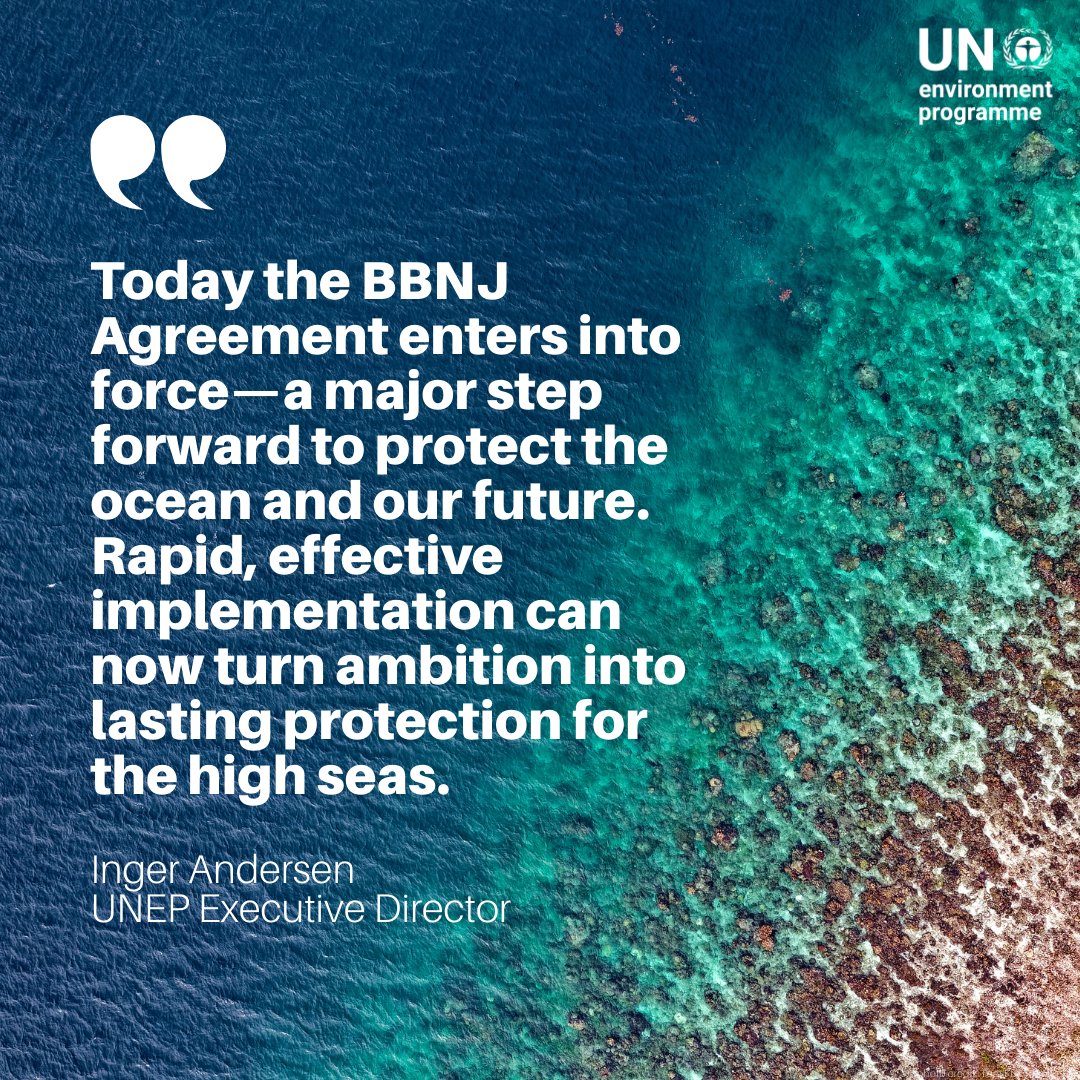
The BBNJ Agreement closes this governance gap by creating a framework that balances sovereignty and shared stewardship, drawing on the United Nations Convention on the Law of the Sea (UNCLOS) while extending protections beyond existing maritime jurisdictions. The text was finalized on 4 March 2023 and adopted later that year; it opened for signature on 20 September 2023 and achieved the necessary 60 ratifications on 19 September 2025, triggering the treaty’s entry into force 120 days later. As of January 2026, more than 80 countries have ratified the treaty, making it legally binding for those Parties.
Rule-less Past Is Over
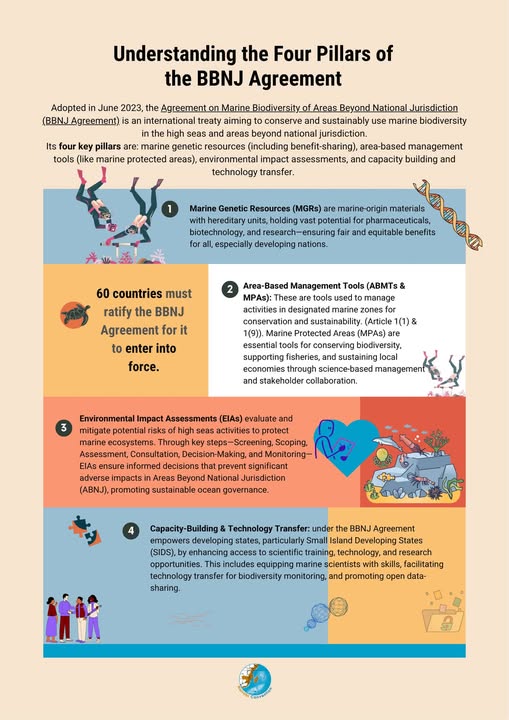
At its core, the BBNJ Agreement is structured around four interconnected pillars designed to address the ecological and governance complexities of the high seas. First, Area-Based Management Tools (ABMTs), especially Marine Protected Areas (MPAs), provide for the creation of legally enforceable protected zones in international waters. This mechanism is fundamental to advancing global conservation ambitions such as the 30×30 target agreed at the 2022 Kunming-Montreal Global Biodiversity Framework to protect at least 30% of the world’s oceans by 2030. Prior to the treaty, high seas protection was minimal; the BBNJ framework enables global MPA networks that could stretch across key oceanic biodiversity hotspots, from the Sargasso Sea to deep-sea vent ecosystems.
Second, the treaty establishes a regime for Marine Genetic Resources (MGRs), including benefit-sharing provisions. These provisions require that the benefits scientific, commercial, or otherwise derived from genetic material collected in the high seas are shared equitably among Parties. This is particularly significant for developing nations that often lack the technological capacity to exploit such resources independently, and it represents a major step toward global equity in marine bio-innovation.
The third pillar mandates Environmental Impact Assessments (EIAs) for activities in or affecting the high seas that could have significant adverse effects on the marine environment. This requirement incorporates the precautionary principle, obliging states to evaluate and mitigate potential harms before carrying out projects like deep-sea mining, carbon sequestration efforts, seabed infrastructure development, or large-scale marine harvesting. These EIAs broaden the scope of ocean governance, enabling assessments of cumulative and transboundary impacts, including pollution and climate-related stressors.
Fourth, the Agreement includes provisions for Capacity-Building and Technology Transfer, acknowledging disparities in scientific, technical, and financial capabilities among nations. Under this pillar, developed Parties commit to assisting developing countries through training, collaborative research, resource sharing, and technological support. This fosters inclusive participation in high seas governance and helps build a global coalition equipped to manage complex ocean challenges.
United Nations leadership and other international officials have underscored the significance of the treaty’s entry into force. The International Maritime Organization (IMO) also welcomed the treaty’s entry into force. IMO Secretary-General Arsenio Dominguez highlighted that the BBNJ framework demonstrates how countries can collaborate with a shared vision to manage ocean resources sustainably while ensuring that benefits are shared fairly across humanity. He noted that IMO stands ready to support implementation within its sphere of expertise, particularly given its long history of maritime environmental regulation.
Despite the treaty’s comprehensive scope, it does not directly solve every challenge facing the high seas. Plastic pollution and marine litter, for example, are not addressed through dedicated, binding articles. Instead, the treaty’s language on pollution and EIAs allows Parties to consider the impacts of plastic waste when evaluating planned activities that could exacerbate marine pollution. Indirectly, cumulative impact assessments and area-based protections can mitigate some effects of persistent plastics, but dedicated global action on plastics remains governed by other instruments, such as MARPOL and emerging plastics treaties.
National approaches to the treaty illustrate the diversity of strategic considerations in global environmental diplomacy. India signed the BBNJ Agreement in September 2024 but has not yet ratified it, choosing instead to conduct comprehensive reviews of domestic legislation including the Biological Diversity Act (2002), Environment Protection Act (1986), and Wildlife Protection Act (1972) to ensure alignment with treaty obligations before ratification. This careful sequencing reflects an effort to harmonize domestic and international frameworks. Other major maritime and economic powers, such as the United States, the United Kingdom, and Russia, have also signed but not ratified the agreement, meaning they currently participate as observers and do not yet hold decision-making rights within the treaty’s governance structures. Their eventual ratification will be crucial for the regime’s legitimacy and effectiveness, as widespread participation strengthens multilateral norms and enforcement capacity.
Way Forward
Operationalising the BBNJ governance system involves several interconnected priorities. The first Conference of the Parties (COP), required to convene within one year of entry into force, will be decisive in establishing the treaty’s institutional architecture, including the location and staffing of its secretariat, the formation of scientific and technical bodies, and the finalisation of detailed rules for MPA designation, EIAs, and benefit-sharing mechanisms. Belgium and Chile are among the states interested in hosting the secretariat, which will serve as the organisational backbone for implementation.
Another critical element will be ratification by remaining major maritime states. Broader participation would enhance the Treaty’s normative and regulatory reach, facilitating the coordinated establishment of comprehensive MPA networks and more coherent regional governance. Additionally, operationalising mechanisms such as the Clearing-House for marine genetic resources data will require investments in digital infrastructure and standardized reporting protocols, with significant support needed for developing countries to participate effectively.
Finally, translating the treaty’s ecosystem-based approach into concrete conservation outcomes will require integration with existing sectoral bodies, including Regional Fisheries Management Organisations (RFMOs), which have historically lacked strong conservation mandates. Negotiating governance hierarchies and collaborative frameworks across these institutions will be challenging but essential for aligning fisheries management, shipping regulation, scientific research, and biodiversity conservation under the shared goals of the BBNJ regime. The BBNJ Agreement represents an unprecedented moment in ocean governance: a legally binding, multilateral instrument aimed at conserving and sustainably using the rich biological diversity of the high seas. As implementation begins, the world now has a framework through which it can collectively address the vast, interconnected challenges facing the oceans — from biodiversity decline to climate change while striving to ensure that high seas resources are protected for present and future generations.
*Editor, Focus Global Reporter