
Dr. Arvind Kumar*

Over the past decade, Uttar Pradesh has shed its old “BIMARU” image to emerge as one of India’s most dynamic states, driven by improved governance, stabilised law and order, and major infrastructure expansion. Under Chief Minister Yogi Adityanath, the focus has shifted from perception to performance, tightening fiscal management and boosting investor confidence. Once dependent on Delhi’s assistance, UP now projects confidence and scale, investing heavily in expressways, connectivity, industrial parks, and technology hubs. Prime Minister Narendra Modi has noted that Uttar Pradesh “is on the trajectory to become India’s largest economy.” In a high-profile four-day visit to Singapore and Japan, the state secured MoUs worth around ₹1.5 lakh crore and additional investment proposals over ₹2.5 lakh crore, underscoring growing global interest in the state’s enterprises and infrastructure projects. Agreements span industrial development, logistics, semiconductors, data centres, green technologies, and governance cooperation. Discussions also included plans for a ‘Japan City’ and enhanced Singapore partnerships to deepen investment, skills collaboration, and industrial ecosystems in UP. These developments reflect Uttar Pradesh’s rising global economic stature and strategic push to become a trillion-dollar economy.
Art of Turning Scale into Strength
Economically, the numbers tell a story of compounding ambition. Uttar Pradesh’s gross state domestic product has risen from around ₹12.75 lakh crore in 2016–17 to roughly ₹27.5 lakh crore by 2025, with projections touching ₹32 lakh crore by 2026. In 2023–24, while India’s GDP grew at 9.6%, UP clocked 11.6% GSDP growth, outpacing the national average and signalling that the erstwhile laggard is now running ahead of the pack. The state budget has swelled to about ₹8.08 lakh crore 2.5 times its 2016–17 size yet UP is a revenue-surplus state, ranked by NITI Aayog among leaders in financial discipline, with own-tax effort and revenue share in national taxes steadily rising. This is what a “developmental state” looks like in practice: not just bigger spending, but better balance sheets.
That macro turnaround rests on an unforgiving reset in law and order, the political core of the so‑called “Modi–Yogi model.” Once caricatured as a theatre of riots, mafia and political protection rackets, UP has seen an 85% reduction in serious offences according to NCRB-linked data, with dacoity down over 70%, loot nearly 70%, murder by around 29%, rape by 52% and kidnapping by 41%. Over 8,000 police encounters have resulted in 222 dreaded criminals killed, more than 8,000 injured, and tens of thousands booked under the Gangster Act and NSA; properties worth well over ₹14,000 crore linked to mafias have been seized or demolished. Critics may debate methods, but there is no denying that the “law-and-order dividend” has underwritten a new sense of security for investors, small traders and women commuters alike, turning fear into an informal tax rebate on everyday life.
It is consciously recasting itself from a BIMARU state into an “expressway state,” with 22 expressways operational, proposed or under construction and seven already carrying traffic, including the Purvanchal and Bundelkhand expressways that stitch together the state’s poorer east and south. More than 1,400 km of new roads have been built, 168 block headquarters connected with double-lane roads and nearly 28,000 km renovated towards a target of strengthening 46,600 km by 2025–26, backed by over ₹34,000 crore allocated for highways and bridges. The Gorakhpur Link Expressway alone, a ₹7,283‑crore project tying Gorakhpur to the Purvanchal Expressway, is emblematic of how connectivity is now being used as industrial policy, not just as civil works.
A similar story plays out in the skies. Uttar Pradesh today has 16 operational airports, including four international airports, and plans for 24 airports with five international gateways as it positions itself as a logistics and aviation hub for North India. Jewar’s greenfield airport near Noida, Ayodhya’s new airport and expanded regional airstrips together signal a state shifting from landlocked to globally connected, with over ₹2,100 crore in budgetary emphasis for aviation infrastructure. For a generation that once associated UP with bad roads and cancelled trains, this is not just infrastructure it is a psychological flyover out of low expectations.
What makes the UP story interesting is that it is not confined to brick-and-mortar assets; it is also about “soft industrial policy” and sectoral bets. The One District One Product (ODOP) scheme, launched in January 2018 and now covering all 75 districts, has created product-specific industrial ecosystems around local strengths from leather in Agra to locks in Aligarh and black pottery in Azamgarh. More than 80,000 artisans have been trained and given modern toolkits, with over ₹2,500 crore in credit extended, leading to higher-quality products, MSME formalisation and a visible jump in exports, amplified by e‑commerce tie‑ups and ODOP gifts to world leaders during India’s G20 presidency. In development jargon, ODOP is UP’s experiment in “glocalisation” embedding traditional crafts into global value chains while keeping value addition anchored at the district level.
The digital economy is another deliberate frontier. Under the Data Centre Policy 2021, Uttar Pradesh initially targeted three data centre parks and 250 MW capacity, but quickly revised ambitions to eight parks, 900 MW and roughly ₹30,000 crore in investment. By late 2025, the state had already approved investment proposals worth around ₹21,343 crore, with six data centre parks and two units cleared and seven projects fully operational, while proposed capacity reached about 644 MW. In January 2026, UP signed its single biggest investment proposal ever, an MoU worth about ₹2.27 lakh crore with AM Green to build a 1‑GW hyperscale AI‑focused data centre in Greater Noida, designed to house nearly five lakh high‑performance chips and position the state as a national AI and data hub. This is classic “crowding‑in”: the state builds credibility and enabling policy, private capital builds the server farms.
Human development, too, has been pulled into the frame, even if challenges remain. The Yogi government has significantly ramped up allocations to health and family welfare, with around ₹37,956 crore earmarked for healthcare and family planning alongside nearly ₹2,867 crore for AYUSH, financing new medical colleges, district hospitals, hostels for women medical students and emergency trauma facilities across districts. On the education side, initiatives like the Chief Minister Model Composite School scheme aim to set up 150 modern composite schools with labs, digital classrooms and sports infrastructure, while large-scale recruitment of teachers and digital tools is intended to push learning outcomes. By August 2025, over 13.45 lakh youth had been linked to private jobs through 10,830 Rozgar Melas, including overseas placements to Japan, Germany, Croatia and the UAE, signalling an emerging “skills‑to‑migration” pipeline rather than distress out‑migration.
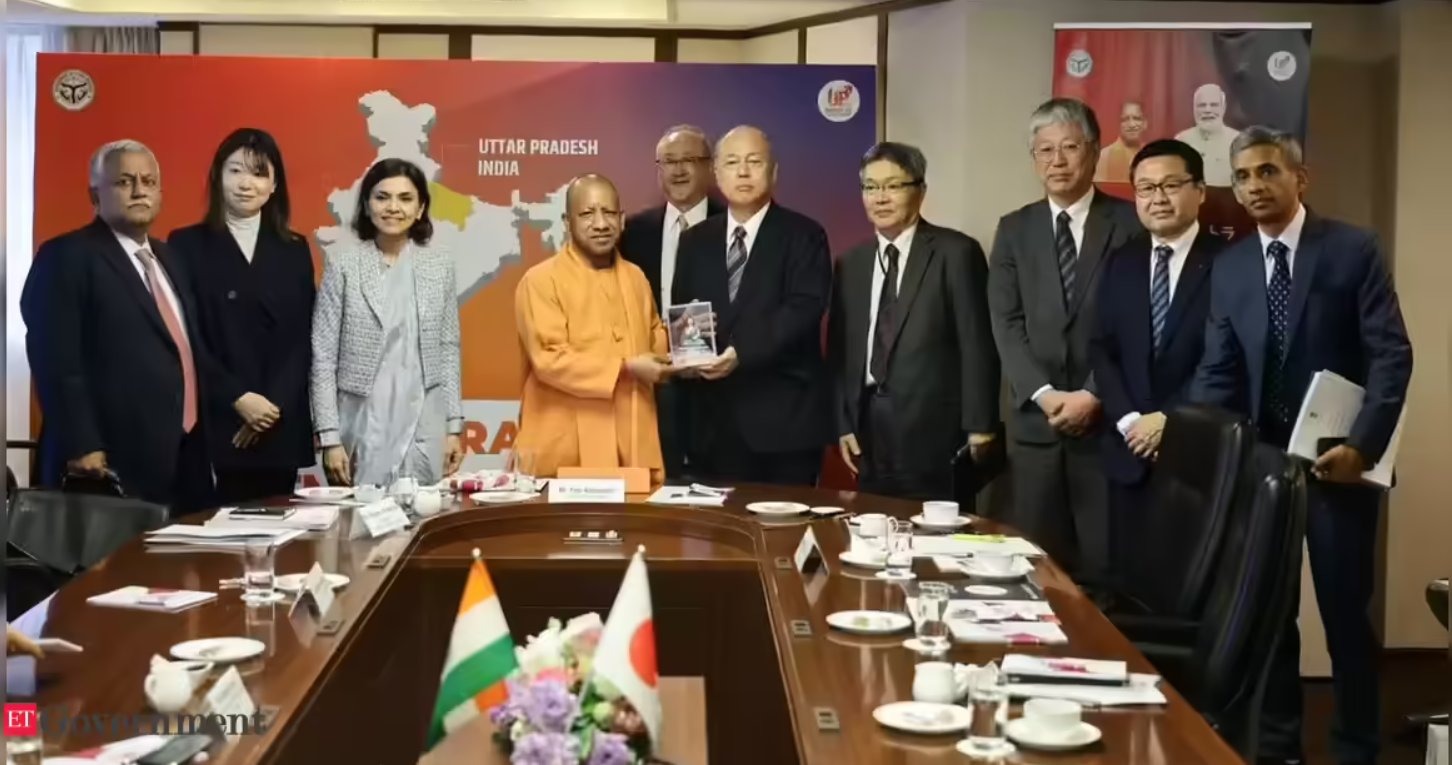
All of this sets the stage for Uttar Pradesh’s new outward‑facing diplomacy, with Yogi Adityanath acting less like a provincial satrap and more like the CEO of “UP Inc.” His recent four‑day visit to Singapore and Japan is best read as the international roadshow of a state that now believes it can anchor a one‑trillion‑dollar economy by 2029–30. The tour yielded MoUs worth about ₹1.5 lakh crore and investment proposals totalling ₹2.5 lakh crore across sectors such as agricultural machinery, automobile OEMs and components, semiconductors, data centres, green hydrogen, compressed biogas, logistics, warehousing, MRO, cargo hubs, skilling and fintech. From Kubota, Spark Minda and Japan Aviation Electronics to meetings with Suzuki, Honda, Mitsui, Rapidus and MUFG Bank, the message from boardrooms was clear: the world’s capital is now prepared to treat Uttar Pradesh as a “dream destination” for manufacturing and advanced services, not merely as a vast consumption market.
The visit also seeded deeper institutional linkages. Plans for a 500‑acre “Japan City” under the Yamuna Expressway Industrial Development Authority will curate a dedicated ecosystem for Japanese investors, complete with auto clusters and R&D facilities for OEMs and component makers. A Green Hydrogen Centre of Excellence, in collaboration with the University of Yamanashi, Yamanashi Hydrogen Company, IIT Kanpur, IIT‑BHU and other UP universities, is meant to future‑proof the state’s decarbonisation and industrial competitiveness. Agreements to link UP’s Buddhist and Ramayana circuits with Japanese tourism, and to expand language and technical training aligned to Japanese industry needs, add a cultural and human‑capital layer to what might otherwise have been just another investment roadshow.
Way Forward
The alignment between Prime Minister Narendra Modi and Chief Minister Yogi Adityanath has created a governance model in Uttar Pradesh that combines ideological clarity with managerial execution, integrating law and order, fiscal discipline, infrastructure expansion and targeted welfare into a single growth framework. The next phase, however, will require institutional deepening rather than headline momentum ensuring judicial and regulatory predictability, converting infrastructure into productivity gains, strengthening human capital to match high value investments, maintaining fiscal resilience, and broadening social mobility so growth is inclusive. If Uttar Pradesh can translate capital expenditure into competitive industries, quality jobs and equitable opportunity, it will move from being a story of rapid transformation to a durable template for large scale subnational development in India.
*Editor, Focus Global Reporter