Dr. Arvind Kumar*
The India–Africa partnership is increasingly embedded within a wider geo-economic and geopolitical architecture. As global supply chains are reconfigured through friend-shoring and diversification away from concentrated dependencies, India’s manufacturing ambitions align with Africa’s industrialization drive. Cooperation in pharmaceuticals, textiles, automotive components, digital services, and critical minerals processing offers mutual gains while reducing exposure to external shocks. Maritime security in the Indian Ocean, energy transit routes, and counter-terrorism cooperation further bind Indian and African strategic interests

“The Sustainable Development Goals and global climate commitments cannot be realised without assertive leadership and agency from the Global South” the UN Deputy Secretary-General Amina Mohammed, has consistently warned and these developments signal a decisive shift in the centre of gravity of global governance and development, with the India–Africa partnership emerging as a critical pillar of a more multipolar, equitable, and resilient international order.
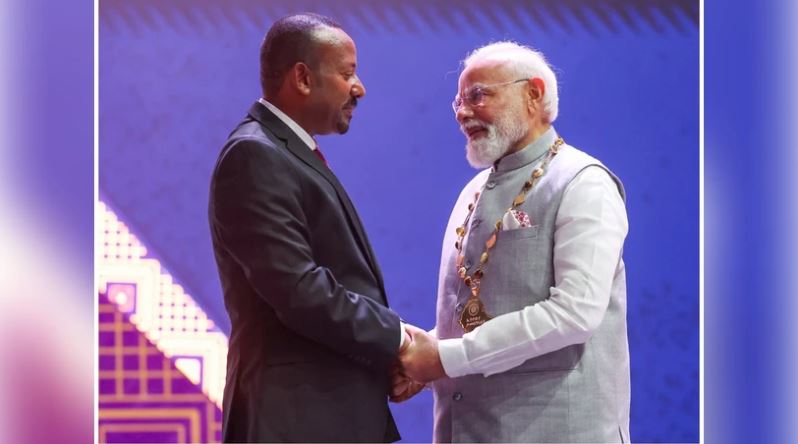
This recalibration aligns closely with the Hon’ble Prime Minister Narendra Modi’s recent visit to Africa most notably his engagement with Ethiopia encapsulates the central argument and trajectory of this analysis: India–Africa relations are undergoing a qualitative transformation shaped by converging geopolitical, economic, and developmental imperatives in a rapidly reordering world. Far from a ceremonial outreach, the visit reflects India’s strategic intent to position Africa at the heart of its Global South diplomacy at a time when the international system is marked by fragmentation, protectionism, and institutional fatigue.
India–Africa relations have evolved from historical solidarity and South–South cooperation into a pragmatic, multidimensional partnership shaped by post-pandemic realities. The COVID-19 crisis served as a catalytic moment. While much of the developed world turned inward through vaccine nationalism, India operationalised solidarity through the Vaccine Maitri initiative, supplying millions of doses to African nations and multilateral health agencies. This intervention was neither episodic nor charitable; it demonstrated India’s capacity to translate domestic manufacturing strength into geopolitical credibility. It also reinforced Africa’s perception of India as a reliable partner during systemic crises, a distinction that continues to shape contemporary diplomacy.
From Diplomatic Courtesy to Strategic Convergence
The economic underpinnings of this partnership have since expanded rapidly. Bilateral trade reaching the USD 100 billion mark and cumulative Indian investments of over USD 75 billion reflect not only scale but diversification spanning pharmaceuticals, manufacturing, information technology, energy, and infrastructure. Equally consequential is India’s emphasis on human capital, evidenced by tens of thousands of scholarships and technical training programmes for African youth. Unlike extractive models that prioritise resource flows, India’s engagement increasingly embeds skills, institutions, and local employment into its investment footprint, giving the partnership a developmental character aligned with Africa’s long-term transformation agendas.
India’s G20 presidency in 2023 further institutionalised this convergence by securing permanent G20 membership for the African Union. This move altered the geometry of global economic governance, acknowledging Africa as a systemic actor rather than a peripheral recipient of decisions taken elsewhere. By foregrounding issues such as industrialisation, health security, digital public infrastructure, climate finance, and agricultural resilience, India effectively mainstreamed African priorities within one of the world’s most influential forums. The decision resonated across the Global South as evidence that existing power structures, often perceived as immutable, can be reshaped through coalition-building and strategic diplomacy.
Yet this deepening partnership unfolds within a fragmented global economy marked by tariff wars, supply-chain disruptions, and rising protectionism. Unilateral trade measures by advanced economies have injected uncertainty into global commerce, complicating market access for both India and Africa. For African states seeking industrial diversification and value-addition, such volatility compounds existing structural constraints, including infrastructure deficits and historically fragmented regional markets. Paradoxically, these pressures also create incentives for India and Africa to explore alternative trade settlement mechanisms, regional value chains, and reduced dependence on a single reserve currency, thereby enhancing collective resilience.
Africa’s internal diversity necessitates differentiated engagement. South Africa remains a critical partner for financial cooperation and policy coordination; Egypt offers strategic connectivity through the Suez Canal and emerging green energy corridors; Nigeria anchors West Africa with its demographic scale and entrepreneurial dynamism; while North African economies such as Algeria and Morocco present opportunities in critical minerals, renewables, and manufacturing integration. India’s challenge and opportunity lies in calibrating country-specific strategies that respect regional priorities while advancing its own geo-economic objectives.
Modi’s Ethiopia visit encapsulated this approach. The recognition he received was rooted not only in diplomatic goodwill but in tangible economic presence: Indian investments generating tens of thousands of jobs and supporting local manufacturing ecosystems. By invoking Ethiopia’s anti-colonial legacy, Modi framed contemporary cooperation as an extension of shared aspirations for autonomy, dignity, and development in a post-hegemonic world. This narrative resonates across Africa, where historical memory and present-day economic agency remain deeply intertwined.
Beyond bilateralism, the India–Africa partnership is increasingly embedded within a wider geo-economic and geopolitical architecture. As global supply chains are reconfigured through friend-shoring and diversification away from concentrated dependencies, India’s manufacturing ambitions align with Africa’s industrialisation drive. Cooperation in pharmaceuticals, textiles, automotive components, digital services, and critical minerals processing offers mutual gains while reducing exposure to external shocks. Maritime security in the Indian Ocean, energy transit routes, and counter-terrorism cooperation further bind Indian and African strategic interests.
The Middle East adds another layer of complexity. Climate stress, energy transition pressures, and economic volatility in the MENA region directly affect both India and Africa through energy prices, food security, and migration dynamics. Coordinated approaches involving renewable energy, water management, and climate-resilient infrastructure leveraging initiatives such as the International Solar Alliance illustrate how India and Africa can jointly shape cross-regional solutions to systemic risks.
At the multilateral level, the erosion of traditional donor commitments and the legitimacy crisis confronting institutions like the United Nations underscore the urgency of Global South leadership. Without structural reform of global financial institutions, debt relief mechanisms, and climate finance architectures, development trajectories in much of the Global South will remain constrained. India, Africa, and key partners such as Brazil and South Africa now occupy pivotal positions to articulate and operationalise these reforms through platforms like the G20 and BRICS.
The Way Forward
The future of India–Africa relations will depend on the ability to translate political alignment into durable institutional frameworks. This requires moving beyond episodic summits toward sector-specific roadmaps that integrate manufacturing, digital public infrastructure, renewable energy, and skills development with Africa’s Agenda 2063 priorities. Trade facilitation measures that lower transaction costs, expand local-currency settlements, and strengthen regional value chains can insulate cooperation from external shocks. Simultaneously, deeper collaboration in research, technology, and innovation particularly in artificial intelligence, biotechnology, and climate adaptation can position the partnership at the frontier of emerging industries.
Ultimately, India–Africa relations are not about replicating existing power hierarchies but about co-creating alternatives. In a multipolar world marked by uncertainty and contestation, this partnership offers a model grounded in mutuality, strategic autonomy, and shared prosperity. If nurtured with institutional depth and strategic patience, it has the potential to reshape not only bilateral ties but the contours of global governance itself.
*Editor, Focus Global Reporter