Dr. Arvind Kumar*

According to the UN’s World Urbanization Prospects 2025, cities are now home to 45% of the world’s 8.2 billion people more than double the share in 1950, when only one in five people lived in cities. Two-thirds of all global population growth between now and 2050 is projected to occur in urban areas, and the number of megacities has quadrupled from just 8 in 1975 to 33 in 2025, with 19 of them located in Asia. With less than five years to achieve the Sustainable Development Goals, the need to deliver adequate, safe and affordable housing and to upgrade informal settlements is more urgent than ever. World leaders have already reaffirmed the centrality of adequate housing, through the Pact for the Future and the Doha Declaration on Social Development among other agreements. UN Secretary-General António Guterres in his central message said that housing must be placed “at the heart of sustainable development” — was a rebuke to decades of treating shelter as a secondary social concern rather than a foundational one. The message was reinforced by Annalena Baerbock, President of the UN General Assembly, who told delegates that without safe housing, health deteriorates, education is disrupted, inequality hardens, and communities become more vulnerable to climate shocks.
The 13th World Urban Forum (WUF13), held in Baku, anchored by the theme Housing the World: Safe and Resilient Cities and Communities, the Forum surfaced a hard consensus: the world’s housing and climate crises are no longer separable. The Forum concluded with the Baku Call to Action, a stakeholder-led outcome framework linking housing to climate resilience, inclusive finance, and ecosystem-based restoration.
The Urban Century and Its Discontents
We are living through the most consequential demographic shift in human history. According to the UN’s World Urbanization Prospects 2025, cities are now home to 45% of the world’s 8.2 billion people more than double the share in 1950, when only one in five people lived in cities. Two-thirds of all global population growth between now and 2050 is projected to occur in urban areas, and the number of megacities has quadrupled from just 8 in 1975 to 33 in 2025, with 19 of them located in Asia.
This is not merely a story of numbers. Cities are growing because they are destinations of desperation and the engines of aspiration, and they are often unequipped to be either. According to UN-Habitat data cited at WUF13, nearly 3 billion people worldwide face some form of housing inadequacy. More than 1.1 billion live in informal settlements or slums; over 300 million are functionally homeless. The construction sector, which is meant to solve this crisis, contributes 34% of global energy-related CO₂ emissions meaning the solution, badly managed, worsens the problem. Meanwhile, projections suggest 167 million homes could be destroyed by climate-related disasters by 2040. The city, once a symbol of civilisational achievement, is increasingly a barometer of civilisational failure.
Voice shaping Baku 2026
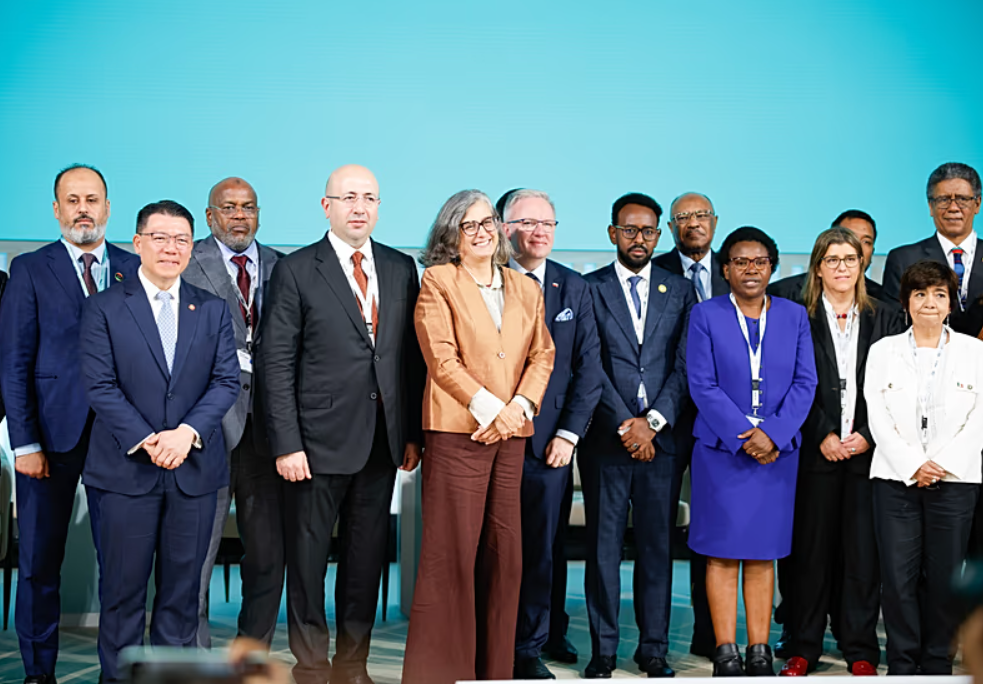
UN-Habitat Executive Director Anacláudia Rossbach, whose voice shaped much of the forum’s moral register, described the scale of interest as “unprecedented” and called on cities to be built on the basis of inclusivity, not exclusion. Pointedly, she noted that that social inequality is not merely deepening; it is spatialising, embedding itself into the very geography of cities. The Urban Expo that ran alongside the forum brought together over 217 organisations from 66 countries, presenting innovations in affordable housing, digital technologies, climate resilience, and inclusive urban planning. A dedicated session jointly organised by UNDRR, UNEP, UNDP, and UN-Habitat positioned housing not as a standalone sector but as a core urban system linking risk, climate, governance, services, and social cohesion; and underscored the importance of nature-based solutions and ecosystem-based restoration, including wetlands revitalisation and urban green infrastructure, as integral tools in managing stormwater, reducing urban heat islands, and buffering cities against climate shocks.
India: A Nation Urbanising at Scale, and at Speed
Its worth to mention here about India that with an urban population now estimated at approximately 555 million around 37.6% of its 1.47 billion, it is at the midpoint of urbanisation wave. On air quality, 95 out of 131 cities tracked under India’s National Clean Air Programme showed improvement in PM10 concentrations by 2023–24 relative to the 2017–18 baseline, and ₹1.55 lakh crore has been mobilised for clean air infrastructure including EV adoption, tree planting, and waste-to-energy projects. On urban heat adaptation, Ahmedabad’s Heat Action Plan, the first city-level heat-health plan in South Asia, has since been held up by the NRDC as a template for cities across India and internationally.
The contradictions, however, run just as deep. On housing, a shortfall of 18.78 million urban units persists, and India accounts for an estimated 236 million slum dwellers nearly half of the urban poor’s global count according to UN-Habitat. Some 118 Indian cities discharge wastewater indirectly into water bodies and 41 direct it straight into rivers, making wetland restoration efforts structurally incomplete so long as sewage infrastructure lags behind city growth. The gap between India’s ecological ambition and its implementation bandwidth is, in itself, a microcosm of the central tension the World Urban Forum in Baku spent five days trying to resolve.
From Declarations to Delivery
The forum’s central outcome, the Baku Call to Action, is a stakeholder-led document notable in itself, as it represents not merely a governmental consensus but a convergence across organisations. It frames housing as both a human right and a development lever, demanding that it be linked systematically to land tenure security, climate adaptation, public finance reform, and inclusive governance. Critically, WUF13 positioned ecosystem-based approaches not as peripheral green add-ons but as central to urban resilience. Revitalising urban wetlands, restoring degraded peri-urban ecosystems, integrating green corridors into housing design, and deploying nature-based solutions for stormwater and heat management were repeatedly highlighted as cost-effective, scalable, and community-empowering strategies.
The Way Forward
The way forward requires a transition from a housing-delivery paradigm to an integrated urban systems approach. Urban planning must prioritise in-situ slum upgrading rather than displacement-led redevelopment, while secure land tenure should be recognised not only as a social safeguard but also as a resilience instrument that encourages household investments in adaptation and local infrastructure. Simultaneously, municipal governance needs stronger fiscal architecture through City Finance Taxonomies, green municipal bonds, blended finance mechanisms, and climate-responsive budgeting capable of mobilising capital at the scale required. Ecosystem based adaptations must become foundational as critical infrastructure for flood mitigation, heat reduction, groundwater recharge, and biodiversity protection rather than ornamental. The choice is not between growth and sustainability; it is between planned urban transformation and unmanaged urban vulnerability.
*Editor, Focus Global Reporter