
Dr. Arvind Kumar*

The world today stands at the intersection of crisis; a triple planetary breakdown, compounded by an escalating energy war and the fragility of global oil markets. From the trenches of Ukraine to the oil fields of the Middle East, the geopolitics of energy has redrawn the map of global dependencies. Against this backdrop, India’s recent decision to go “100% biofuel” still importing a large share of its crude and acutely exposed to climate shocks, appears, at first glance, both visionary and pragmatic. It promises cleaner energy, reduced crude imports, and an opportunity for self-reliance in a turbulent world where the price of energy defines political and economic stability. Road Transport Minister Nitin Gadkari has gone further, saying it will be made mandatory for automakers to offer vehicles that can run entirely on biofuels, framing ethanol at around ₹65 a litre as a cheaper, greener alternative to petrol.
But beneath this appeal lies an uncomfortable question: has the decision been made too hastily, and at what ecological cost? When examined beyond the rhetoric of green growth, India’s biofuel push appears less of an environmental triumph and more of an ecological gamble one that could unravel hard-won water security, deepen agrarian distress, and strain biodiversity systems already fraying at the edges.
Beyond arithmetic
The government’s rationale is straightforward: energy security in uncertain times. With the West Asian conflict unsettling global oil supplies and India importing nearly 80% of its crude, the blending of ethanol with petrol was an attractive alternative. The country achieved its 20% ethanol blending target (E20) ahead of schedule in 2025 and is now moving toward full biofuel integration. Yet, this ambition, while geopolitically sound, rests on a deeply unsustainable foundation. The irony is hard to miss, India’s green fuel revolution may soon become another environmental liability, much like the Green Revolution that boosted food production but crippled soil and water ecosystems for decades. What was once hailed as salvation for food security turned into an ecological trap, and biofuel risks becoming its 21st-century equivalent.
According to CSTEP, meeting India’s ethanol blending target would require diverting land roughly seven times the size of New York City for maize cultivation by 2030 around eight million additional hectares. The country already produces nearly 40% of its ethanol from sugarcane and the rest from grains like rice and maize, crops that are both water-hungry and chemically intensive. The NITI Aayog itself admits that producing one litre of ethanol from sugarcane requires 2,860 litres of water, while rice-based ethanol guzzles as much as 10,000 litres per litre of fuel, as reported by India Today and Kisan Tak. Food Secretary Sanjeev Chopra stated in 2024 that “about 2.5 to 3 kilograms of rice are required to produce a litre of ethanol,” acknowledging the staggering water footprint that accompanies the process. This is not a minor concern for a nation where, as per the Composite Water Management Index, 21 major cities including Delhi, Bengaluru, and Chennai face the threat of groundwater depletion by 2030.
The repercussions of these figures extend far beyond arithmetic. Long before the current policy overdrive, the International Water Management Institute (IWMI), in a joint technical paper hosted by the CBD, had already quantified that one litre of ethanol from irrigated sugarcane in India consumes about 3,500 litres of irrigation water, and warned that expanding such biofuel programmes in water-scarce countries like India and China would aggravate existing scarcity and further pressure rivers, wetlands and aquifers. Experts such as Dr. Anjal Prakash, lead author for the Intergovernmental Panel on Climate Change (IPCC), have described this policy as a “water-compounding disaster,” noting that both sugarcane and maize demand enormous volumes of water and could worsen climate vulnerability for farmers. In Maharashtra, sugarcane occupies less than 4% of the cropped land but consumes nearly 70% of irrigation water, a figure cited in Moneycontrol. Scaling this model for fuel production is not clean energy; it is liquid energy extracted at the cost of liquid life.
The environmental trade-offs don’t stop at water. The Convention on Biological Diversity (CBD) has repeatedly warned that monocultures of biofuel crops lead to habitat loss and a decline in pollinators, both vital for food security. As fields tilt toward fuel crops, landscape diversity diminishes, undermining ecological resilience. In many regions, especially those like Marathwada and Vidarbha, ethanol plants are being established close to cane-growing areas already facing severe droughts, as reported by National Herald India. The Down To Earth analysis published in March 2026 warns that overemphasis on ethanol for transport will likely “derail the transition to zero-emission vehicles” and may even “create a new form of dependence on water, land, and industrial agriculture.” The report also highlights how older vehicles not tuned for E20 or beyond could emit higher quantities of nitrogen oxides (NOx) and unregulated toxins like acetaldehyde, offsetting the very emissions reductions that biofuels claim to deliver.
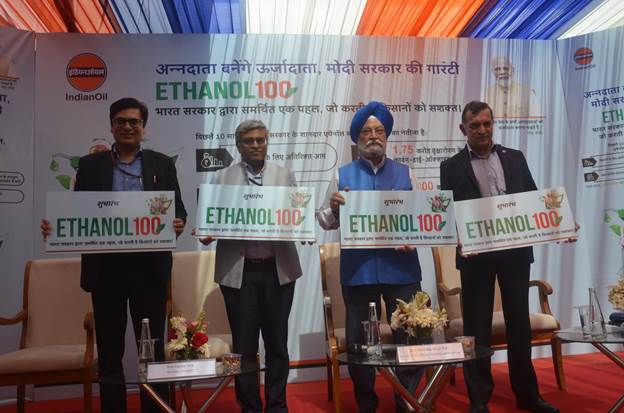
To be sure, the government’s figures are impressive on paper. The ethanol blending policy has reportedly saved over ₹1.06 trillion (roughly $12 billion) in crude imports and prevented 54 million tonnes of carbon emissions over a decade, according to official data. Yet, such numbers obscure the hidden environmental accounting. Producing ethanol requires massive quantities of chemical fertilizers all of which depend on imported natural gas. As economist Ritesh Kumar Singh argued in Moneycontrol, the ethanol policy “shifts costs rather than eliminates them,” merely replacing one dependency with another: reducing oil imports while increasing dependence on imported fertilizer, diesel for irrigation, and energy-intensive distilleries powered by coal-based grids. The illusion of “green growth” thus rests on a resource-intense scaffolding that is neither clean nor circular.
What is most worrying is the policy’s detachment from ground realities. In Rajasthan’s Tibbi village, protests erupted last year when locals discovered that an ethanol plant was being constructed without public consultation. Villagers complained that the factory would “take away our water,” an echo of the chronic rural disempowerment India saw during earlier industrial booms. This loss of participatory governance mirrors the Green Revolution’s history, where a technocratic approach solved one crisis while sowing the seeds of another. When policies are driven by urgency and optics rather than by ecosystem thinking, they risk transmuting short-term gains into long-term liabilities.
The parallel with the Green Revolution is not accidental; it is haunting. Just as high-yield seeds and synthetic fertilizers once promised abundance but ultimately left behind a legacy of soil toxicity, pest resistance, and aquifer depletion, today’s biofuel revolution risks hurtling down a similar path if pursued without ecological foresight. This is not an argument against green fuels; indeed, India’s push toward cleaner and more self-reliant energy systems is both necessary and strategically important in an era of geopolitical volatility and climate uncertainty. However, the danger lies in advancing this transition without adequately examining its backward and forward linkages across water, agriculture, biodiversity, rural livelihoods, and industrial dependency chains. The problem, therefore, is not biofuel per se, but the absence of a holistic framework that integrates the water-energy-food-biodiversity nexus into policy design. Water is not a sector; it is the invisible currency that sustains all sectors. Every drop diverted from irrigation, drinking needs, or groundwater recharge to feed ethanol production incrementally erodes the foundations of environmental security and rural stability. If the first Green Revolution compromised ecological integrity in the pursuit of food security, this new “Green Fuel Revolution” risks compromising water security for the illusion of energy independence.
Way Forward
This is why the pace and framing of India’s biofuel turn matters as much as the technology itself. International Energy Agency analysis released at India Energy Week welcomed the surge of liquid biofuels but urged India to adopt a comprehensive “sustainable fuels roadmap” beyond 2030, explicitly warning that long-term deployment must be aligned with environmental and resource constraints, not only with blending mandates and investor certainty. A more prudent path lies not in abandonment but in recalibration. India’s PM-JI-VAN Yojana already envisions second-generation (2G) ethanol derived from crop residues and municipal waste—feedstocks that don’t compete with food or drinkable water. Yet, these remain pilot projects, dwarfed by the scale of first-generation ethanol plants that draw from farmlands and aquifers alike. The government must pivot decisively toward such non-food pathways and integrate stringent water accounting into every stage of ethanol production. It must also decentralize production, enabling region-specific feed-stocks rather than imposing one national model that suits none.
The biofuel push, in its current avatar, is both a mirror and a warning, a mirror of past policy blindness and a warning of a resource crisis in the making. It promises fuel security but risks igniting a new war over water. The question, then, is not whether biofuels are good or bad; it is whether development that drains aquifers, erodes biodiversity, and displaces farmers can ever be called sustainable.
*Editor, Focus Global Reporter