Dr. Arvind Kumar*

The warning has already been fired. What lies ahead is the test of whether we were listening. As 2026 unfolds, the climate system is reorganising in ways that leave little space for denial. The World Meteorological Organization’s latest Global Seasonal Climate Update is blunt: sea-surface temperatures in the equatorial Pacific are rising fast, and El Niño conditions are expected to emerge by mid‑2026, with “nearly global dominance of above‑normal land surface temperatures” in the coming months. NOAA’s Climate Prediction Center has already put the planet on El Niño Watch, estimating a 61% chance that El Niño will set in between May and July and persist at least to the end of the year. This is not just another fluctuation in a distant ocean; it is a multipliers’ summit – where ocean heat, atmospheric stagnation, and political complacency meet.
At the global level, the framing is no longer in doubt. UNEP’s Executive Director has warned that triple planetary crisis “threatens the well‑being and survival of millions of people”, while the UN Secretary‑General uses almost identical language to insist that this is a systemic threat, not an environmental sidebar. In this framing, El Niño 2026 is not an isolated event; it is a flashpoint inside a larger structural breakdown.
WMO points out that the last strong El Niño, layered on top of human‑driven warming, helped make 2024 the hottest year ever recorded. Carbon Brief’s synthesis of five major temperature datasets suggests that 2026 is likely to become the second-warmest year on record, with a non‑trivial chance of overtaking 2024 and roughly a 30% probability of crossing 1.5°C of warming for a second year. When climate scientists describe El Niño‑driven extremes as “threat multipliers”, they are being conservative; the director of the UN University’s Institute for Water, Environment and Health goes further, speaking of a global “water bankruptcy” that El Niño will accelerate by disrupting rainfall, drying out some regions and flooding others. The question is not whether disruption is coming, but how unevenly we will let it be distributed.
Stress Test We Chose to Ignore
Under the surface of our seas, the quiet emergency is already mapped in satellite pixels. NOAA and other centres tracking global marine heatwaves report that, helped by the anticipated 2026 El Niño, the share of the world’s oceans in marine heatwave conditions is projected to expand from about 23% February to around 30% by mid‑year and 37% by late 2026. Coral reef science has long warned that just a 1°C rise above normal seasonal temperatures can bleach corals – forcing them to expel the algae that feed them and turning vibrant reefs into ghostly skeletons. During the 2015–16 El Niño, one of the strongest on record, a marine heatwave triggered the third global mass coral bleaching event ever documented, severely impacting an estimated 38% of reefs worldwide and causing unprecedented mortality across all three major ocean basins. When agencies like NOAA and reef scientists tie these bleaching crises explicitly to El Niño‑driven marine heatwaves, they are effectively saying that this year’s Pacific anomaly is a death test for underwater biodiversity and the coastal livelihoods that depend on it.
El Niño does not just heat water; it rearranges life. FAO warns that El Niño‑induced climate hazards “pose high risks to food security” by disrupting rainfall and temperature patterns, hitting agriculture and rural livelihoods simultaneously. The UNU‑INWEH leadership frames these extremes as a “threat multiplier”, stressing that droughts in South Asia and floods in western South America can occur in the same El Niño year, tearing both rainfed agriculture and hard infrastructure apart.
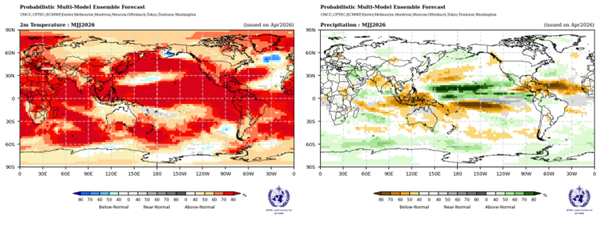
India sits exactly at this intersection of risk. The India Meteorological Department’s first long‑range forecast for the 2026 southwest monsoon is unambiguous: seasonal rainfall is likely to be below normal, at about 92% of the Long Period Average, with a 35% probability of deficient rains and another 31% probability of “below normal” rainfall. IMD attributes this bleak outlook primarily to the expected development of warmer‑than‑normal El Niño conditions during the second half of the monsoon season, even as a positive Indian Ocean Dipole later in the season may offer only partial relief. Analysts note that this is the first below‑normal monsoon forecast in three years and warn of impacts on crops, inflation and overall growth.
Food security experts are not waiting for the first drought declaration to raise the alarm. A joint study by FAO and WMO, cited recently in an Indian editorial, found that extreme heat reduced India’s wheat yields by between 9 and 34% in 2022, and also depressed milk and egg production. The same editorial flagged an assessment by the International Research Institute for Climate and Society that puts the probability of a prolonged El Niño developing by mid‑2026 at around 70% – a configuration likely to dominate global weather for the rest of the year. When global cereal prices are creeping up again – with wheat, maize and rice prices 13, 4 and 5% higher respectively than a few months ago – any El Niño‑related hit to India’s kharif and rabi output will reverberate far beyond our borders.
The health system, too, has been warned in advance. WHO has updated its heat and health guidance, stressing that the negative health impacts of extreme heat are “predictable and largely preventable” if public health systems adopt robust heat‑health action plans, early warning systems, and targeted protection for vulnerable groups. Yet in India, as the 2026 summer starts with heatwave temperatures above 45°C in several regions, IMD is already warning of “above‑normal” heatwave days from May to June across large parts of east, central and northwest India. Heat is not just an inconvenience; it is a silent mass casualty event in slow motion, and WHO has effectively told governments there is no excuse for being surprised.
It would be unfair, though, to pretend that India has done nothing. The Union Minister of State for Earth Sciences has informed Parliament that NDMA and IMD have been working with 23 states to develop Heat Action Plans since 2013 – comprehensive early warning and preparedness frameworks that include seasonal outlooks, extended‑range forecasts, daily colour‑coded warnings, and additional morning bulletins dedicated to heatwaves. Over the past decade, the meteorological backbone of early warning has undoubtedly strengthened: India now receives seasonal temperature outlooks in March, fortnightly extended forecasts, and daily severe weather warnings that are far more granular than a decade ago. The uncomfortable question is not whether these systems exist, but whether they are yet matched by local capacity, finance and accountability to act on them?
Way Forward
So what does a serious, disruptive response look like in India, in the year of El Niño? International agencies have already sketched the contours, the need to shift from reactive drought and flood relief to anticipatory, climate‑smart water and agricultural management – investing in water‑efficient irrigation, resilient crops, and upgraded water infrastructure before the crisis hits; embedding heat‑health action plans into core public health governance rather than treating them as seasonal advisories; work points towards diversifying rural livelihoods and strengthening social safety nets, so that a single failed monsoon does not translate automatically into hunger and distress migration; and a structural shift away from fossil‑fuel‑centred, waste‑intensive growth towards models that cut emissions, reduce pollution and halt nature loss together; elevating wetlands, floodplains and aquifers to the status of critical infrastructure in policy and budgets, recognising that “water bankruptcy”, as the UN university warns, is as destabilising as financial bankruptcy.
The choice is not to out‑argue the science, but to out‑pace the risks – to move so decisively on heat, water and biodiversity that El Niño 2026 becomes remembered not only as a year of compounded extremes, but as the year in which living with permanent climate emergency is a political choice, not a meteorological fate.
*Editor, Focus Global Reporter