
Dr. Arvind Kumar*

This unevenness is not incidental; it is profoundly gendered. As António Guterres underscored in his message for World Water Day 2026, safe water and sanitation are foundational to the rights, health and dignity of women and girls. When access fails, it is women and girls who bear the heaviest costs through compromised health, lost opportunities and constrained agency. The policy implication is clear: water governance cannot be effective unless it is explicitly gender-responsive.
The world’s water crisis today cannot be understood in isolation from the broader triple planetary crisis the intertwined challenges of climate change, biodiversity loss and pollution that are reshaping ecosystems and human systems alike. These forces are intensifying water stress, degrading freshwater sources and undermining the reliability of supply, particularly in vulnerable regions. Against this backdrop, the past decade has witnessed measurable progress in water, sanitation and hygiene (WASH). Between 2015 and 2022, access to safely managed drinking water rose from roughly 69% to 73% of the global population, sanitation from 49% to 57%, and basic hygiene services from 67% to 75%. These gains, while significant, mask a deeper structural failure: in 2022, some 2.2 billion people still lacked safely managed drinking water, 3.5 billion lacked safely managed sanitation, and 2 billion were without adequate hygiene services. The promise of universal WASH under the Sustainable Development Goals (SDGs) thus remains distant and deeply uneven, with the burdens of this shortfall falling disproportionately on women and girls.
This unevenness is not incidental; it is profoundly gendered. As António Guterres underscored in his message for World Water Day 2026, safe water and sanitation are foundational to the rights, health and dignity of women and girls. When access fails, it is women and girls who bear the heaviest costs through compromised health, lost opportunities and constrained agency. The policy implication is clear: water governance cannot be effective unless it is explicitly gender-responsive.
Gendered Burden
The scale of the gendered burden is stark. Globally, an estimated 1.8 billion people live in households without drinking water on premises. In roughly two-thirds of these households, women and girls are responsible for water collection. Data from international agencies show that women and girls aged 15 and above shoulder this responsibility in about 70% of such cases, often walking longer distances and facing greater safety risks than their male counterparts. The cumulative effect is staggering: women and girls collectively spend an estimated 200–250 million hours every single day fetching water. This is time systematically diverted from education, paid employment, rest and participation in public life.
Such disparities are not merely social; they are institutional. Despite longstanding international commitments, women remain under-represented across water governance structures, from local committees to national utilities. Evidence from multiple low- and middle-income countries indicates that fewer than one in five water sector employees are women, with even lower representation in technical and leadership roles. This exclusion is not just inequitable; it is inefficient. When decision-making systems fail to incorporate the lived realities of those most engaged in water management at the household level, policies risk being misaligned with actual needs.
India’s recent trajectory offers a compelling case study of both progress and persisting gaps. The Jal Jeevan Mission has rapidly expanded rural household tap connections from roughly one-fifth coverage in 2019 to a majority of households by early 2026. This transformation has had immediate gendered benefits: reducing the drudgery of water collection, lowering exposure to physical risk, and freeing up time for women to pursue education, livelihoods or community engagement. Importantly, the mission’s emphasis on community-based management has begun to formalise women’s roles in local water governance, though representation and influence remain uneven across regions.
In urban India, efforts such as the AMRUT Mission initiative “Women for Water, Water for Women” signal a shift from symbolic inclusion to substantive participation. By engaging women from Self-Help Groups in the functioning of water treatment plants, the programme aims to demystify technical processes and build a pipeline of women equipped to participate in urban water governance. While still limited in scale, such initiatives point toward a broader reconfiguration of the sector one that recognises women not merely as beneficiaries, but as stakeholders and leaders.
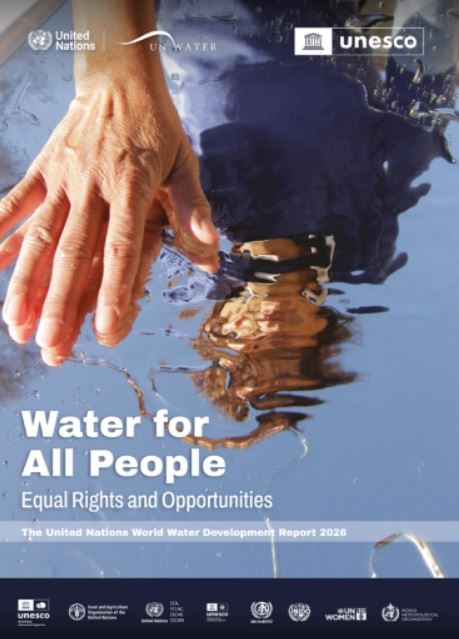
The UN World Water Development Report 2026, coordinated by UNESCO’s World Water Assessment Programme, provides the analytical backbone for this year’s theme. Titled “Water for All People – Equal Rights and Opportunities”, it documents how unequal access to water and sanitation multiplies disadvantages in health, education, income and safety for women and girls. The report notes that climate change, water scarcity and hydrometeorological disasters are intensifying these inequalities, particularly in already water‑stressed and disaster‑prone contexts. It also underlines that women’s under‑representation in water management – from utilities to basin authorities – weakens system performance, because institutions ignore the lived realities of the very people who manage water daily at household level.
However, the challenge is not only one of policy design it is also one of political economy. The multilateral system tasked with coordinating global water and gender agendas is itself under strain. By the end of 2025, unpaid contributions to the United Nations’ regular budget had reached record levels, raising concerns about the organisation’s liquidity and its ability to sustain programme delivery. In such a context, issues like water and gender often perceived as “soft” sectors risk being deprioritised, even as their importance grows in the face of intersecting crises. Layered onto these structural challenges is a more recent and deeply troubling trend: the emergence of water as a target and tool in geopolitical conflict. Incidents in early 2026, including reported strikes on desalination infrastructure in the Gulf region, have underscored the vulnerability of water systems in conflict settings. In parallel, longstanding tensions around transboundary water resources such as those linked to the Grand Ethiopian Renaissance Dam continue to highlight the fragility of cooperative water governance.
The gender implications of such disruptions are profound. When centralized water infrastructure is damaged or rendered inoperable, the burden of securing water reverts to households. In practice, this means a re-intensification of unpaid labour for women and girls, along with heightened exposure to health risks and gender-based violence. Beyond physical attacks, emerging threats such as cyber intrusions into water utilities introduce new vulnerabilities. As water systems become more digitised, they also become more susceptible to disruption—raising concerns about resilience, particularly in urban contexts. These risks, when combined with climate stress and governance deficits, create a volatile environment in which hard-won gains in gender equity can be rapidly reversed.
Way Forward
The way forward demands a shift in both perspective and practice. Water and gender must be treated as core governance and investment priorities, with gender analysis embedded across all dimensions of policy from infrastructure and tariffs to climate adaptation and disaster risk management. Beyond expanding access, the focus must move toward agency and participation, ensuring women hold not just seats, but decision-making power in water institutions. Equally critical is scaling investments in capacity building to enable women to transition from users to engineers, managers and policymakers, supported by institutional reforms that dismantle structural barriers. At the same time, stronger gender-disaggregated data particularly on time use, safety and service quality is essential to make inequalities visible and actionable.
Ultimately, success must be redefined. Progress cannot be measured only in connections or coverage, but in freedoms gained and inequalities reduced. If women and girls continue to spend hundreds of millions of hours fetching water by 2030, the global community will have failed regardless of targets met. Rethinking water through a gender lens is not peripheral; it is central to sustainable development. It demands a reordering of priorities and power, recognising that where water flows equitably, opportunity follows.
*Editor, Focus Global Reporter