Dr. Arvind Kumar*
Prime Minister Narendra Modi undertook a landmark five-nation tour between 15–20 May 2026, visiting the UAE, the Netherlands, Sweden, Norway and Italy to deepen India’s strategic partnerships at a time of global turbulence (Middle East tensions, supply-chain stress, energy price shocks). The tour yielded over 30 new MoUs and agreements, as well as binding commitments on trade, investment and joint initiatives in energy, technology, defence and connectivity. It underscored India’s strategic autonomy and global outreach, projecting India as a reliable partner for energy security, technology transfer and supply-chain resilience. In sum, PM Modi’s visit delivered concrete outcomes (energy reserves, semiconductor pacts, defence roadmaps, investment pledges) that bolster India’s interests (stable energy, diversification, industrial upgrading) while managing geopolitical risks.
Executive Summary
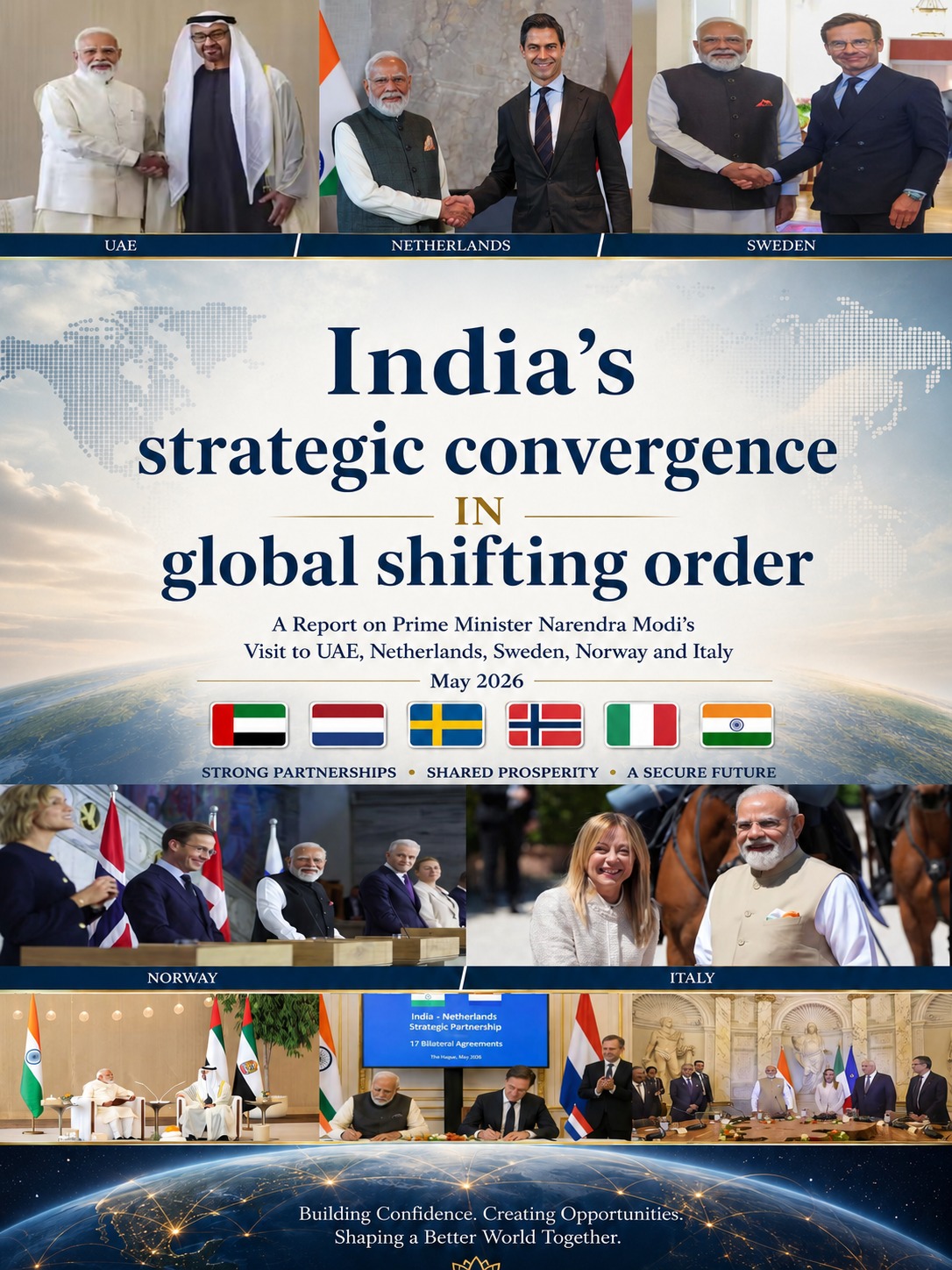
In Abu Dhabi, Modi met UAE President Sheikh Mohamed bin Zayed and secured critical energy and security deals. In the Netherlands, he elevated bilateral relations to a Strategic Partnership with 17 agreements spanning semiconductors, green hydrogen, water and defence. In Sweden, India and Sweden adopted a Strategic Partnership 2026–30, endorsing new tech corridors (AI, 6G), innovation platforms and a goal to double trade. In Norway (during the India-Nordic Summit), Modi expanded ties into a “Green Strategic Partnership” focusing on climate, clean energy, the Arctic and maritime security. Finally in Rome, India and Italy upgraded to a Special Strategic Partnership, agreed defence industrial roadmaps, reaffirmed the India–Middle East–Europe Economic Corridor (IMEC) initiative and set a 2029 trade target of €20 billion.
Strategic Context
The tour came amid a volatile world order. The ongoing Middle East conflict (including renewed Iran tensions and the Israel-Gaza war) has disrupted oil markets and trade routes, sharply raising energy security concerns for India. Oil prices and shipping risks escalated after Iran closed the Strait of Hormuz in March–April 2026, which accounts for ~80% of India’s oil imports. At home, India’s economy faced higher inflation and current account deficits due to fuel import costs.
Simultaneously, global trade patterns are being rewired. Europe and the West are diversifying away from China-centric supply chains, seeking new hubs in India’s large market. In 2026 the India–EU Free Trade Agreement negotiations concluded in principle, highlighting Europe’s need for stable partners. India thus saw an opportunity to lock in investment, technology and supply-chain diversification while avoiding overreliance on any bloc. For these reasons, engaging the Gulf and Europe in one tour allowed India to simultaneously secure energy (from the UAE), pursue technology and investment (in Europe), and signal balance.
Visit Itinerary and Meetings
- 15 May – UAE: PM Modi arrived in Abu Dhabi and held talks with UAE President Sheikh MBZ. He met Emirati ministers and business leaders. Key discussions: energy security, strategic reserves, defense, investments and Indian diaspora welfare.
- 16–17 May – Netherlands: Modi traveled to The Hague. He met King Willem-Alexander and Queen Máxima, and held a tête-à-tête with Dutch PM Rob Jetten. They also addressed Dutch industry (semiconductor firms like ASML, chip equippers). The official focus was on semiconductors, water management, green tech, defence cooperation, and a five-year roadmap (2026–30) for joint projects.
- 17 May – Sweden: In Gothenburg Modi met Swedish PM Ulf Kristersson and European Commission President Ursula von der Leyen at the European Round Table for Industry. He engaged with CEOs and innovation leaders in AI, green energy and manufacturing sectors. Key topics: artificial intelligence, tech corridors, startups, and Europe-India trade following up on the EU FTA.
- 18 May – Norway: Modi flew to Oslo for bilateral talks with PM Jonas Gahr Støre and participation in the 3rd India–Nordic Summit (with Nordic leaders from Denmark, Finland, Iceland, Norway and Sweden). He addressed the India–Norway Business & Research Summit, meeting Norwegian industry and R&D counterparts. Themes: climate change, Arctic cooperation, blue economy, defence research, and people-to-people ties.
- 19–20 May – Italy: In Rome Modi met Italian PM Giorgia Meloni and President Sergio Mattarella. They elevated ties to a Special Strategic Partnership (continuing the 2023 Strategic Action Plan). The leaders co-chaired a CEO roundtable (in aerospace, defence and energy) and signed pacts on defence, agriculture, maritime connectivity, higher education and finance. Defence, IMEC, climate and diaspora issues featured prominently. Modi invited Italy to the IMEC initiative connecting India–Gulf–Europe.
UAE: Energy Security and Strategic Partnership
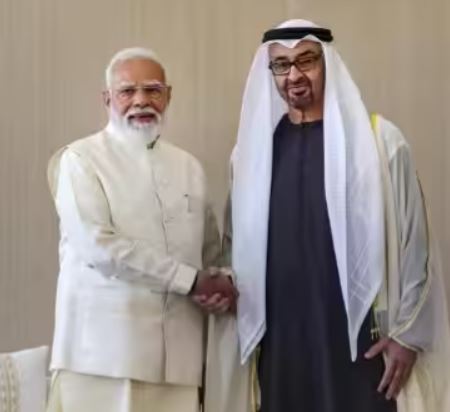
On 15 May 2026, Modi’s Abu Dhabi meeting with President Sheikh MBZ produced a flurry of energy and security agreements. Both leaders emphasised energy cooperation, maritime security and defence ties. They signed:
- An MoU between India’s Strategic Petroleum Reserves Ltd (ISPRL) and UAE’s ADNOC to enhance India’s oil reserves. This covers storage of up to 30 million barrels of crude in India’s facilities, bolstering resilience against supply shocks.
- A Strategic LPG Supply pact (Indian Oil-ADNOC) to secure long‑term LPG delivery, ensuring stable fuel for Indian households.
- A Defence Framework agreement (Letter of Intent) laying out a Strategic Defence Partnership. This institutionalises military-industrial collaboration: joint R&D, co-development, exercises, cyber-defence and secure communications. It effectively commits India and UAE to co-produce defence equipment and share technology.
- Maritime Cooperation MoUs: Cochin Shipyard – Drydocks World JV to set up a ship-repair cluster in Gujarat, plus a tripartite pact for skill-training in ship repair. These strengthen India’s naval logistics and “blue economy”.
- A Term Sheet (LoI) for an 8 Exaflop supercomputing cluster (CDAC‑G42 collaboration), advancing India’s AI infrastructure.
- Investment commitments: UAE entities pledged ~$5 billion into India’s infrastructure and finance sectors (notably Emirates NBD’s $3B RBL Bank deal and Abu Dhabi’s Sammaan $1B).
These outcomes were lauded as strengthening India’s energy security. ADNOC’s exit from OPEC earlier in 2026 boosts potential oil exports, and the SPR agreement ties in India’s Strategic Petroleum Reserve programme. The defence and tech pacts signal deepening UAE-India ties beyond hydrocarbons. PIB noted the visit “strengthens cooperation across energy security, defence, maritime infrastructure, artificial intelligence, supercomputing, investment, and skill development”. Given global oil-price volatility, the energy pacts and storage link are especially valuable for India’s economy.
Netherlands: Strategic Technology Partnership
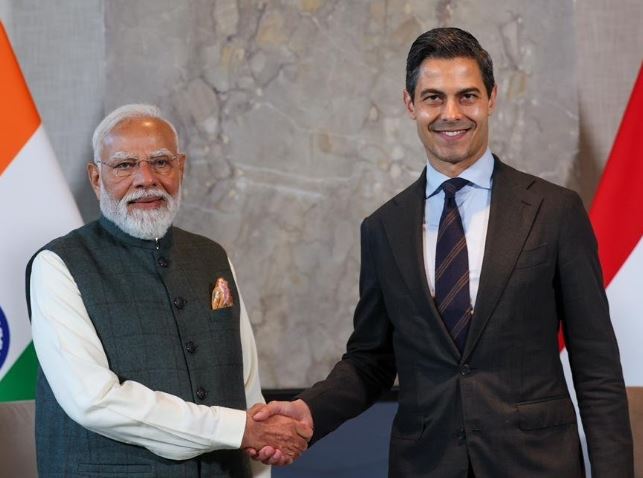
Modi’s Netherlands visit (16–17 May) culminated in upgrading bilateral ties to a full Strategic Partnership with a five-year roadmap (2026–30). The leaders signed 17 agreements spanning advanced technology, green energy, trade and security. Key outcomes included:
- Semiconductor Industry Cooperation: A joint declaration linking Tata Electronics and ASML to support India’s planned chip fab in Dholera. The countries agreed to connect the Dutch Semiconductor Competence Centre with India’s Semiconductor Mission, and launch a “brain-bridge” for semiconductor R&D (Eindhoven Univ. & Twente with six IITs, supported by NXP, ASML, Tata, etc).
- Green Hydrogen and Renewables: MoUs on green hydrogen development, critical minerals and renewable energy technologies (agreed as part of 17 pacts) to back India’s climate goals. (The Dutch expertise in offshore wind and hydrogen is a strategic fit.)
- Water Management: Expansion of the existing Strategic Partnership on Water – including cooperation on river rejuvenation, urban water systems and climate adaptation. The joint statement notes initiatives like a Centre of Excellence on Water (IIT-Delhi–Netherlands) and sustainable delta management.
- Defence & Security: Letter of Intent to deepen defence-industrial cooperation (joint development & manufacturing), plus a framework on cyber-security and defense logistics. Both sides agreed to examine a Mutual Logistics Support pact and a Defense Industrial Roadmap (India’s SIDM & Netherlands’ NIDV).
- Trade Facilitation: A customs co-operation MoU was signed to share information and speed up legitimate trade. Both PMs set up a Joint Trade & Investment Committee and Fast-Track Mechanism, eyeing India-EU FTA benefits.
The Netherlands is India’s 4th-largest investor in Europe (~$55B) and an $28B annual trade partner. The strategic partnership taps Dutch strengths: deep tech (ASML), water/climate expertise, and defence technology. The joint press statement stressed global issues too: Modi and Jetten condemned regional terrorism and pledged zero tolerance. Dutch PM Jetten noted the importance of linking Dutch tech to India’s fast-growing market and EU trade gains. Overall, this leg amplified India’s industrial modernization and supply-chain diversification, aligning with Europe’s “China+1” strategy.
Sweden: Innovation and AI Corridor
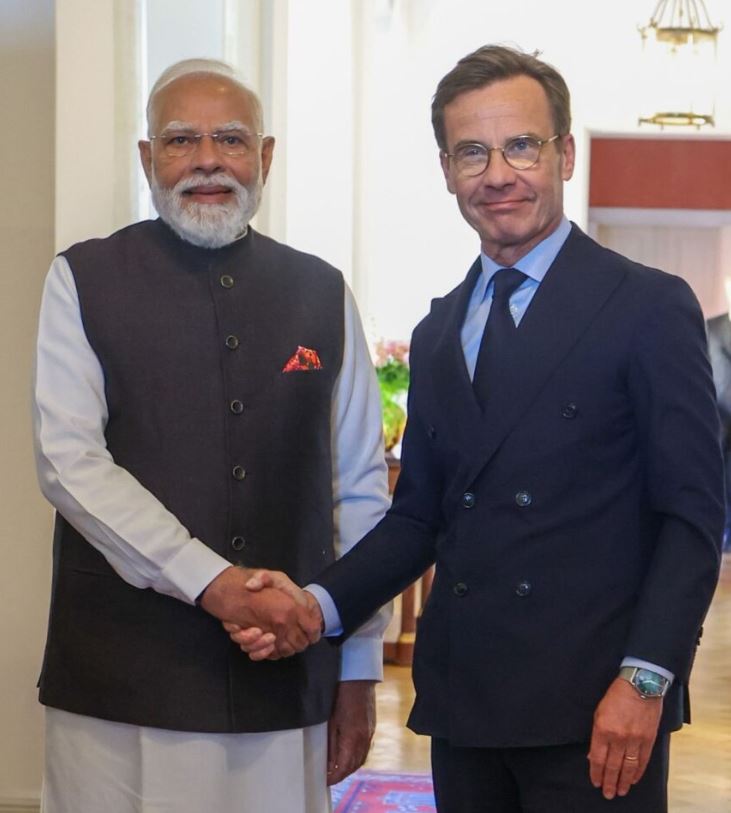
On 17–18 May Modi’s Sweden stop focused on innovation and trade. India and Sweden elevated their ties to a Strategic Partnership (2026–2030), issuing a Joint Statement and Action Plan. A key announcement was the India-Sweden Technology & AI Corridor (SITAC) – a joint initiative to boost AI, 6G and digital R&D between Indian and Swedish companies and universities. Other outcomes included:
- Joint Innovation Partnership 2.0: Upgrading an existing initiative to deepen S&T collaboration, including a virtual India-Sweden Science & Tech Centre. Areas: AI, quantum computing, space, life sciences, critical minerals, renewable energy.
- Economic and Trade Goals: Both countries committed to double bilateral trade and investment within five years. This aligns with global supply-chain realignments after the India–EU FTA. Sweden’s FDI into India (~$2.8B since 2000) is small but the emphasis is on growth opportunities for IT, telecom and manufacturing.
- SME & Startup Platform: Launch of a joint SME/startup exchange to spur job creation and innovation (especially among youth).
- Cultural Links: A “Tagore–Sweden” lecture series (Vikas Bhi Virasat Bhi) to strengthen people-to-people ties.
At the Gothenburg industry forum (attended by von der Leyen and top CEOs), Modi highlighted India’s growth and invited European investment in semiconductors, electronics, AI and green energy. He praised the progress on the India-EU trade deal and positioned India as a manufacturing partner. Overall, the Sweden leg positioned India for the emerging “technology geopolitics” era – leveraging European tech strengths to fuel India’s digital and green goals.
Norway & India–Nordic Summit: Green and Arctic Focus
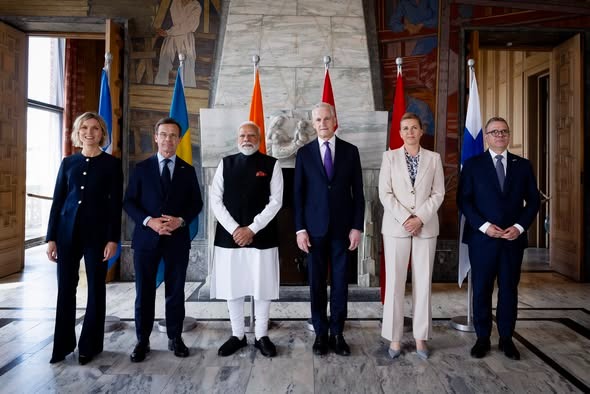
Modi’s Norway visit (18–19 May) was historic (first Indian PM to Norway in 43 years). Key activities: bilateral talks with PM Støre, a meeting with King Harald, and participation in the India–Nordic Summit in Oslo (with PMs of Denmark, Finland, Iceland, Norway and Sweden). The official India-Norway Joint Statement (18 May) emphasized climate and green transition. India and Norway declared a “Green Strategic Partnership” to combat climate change, develop renewables and circular economy, and create green jobs. They agreed a joint action plan on climate/energy cooperation: sharing renewable tech and finance, exploring carbon capture, and ensuring energy security via a balanced mix (including Norwegian LNG imports).
Maritime and Arctic issues featured strongly. The leaders pledged cooperation on the Blue Economy – sustainable shipping, ports, fisheries and ocean research – and reaffirmed support for UNCLOS and a free Indo-Pacific (India welcomed Norway joining the Indo-Pacific Oceans Initiative). India will set up a pavilion at Norway’s Nor-Shipping 2027 (boosting shipbuilding ties). Importantly, polar and Arctic research was highlighted – India and Norway will deepen scientific collaboration in polar regions (important for climate science), reflecting India’s Arctic aspirations and Russia-Europe tensions.
On trade and investment, the Summit welcomed India-EFTA TEPA (with Norway) and a $100 billion FDI/1 million job pledge under it. Both sides encouraged Nordic investors (e.g. Norway’s $28B GPFG fund) to tap India’s market. Security issues (terrorism, Russia-Ukraine, West Asia) were also canvassed: the leaders condemned terrorism (mentioning Pahalgam attack), called for Middle East ceasefire, and reaffirmed need for open Hormuz shipping lanes.
In short, the Norway/Nordic leg extended the tour into clean-energy, climate and northern technology domains. Analysts note that the Nordics’ strength in green tech, digital governance and Arctic policy matches India’s interests. By engaging them, India diversifies partnerships into a highly innovative, transparent region, and strengthens its footprint in emerging domains (Arctic logistics, polar science, sustainable oceans).
Italy: Special Strategic Partnership and IMEC Corridor
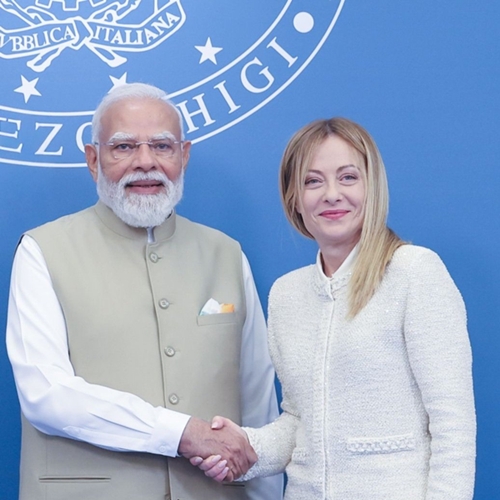
The tour concluded in Rome (19–20 May). Italy and India elevated bilateral ties to a Special Strategic Partnership (beyond the 2023 Strategic Action Plan). Modi and PM Meloni agreed on annual summits and instituted ministerial dialogues in every sector. High-level discussions and forums with CEOs focused on aerospace, naval shipbuilding, energy and critical technology. Outcomes included:
- Defence Industrial Roadmap: Signing of a Joint Declaration of Intent and Industrial Roadmap for co-development/co-production of defence equipment (aerospace systems, naval vessels, next-gen arms). This is a major advance for India’s Make in India Defence push, allowing technology transfer from Italy’s strong defence firms (like Fincantieri, Leonardo).
- Economic/Trade Commitments: Both sides set a goal of €20 billion in annual trade by 2029 (vs. ~€14 b in 2023), leveraging the EU-India FTA. Italy, like others, sees India as a market to reduce U.S./China dependence. They also expanded cooperation in space, AI, clean energy and critical minerals (key for tech manufacturing).
- IMEC and Connectivity: PM Modi reiterated IMEC (India–Middle East–Europe Corridor) commitment. The Joint Declaration specifically reaffirmed mutual support for IMEC (the trilateral India-UAE-EU corridor initiative), seen as transformational for trade routes. This aligns with Italy’s interest in diversifying Asia-Europe links via the Mediterranean.
- Other Pacts: MoUs on maritime heritage (National Maritime Heritage Complex at Lothal, in cooperation with Italian restoration expertise) and on recruiting Indian nurses (addressing Europe’s skills needs) were signed. Agreements also covered agriculture, cultural exchanges (2027 as Year of India-Italy Culture/Tourism) and economic crime prevention.
In Rome, leaders also discussed global security. They reaffirmed support for a peaceful Ukraine and Gaza resolution through dialogue, and condemned terrorism. Notably, Italy welcomed India’s aspiration to join the NSG (Nuclear Suppliers Group), strengthening India’s global standing. Modi’s visit to the UN Food & Agriculture Organization (in Rome) further highlighted cooperation on agri-innovation and food security.
Overall, the Italy leg cemented India-Europe ties. Elevating to a Special Strategic Partnership was seen as a “major step” by media. It signalled convergence on high-tech defence, Indo-Pacific security (Meloni attending I2U2 in Delhi just weeks earlier), and co-management of economic corridors. The focus on IMEC in particular addresses India’s strategic goal of bypassing volatile chokepoints and linking to Europe via the Middle East.
Strategic Benefits for India
- Energy Security: The UAE deals lock in long-term fuel and LPG supplies and expand India’s oil reserves, buffering against Gulf disruptions. Norway cooperation broadens India’s renewable and LNG options (Norway is India’s 3rd largest LNG supplier). By diversifying sources (from Middle East oil to Russia/US/Norway gas), India mitigates import risks.
- Supply Chain Resilience: The Netherlands and Sweden partnerships attract European tech and investment into Indian manufacturing (chips, green hydrogen, electronics). This helps shift global supply chains towards India (a “China+1” partner). Agreements on critical minerals and semiconductors specifically aim to integrate India into the supply chain of advanced components, reducing import dependency. The IMEC corridor commitment with Italy also underlines India’s drive to establish alternative trade routes.
- Defence-Industrial Base: The UAE Framework and Italy defence roadmap greatly expand co-production and technology sharing with trusted partners. Joint projects with Italy (a top EU defence exporter) and enhanced Indian defence dialogues with Europe and the Gulf will boost India’s indigenous defence sector. These moves align with India’s self-reliance goals and raise private sector involvement (business forums with SIDM/NIDV, EU companies).
- Technology Transfer: Collaborations with the Netherlands (semicon), Sweden (AI, 6G, startups) and Nordic countries (digital health, AI in healthcare, polar tech) enhance India’s access to cutting-edge research. The supercomputing pact with UAE and AI corridor with Sweden will help India develop sovereign tech capabilities. MoUs on education and skills (India-Netherlands higher-ed; SME platforms in Sweden) promise talent development.
- Investment and Trade: The tour secured new FDI pledges (UAE $5B, Nordic TEPA goals) and set ambitious trade targets (double trade with Sweden, €20B with Italy). These commitments promote foreign inflows into India’s infrastructure and industry. Europe’s interest in Indian markets is evident – Netherlands is India’s 4th largest European investor, and Italy, Sweden and Nordics see post-FTA opportunity. Settling trade in local currencies (rupee-dirham) was also agreed to reduce transaction costs (MEA backgrounder).
- Geopolitical Balancing: Diplomatically, Modi balanced India’s ties across regions. Deepening ties with the Gulf (UAE) helps manage West Asia instability, even as India maintains strategic autonomy (not joining any bloc). Similarly, engagement with diverse European powers (from Sweden to Italy) ensures India’s voice in both EU and Arctic affairs. Publicly aligning with Europe on issues like terrorism (tacit rebukes of Pakistan’s role) and free navigation in Hormuz signals support for international norms.
- Soft Power and Diaspora: The visits engaged the large Indian diasporas. The UAE tour focused on welfare of 4.5M Indians there, while Italy celebrated the Indian community (future “Year of Culture”). Cultural diplomacy (loan of Chola plates from Netherlands, Tagore lectures in Sweden) enhances India’s image. Recruitment of Indian nurses to Europe also projects India as a critical talent source.
Risks and Considerations
The tour’s outcomes are largely positive, but some challenges remain. Reliance on the Gulf for energy still carries geopolitical risk if conflicts escalate. India must ensure signed agreements (e.g. SPR storage, defence co-production) are fully implemented. Managing complex relations (e.g. Iran vs. Gulf, Russia vs. NATO) requires finesse. The Norway statement reiterated India’s circumspect positions on Ukraine and Russia – maintaining this balance will continue to be tricky given Nordic security concerns.
There is also the challenge of execution: India-EU FTA must be finalized to fully benefit, and infrastructure (rail/port) for the IMEC corridor needs sustained investment. Labour mobility pacts (e.g. nurses, skilled visas) require domestic safeguards. But overall, the tour’s broad diversification of partnerships reduces India’s over-reliance on any one country or region, which is strategic insurance amid global fragmentation.
Strategic Implications and Policy Recommendations
The five-country tour yields short- to long-term benefits for India:
- Short-term: Enhanced market confidence (big energy and investment deals), reassurance on oil supplies, and international goodwill that supports India’s current account and growth. Immediate defense and energy MoUs were finalized, and India’s global stature was bolstered by hosting EU and Nordic leaders in joint statements.
- Medium-term: Technology transfers from Europe (semiconductors, AI, green tech) will take time but position India’s economy on a higher trajectory. The skill development and joint research pacts should materialize as projects (e.g. the IIT-Delhi water center, semiconductor fab spinoffs). The India–EU FTA (pending signature) could further amplify trade and tariff benefits by 2027.
- Long-term: Institutionalizing ties (annual summits, defence roadmaps) creates lasting frameworks. Strategic projects like IMEC, polar research or the proposed sea corridor will unfold over years, reshaping India’s connectivity. The Russia-Ukraine and Middle East conflicts may evolve, so India gains by having diversified allies and advocating diplomacy. Continued engagement with Europe and the Gulf is likely to yield further FDI inflows, technology hubs, and security cooperation over the next decade.
Way Forward
The success of Prime Minister Narendra Modi’s May 2026 diplomatic outreach to the UAE and Europe will ultimately depend not merely on the announcements and agreements signed during the visit, but on the speed, institutional continuity and strategic seriousness with which these understandings are translated into measurable outcomes. In this regard, India must now move decisively toward the implementation phase. Agreements related to energy security, strategic petroleum reserves, semiconductor cooperation, defence manufacturing, artificial intelligence, green hydrogen and sustainable infrastructure require coordinated execution involving ministries, state governments, industry stakeholders and international partners. India should particularly fast-track joint projects announced during the visit, including defence co-production initiatives with Italy, semiconductor and technology collaborations with the Netherlands, and innovation and green-transition partnerships with Sweden and the Nordic countries. Accelerating these initiatives would not only strengthen India’s industrial and technological capabilities but also demonstrate India’s credibility as a dependable strategic partner.
Simultaneously, India must intensify efforts toward securing deeper economic integration with Europe through the early conclusion and ratification of the India-European Union Free Trade Agreement and associated investment arrangements. At a time when global supply chains are being recalibrated due to wars, sanctions, economic nationalism and geopolitical fragmentation, India has a historic opportunity to position itself as a trusted manufacturing, logistics and technology hub for Europe and the wider world. Harmonization of regulatory standards, reduction of trade barriers and expansion of investment facilitation mechanisms with European partners can significantly enhance India’s exports, industrial competitiveness and access to advanced technologies. The agreements discussed during the tour should therefore be integrated into India’s broader economic diplomacy and industrial strategy.
Another critical dimension of the way forward lies in linking these international partnerships with domestic initiatives such as “Make in India,” “Digital India,” “Startup India,” the National Green Hydrogen Mission and semiconductor manufacturing schemes. India should actively incentivize Dutch and Swedish technology firms, European green-energy companies and advanced manufacturing enterprises to establish production bases, research centres and innovation ecosystems in India. This would not only generate employment and technological spillovers but also help India emerge as a global centre for resilient and sustainable manufacturing. In sectors such as renewable energy, electric mobility, green shipping, smart infrastructure and AI-driven industrial systems, India’s collaboration with Europe could become transformational if supported through stable policy frameworks and long-term investment commitments.
Institutional continuity will also be essential in sustaining the momentum generated by the visit. India should strengthen bilateral and multilateral monitoring mechanisms through annual summits, ministerial dialogues, strategic councils and joint working groups to ensure regular review of commitments and timely resolution of bureaucratic bottlenecks. Such institutional mechanisms are particularly important in large-scale strategic initiatives like the India-Middle East-Europe Economic Corridor (IMEC), defence industrial partnerships and climate-related technological collaborations, where coordination among multiple stakeholders is indispensable.
Equally important is the expansion of people-to-people ties and knowledge partnerships. The visit highlighted growing European interest in skilled Indian professionals, healthcare workers, researchers and technology experts. India should therefore negotiate more streamlined mobility and visa frameworks with partner countries while simultaneously encouraging academic collaborations, student exchanges, joint research initiatives and innovation partnerships between universities and think tanks. Enhanced cultural diplomacy and diaspora engagement can further strengthen India’s soft power and create deeper societal linkages that sustain strategic partnerships beyond governmental interactions.
At the geopolitical level, India must continue to maintain its policy of strategic autonomy and calibrated multi-alignment. The current international environment remains deeply volatile due to ongoing wars, geopolitical rivalries, disruptions in maritime trade routes, energy insecurity and technological competition among major powers. In such circumstances, India’s engagement with Europe and the Gulf should complement — rather than replace — its broader strategic relations with the United States, Russia and other major global actors. India’s diplomatic balancing approach enables it to maximize strategic opportunities while avoiding entanglement in bloc politics or great-power confrontations. At the same time, India must continue strengthening its domestic defence manufacturing capacities, renewable energy infrastructure, critical mineral security and technological self-reliance to reduce vulnerabilities arising from external shocks.
Conclusion:
India today is increasingly viewed not merely as a large market or developing economy, but as a pivotal geopolitical actor, a reliable democratic partner and an emerging pillar of stability in an uncertain world order. If the agreements and understandings reached during this visit are implemented effectively and sustained through institutional commitment, the tour could become a defining step in strengthening India’s economic resilience, technological advancement and global influence in the decades ahead.
References
- https://www.pmindia.gov.in/en/news_updates/india-netherlands-joint-statement-on-the-visit-of-pm-of-india-to-netherlands/#:~:text=Both%20leaders%20also%20welcomed%20the,its%20continuation%20for%20next%20phase
- https://indianexpress.com/article/india/india-netherlands-strategic-partnership-17-pacts-narendra-modi-rob-jetten-10693924/
- https://www.reuters.com/world/india/india-signs-pacts-with-uae-defence-petroleum-during-modis-visit-2026-05-15/
- https://www.reuters.com/world/india/indias-modi-begin-five-nation-tour-including-uae-amid-middle-east-crisis-2026-05-11/
- https://www.mea.gov.in/press-releases.htm?dtl/41126/Visit_of_Prime_Minister_to_UAE_Netherlands_Sweden_Norway_and_Italy_May_15__20_2026
- https://www.reuters.com/world/india/india-seeks-dutch-knowhow-semiconductor-push-2026-03-04/
- https://www.pmindia.gov.in/en/news_updates/india-netherlands-joint-statement-on-the-visit-of-pm-of-india-to-netherlands/
- https://timesofindia.indiatimes.com/india/jobs-ai-trade-more-key-outcomes-of-pm-modis-sweden-visit/articleshow/131167116.cms
- https://www.mea.gov.in/bilateral-documents.htm?dtl/41184/IndiaNorway+Joint+Statement+May+18+2026
- https://www.reuters.com/world/india/italy-india-set-upgrade-ties-during-modis-visit-rome-2026-05-19/
- https://www.tribuneindia.com/news/india/pm-modis-uae-visit-yields-defence-energy-deals-5-bn-investment-commitment/
- https://www.internationalaffairs.org.au/australianoutlook/pm-modis-five-nation-tour-and-indias-expanding-strategic-geography/
- https://www.aljazeera.com/news/2026/5/19/india-nordic-summit-why-is-modi-wooing-northern-europe
- https://timesofindia.indiatimes.com/videos/news/modi-meloni-talks-boost-india-italy-defence-imec-and-technology-cooperation/videoshow/131238644.cms
*Editor, Focus Global Reporter