Dr. Arvind Kumar*
This weekend, New Delhi will become the centre of a consequential moment for the global South as leaders from eleven nations gather at Bharat Mandapam for the 18th BRICS Leaders’ Summit. The grouping will mark twenty years since its founding at a time when the post-war world order, its institutions, currencies and strategic alliances are under unprecedented strain. The timing is more than symbolic. Prime Minister Narendra Modi has repeatedly framed India’s fourth BRICS chairship as an opportunity to reshape the grouping’s future. With that opportunity now becoming a reality, the central question is whether India can give BRICS greater coherence, strategic purpose and influence or whether the summit will simply add to the cacophony of an increasingly fragmented world. If Modi’s instinct is right, this could be the BRICS summit that changes the terms of the century ahead.
The backdrop could hardly be starker. The war in Ukraine grinds on into its fifth year without resolution; American and Israeli strikes on Iran have pulled the Gulf deeper into confrontation; and Washington’s use of tariffs as a blunt instrument of foreign policy has touched almost every BRICS economy at once. India itself absorbed duties peaking near fifty percent last year over its Russian oil purchases, later eased but never fully resolved; Brazil faced a comparable fifty percent tariff over an unrelated domestic dispute, and South Africa a thirty percent levy of its own. Layered on top has been President Trump’s explicit warning that any BRICS move away from the dollar a common currency, alternative payment rails would trigger tariffs as high as one hundred percent. Whatever the merits of that position, the message received across the Global South was unambiguous: market access and monetary autonomy were being treated as privileges Washington could withdraw at will.
Can India course correct BRICS?
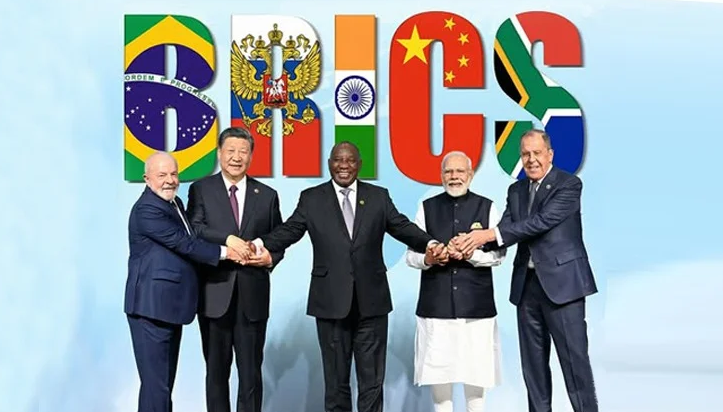
It is precisely this climate that gives BRICS its renewed relevance. A bloc speaking for economies producing roughly forty percent of global output and home to nearly half of humanity is not a talking shop any serious power can ignore, however imperfect its cohesion. But relevance is not the same as direction, and that is where India’s chairmanship becomes consequential. Modi has for years pushed a vision of reformed multilateralism, that institutions built for a mid-twentieth-century world, from the UN Security Council to the IMF and WTO, cannot referee a multipolar century; and this summit is India’s clearest chance to turn that argument into an agenda rather than a slogan. Crucially, India has tried to keep that agenda non-Western rather than anti-Western, resisting pressure from some members to turn BRICS into a vehicle for confrontation with Washington and Brussels even as it deepens ties with Moscow and Beijing. It is a difficult balance that every founding member besides China has preferred, since a bloc built on opposition to the West offers far less than one built on strategic autonomy.
Nowhere is that balancing act more visible than in the guest list itself. Xi Jinping’s arrival marks his first visit to India since 2019. Vladimir Putin arrives for his second visit to India within a year, with a separate bilateral expected on the sidelines, this reflects that India can host both leaders comfortably at the same summit, while still negotiating trade terms with Washington and maintaining defence ties with the West, quietly vindicates the strategic-autonomy playbook Modi has pursued for a decade.
The geoeconomic story running underneath all of this is the slow unwinding of dollar dependence, and here language matters almost as much as substance. India has been careful to describe its position not as de-dollarisation but as de-risking; settling more bilateral trade in national currencies, linking central-bank digital payment systems, and reducing the friction of routing trade between two countries through a third country’s currency, and by extension its foreign policy. What has shifted is the political cover for having this conversation: when the custodian of the world’s reserve currency threatens triple-digit tariffs for discussing alternatives, it becomes harder to insist the arrangement is neutral rather than a lever of American pressure. Reforming the petrodollar order is no longer a fringe demand; it is a reasonable response to watching that order weaponised in real time.
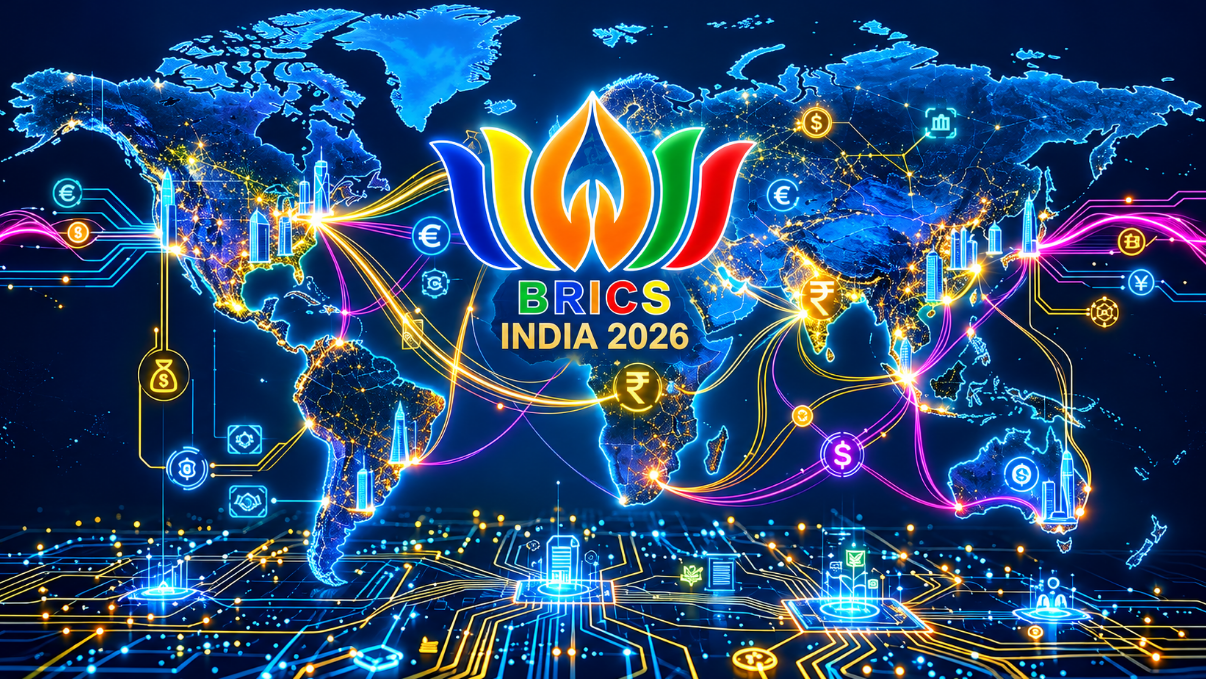
There is a third register to this story that draws less attention than geopolitics or trade: the environment. India’s chairship theme, “Building for Resilience, Innovation, Cooperation and Sustainability,” was designed to place climate equity alongside currency reform, and for good reason. A BRICS able to align its members on climate finance, the New Development Bank’s green lending, and equitable emissions pathways would hand the Global South a stronger position in future climate negotiations than any single member could command alone.
None of this means BRICS is smoothly functioning rather than genuinely hard to manage. Iran and the UAE remain at odds over Middle East fallout; Ethiopia’s Nile dam project has strained ties with Egypt; Saudi Arabia and the UAE diverge on their approach to Israel; and China’s economic weight means founding members India and Brazil, who see BRICS chiefly as a development project, must constantly balance Beijing and Moscow’s more geopolitical reading of the same institution. India’s own relationship with China, though visibly improving, remains unresolved at the border even as trade and diplomatic contact resume. A credible account of this summit holds both truths together: BRICS is more fractious than its founders imagined, and India, more than any other member, has the incentive and the capital to keep it from splintering the way other regional groupings have.
Prospects Ahead
That, ultimately, is the case for optimism, and it is a testable one rather than a rhetorical one. Delhi does not need a dramatic new institution to count as a success: a joint New Delhi Declaration, tangible progress on settling more intra-BRICS trade in national currencies with interoperable payment systems, formal backing for the BRICS Global Value Chains Action Plan for 2026–2030, and workable common language on UN reform and terrorism would together already constitute a substantial package. The more revealing test lies beyond the communiqué, in whether declarations turn into funded pilots, whether the proposed BRICS Startup Innovation Fund and the Network on Digital Agriculture that India is coordinating actually move money and technology rather than sit in an annex, whether the Strategy for BRICS Economic Partnership 2030 gets real budget lines behind it, and whether the New Development Bank’s lending book tilts further toward local-currency instruments rather than dollar-denominated ones.
If New Delhi can thread that needle while banking even half of its economic agenda, it will have done more than host a summit, it will have shown a fractured, tariff-weary, war-fatigued world that there is still a plural, negotiated way to write the next chapter of globalisation, rather than living with the one written unilaterally on everyone else’s behalf. That is what would turn India’s wager that this could be the summit that changes the game into a verdict of substance rather than diplomatic flourish, one that will be decided not this weekend but in the months of implementation that follow.
*Editor, Focus Global Reporter