Dr. Arvind Kumar*

Climate change is fundamentally a water crisis, yet the water already in hand is squandered; only 56% of domestic and barely 25% of industrial wastewater is safely treated worldwide, with India discharging nearly three-quarters of its urban sewage untreated. This waste is also a missed opportunity, since water is a “super-connector” drawing trillions in investment across energy, agriculture and infrastructure. The challenge now is to integrate water transversally across policy, embed ESG into industrial practice, and ask a fundamental question: Are governments, businesses and citizens ready to treat every used litre as a resource rather than waste?
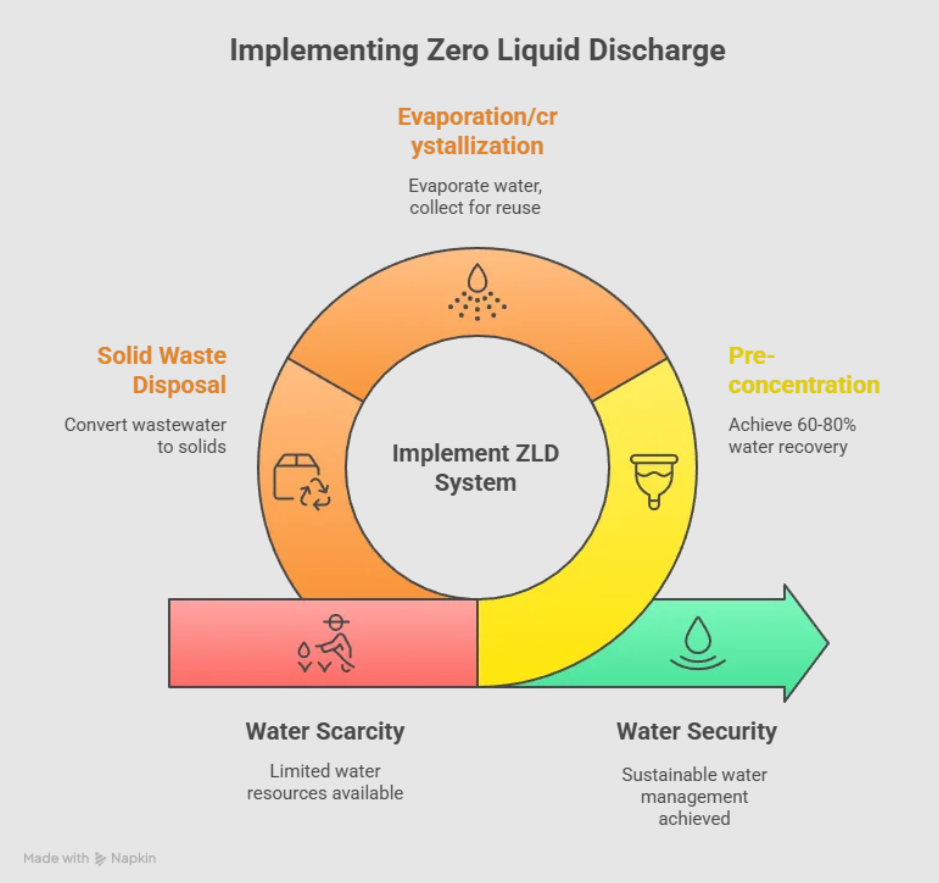
The world is living beyond our hydrological means,” United Nations Secretary-General António Guterres warned in 2026, the same year a UN-backed scientific assessment formally declared what researchers termed an era of “global water bankruptcy” humanity drawing down glaciers, aquifers and lakes faster than nature can refill them. That single warning captures the argument of this piece: climate change is, at its core, a water crisis, and buried inside that crisis is an unusually solvable problem; the water we have already used once and simply throw away. Zero Liquid Discharge (ZLD), the practice of recovering and reusing virtually all industrial and municipal wastewater so that nothing untreated re-enters rivers, soil or sea, has moved from a niche engineering ideal to one of the sharpest tests of whether India can convert a resource crisis into a resource economy.
The Water Imperative
Climate change rarely arrives as an abstraction; it arrives through water; vanishing glaciers, erratic monsoons, drying aquifers, cities that flood one season and ration the next. Nearly three in four natural disasters recorded globally are water-related, and UN data show more than half the world’s large lakes have lost volume since the early 1990s, alongside sharp glacier retreat. India feels this acutely: home to 18% of humanity but barely 4% of the planet’s freshwater, it ranks among the most water-stressed large economies on earth, a mismatch that climate change is widening, not easing.
Yet even as scarcity deepens, the water already in hand is treated carelessly. Globally, only 56% of domestic wastewater is safely treated; the rest well over a hundred billion cubic metres a year returns to rivers, groundwater and soil largely untreated. Industrial effluent fares worse still: among the few countries that report the figure, barely a quarter receives safe treatment. This is no environmental footnote. Poorly managed wastewater is estimated to generate close to 1.6% of global greenhouse gas emissions roughly on par with commercial aviation making liquid waste as much a climate lever as a public-health one.
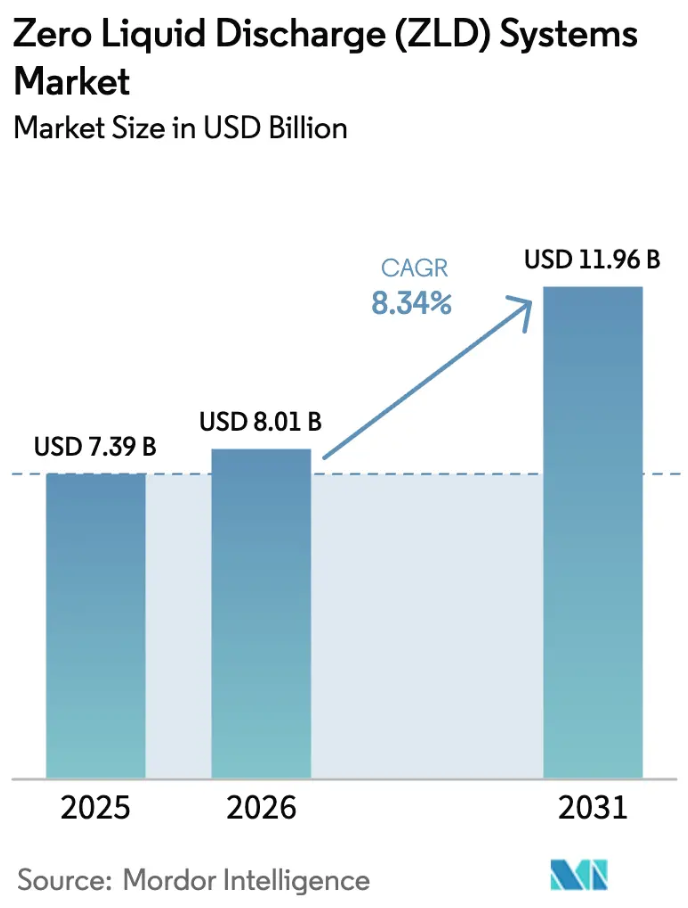
Set against this waste is a striking opportunity. The global water and wastewater treatment market, worth over $372 billion in 2025, is projected to nearly double by 2034, even as the OECD and World Bank put the world’s water infrastructure financing gap at $6.7 trillion by 2030, rising to $22 trillion by 2050. Investors are responding; in a 2025 survey of over 300 senior water-sector decision-makers, 96% planned to maintain or increase investment, and analysts estimate every dollar invested in water returns at least $2.50 in wider economic output. This is because water is not really a “sector” at all, it is a super-connector. It underwrites energy generation, absorbs 72% of global freshwater withdrawals through agriculture, sustains livelihoods and urban infrastructure, and increasingly decides where the AI-driven data economy can even be built. Touch any development goal, and water is already there.
Closing the Loop
Zero Liquid Discharge sits at the sharpest edge of this story: liquid effluent. India’s Central Pollution Control Board found Indian cities generate roughly 72,368 million litres of sewage daily, yet installed treatment capacity covers under 44% of it, and actual treatment reaches barely 28%. Nearly three-quarters of India’s urban sewage over 52,000 million litres daily is discharged into rivers, groundwater and soil essentially untreated, a volume projected to grow 75-80% over the next 25 years as cities expand. Textiles, tanneries, distilleries and pulp and paper remain the most persistently flagged industrial polluters, and the pandemic made the danger of that neglect impossible to ignore. It was this urgency that led India Water Foundation, with the UN Environment Programme and support from the Ministry of Science and Technology, the Ministry of Jal Shakti and the Central Pollution Control Board, to convene in 2020 the first global discourse of its kind on liquid waste: a high-level dialogue on “The Future of Liquid Waste Management Amidst COVID: What Lies Ahead.”
That trajectory gained further policy weight when the Ministry of Environment, Forest and Climate Change issued the Draft Liquid Waste Management Rules, 2024, on 7 October 2024 built on the principle of “Extended User Responsibility,” requiring bulk water users, industries, municipalities, SEZs, railways and even religious sites to register, treat and progressively reuse their wastewater, backed by environmental compensation rather than token fines. For industry, this was never a sudden pivot. As early as 2011, IWF, together with the Rajasthan State Industrial Development and Investment Corporation and the Government of Rajasthan, convened a first-of-its-kind International Conference on Water Use Efficiency in the Industrial Sector in Jaipur, years before Zero Liquid Discharge entered the mainstream sustainability vocabulary. That conference did not stop at dialogue: Rajasthan went on to enact a State Water Law, and its Department of Industries allocated additional industrial plots specifically for water-treatment facilities to enable recycling and reuse of industrial wastewater.
Two case studies show what follow-through looks like. In Tamil Nadu, Tirupur’s textile cluster once turned the Noyyal river black with untreated dye effluent, triggering a 2011 Madras High Court order that shut roughly 700 dyeing units and cost 50,000 jobs in a single stroke. Rather than collapse, the cluster rebuilt around Zero Liquid Discharge: by mid-2012, eighteen common effluent treatment plants had reopened on a ZLD model, and Tirupur today recycles some 130 million litres of water daily, needing only about 10% fresh water intake to sustain a textile export economy worth roughly ₹40,000 crore. Half a world away, in Arizona’s Maricopa County, the New Harquahala power project, a 1,000-megawatt plant drawing on scarce Colorado River and groundwater supplies was engineered from the outset as a full Zero Liquid Discharge facility, using evaporation and crystallisation technology to recycle water on site and convert the remainder into solid waste rather than any liquid discharge at all. An emerging economy’s textile hub and a developed economy’s power plant arrived at the same conclusion by different regulatory routes: ZLD is replicable precisely because it is commitment-specific, not geography-specific.
Way Forward
ZLD has to be read through transversality; treating water not as one ministry’s brief but as the connective infrastructure running through energy, agriculture, health and industrial policy alike reinforced by ESG frameworks that make water stewardship a material line item for investors, insurers and boards, not a footnote in a sustainability report. Operationally, this means embedding the 6Rs of the circular water economy; reduce, reclaim, reuse, recycle, recover and rethink into every industrial consent order and municipal master plan, not confining them to pilot projects. It is estimated that India’s circular economy could be worth over $2 trillion and create close to 10 million jobs by 2050; water and liquid waste management sit squarely inside that number. That leaves direct questions for government: will the Liquid Waste Management Rules be resourced and enforced as rigorously as they are drafted, and will bulk users be held to reuse obligations with the same seriousness as emission norms? And for industry and citizens alike: are we prepared to treat every used litre as a resource to be recovered rather than a problem to be discharged? The answer will decide whether India converts water stress into its next industrial advantage.
*Editor, Focus Global Reporter