
Dr. Arvind Kumar*

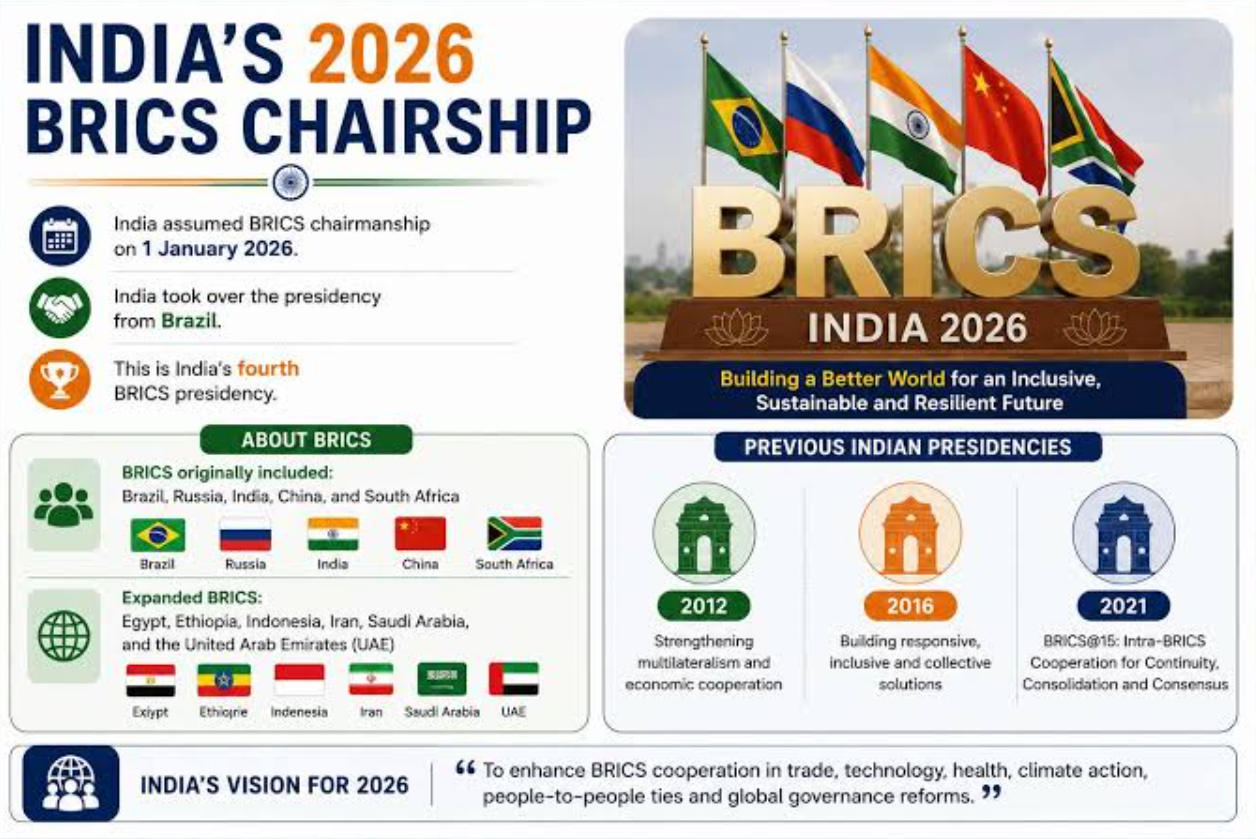
As the global order undergoes profound shifts, the eighteenth BRICS Summit comes at a consequential moment for the future of multilateralism and the Global South. Hosted by India under the theme “Building for Resilience, Innovation, Cooperation and Sustainability,” the Summit presents an opportunity to examine whether BRICS can translate its growing weight into a more resilient, inclusive and sustainable global architecture. Few summits have landed at a moment this loaded. The very nations that authored the post-1945 order are now its quietest custodians: Washington has exited both the Paris Agreement and, for the first time by any country, the UNFCCC itself; tariff walls have gone up in the name of “reciprocity” while landing hardest on the poorest exporters; and wars from Ukraine to West Asia keep rerouting supply chains that developing economies never controlled to begin with. That is the crux of this moment, the institutions built to manage global interdependence are being used selectively by those who built them, while the Global South absorbs the cost of a warming planet, a weaponised trading system, and a currency order it did not design. New Delhi’s real task is to move three ideas from communiqué language into working architecture: sustainability, nexus, and transversality.
The pattern is consistent even where the justification changes. On climate, the withdrawal from the Paris Agreement, followed almost immediately by withdrawal from the UNFCCC treaty framework altogether and rather than other wealthy nations stepping into the funding gap, overall development aid fell 7% in 2024 with steeper cuts projected through 2025, even as the obligation to finance developing-world mitigation and adaptation remains written into the Paris text itself. On trade, the 2025 “reciprocal tariff” regime imposed a 10% baseline and rates up to 50% on economies like Lesotho and 47% on Madagascar; least-developed countries with no leverage to negotiate exemptions the way larger partners did. And on governance, the same double standard holds: the WTO’s Appellate Body has sat paralysed for years because new judges simply aren’t confirmed, the UN Security Council’s permanent seats still exclude the 73% of the world’s countries that make up the Global South, and the IMF and World Bank remain led, by unwritten convention, from Washington and Europe. None of this is new, but its compounding is: climate abdication, tariff coercion and institutional capture are now arriving together, which is precisely why they demand an integrated response rather than three separate ones.
The bloc’s own honesty problem
Yet an integrated response also requires BRICS to confront an uncomfortable reality: it has its own credibility and cohesion problem. The bloc’s May 2026 Foreign Ministers’ Meeting in New Delhi could not agree on a joint statement, splintering over the Iran–Israel–US conflict, with India ultimately issuing a Chair’s Statement instead. Sino-Indian strategic distrust persists beneath a fragile 2024 border disengagement. Consensus-based decision-making means BRICS can coordinate economically while remaining largely silent on security. Analysts have therefore not been wrong to describe the bloc as united more by shared grievance against the existing order than by a common vision of what should replace it. A coalition asking the world to trust it with reformed multilateralism must first demonstrate that it can generate trust internally through binding delivery mechanisms, institutional consistency and tangible outcomes, not declarations alone.
The retreat dressed up as realism
Ten years into the SDG framework, the UN’s own 2025 review found only 35% of targets on track or making moderate progress, with 18% actively regressing and an annual financing gap for developing countries estimated near $4 trillion against a $1.4 trillion debt-servicing burden many of these same countries already carry. This is not an abstraction for BRICS members; it is a shared condition. Agriculture, healthcare and education gaps in India look structurally like those in Ethiopia, Indonesia or Brazil’s interior, meaning the fix isn’t aid flowing one direction but capacity and finance circulating horizontally. This is the logic behind the New Development Bank’s push to lend a rising share of its portfolio in members’ own currencies rather than dollars, and it is why “no one left behind” only means something if the Global South stops importing solutions designed for economies at a different stage of development and starts co-designing its own.
Climate shocks, debt distress, conflict-disrupted trade and currency dependence are not separate files rather they are one feedback loop. A tariff war raises input costs; a war disrupts grain and energy corridors; a currency squeeze then forces the countries least responsible for either to borrow at the highest rates to cope with both. This is the reasoning behind BRICS’s accelerating push on local-currency settlement: intra-bloc trade conducted outside the dollar has reportedly climbed toward two-thirds of total volume, Russia and China now settle roughly 90% of bilateral trade in rubles and yuan, and payment infrastructure like BRICS Pay and mBridge is being built precisely to insulate members from a single currency’s geopolitics. This is not really “de-dollarisation” as ideology, even India’s own external affairs minister has been careful to say New Delhi isn’t seeking to dethrone the dollar. It is risk-management by nations that have watched sanctions, tariffs and interest-rate shocks travel through the same dollar-denominated pipes.
The final step is treating sectors and geographies as one system rather than a list. Agricultural resilience, health financing, education infrastructure, energy security and digital public goods are transversal, a disruption in one cascades into the others, and India’s own UPI-style digital rails are being pitched as a model precisely because infrastructure built for one purpose can be repurposed across many. A genuine common investment pool the New Development Bank scaled up, its membership already expanded well beyond the founding five, financing local-currency projects across regions rather than ring-fenced by geography is the transversal instrument BRICS keeps gesturing toward but hasn’t yet fully built.
The way forward
New Delhi should resist the temptation to treat this summit as a scoreboard against Washington and instead treat it as an infrastructure build. Concretely: lock in NDB local-currency lending targets rather than leaving them aspirational; give the BRICS Payment Task Force a hard interoperability deadline instead of open-ended pilots; convert South-South trade’s rise from $500 billion in 1995 to $6.8 trillion in 2025 into shared standards on agriculture and health procurement, not just bilateral volume; and use the bloc’s collective weight to press, jointly rather than nation-by-nation, for WTO Appellate Body appointments and UN Security Council seats, since fragmented asks have gone nowhere for two decades. Sustainability sets the deadline, nexus explains why single-sector fixes keep failing, and transversality is the only design principle capable of holding both together. Whether New Delhi delivers architecture or another declaration will say more about the next decade of global governance than anything said in Washington or Brussels this year.
*Editor, Focus Global Reporter