Dr. Arvind Kumar*

What if the food on our plates is slowly becoming a public-health threat despite India’s extensive food-safety regulations and enforcement machinery? With institutions, laws and authorities responsible for monitoring food safety at virtually every stage, the persistence of adulteration raises a fundamental question: who is responsible when the system still fails to protect the consumer? Over three years, more than 5.18 lakh food samples were analysed, resulting in 88,192 penalties and 3,614 convictions, yet adulteration continues. In Andhra Pradesh, contaminated milk linked to ethylene glycol reportedly claimed 16 lives, showing that regulatory failure can have fatal consequences. The issue therefore goes beyond periodic raids or individual offenders; it demands accountability across the entire chain from production and processing to transport, retail and consumption and a food-safety system where responsibility is clear, traceability is real and enforcement is continuous.
With festivals approaching, authorities from Maharashtra to Uttar Pradesh report alarming finds of expired or fake ingredients flooding our plates. Food & Drug Administration (FDA) teams unearthed a full “synthetic milk” racket: officials say unscrupulous producers are mixing skimmed-milk powder with caustic soda, detergents and even shampoo to mimic real milk. The sheer brazenness of these schemes has led critics to warn that profiteering has turned food into “poison”. Recent raids nationwide have seized tainted milk, cheese and sweets – underscoring that adulteration is more than a local issue, it’s a nationwide public-health crisis.
Widespread Contamination and Public Health
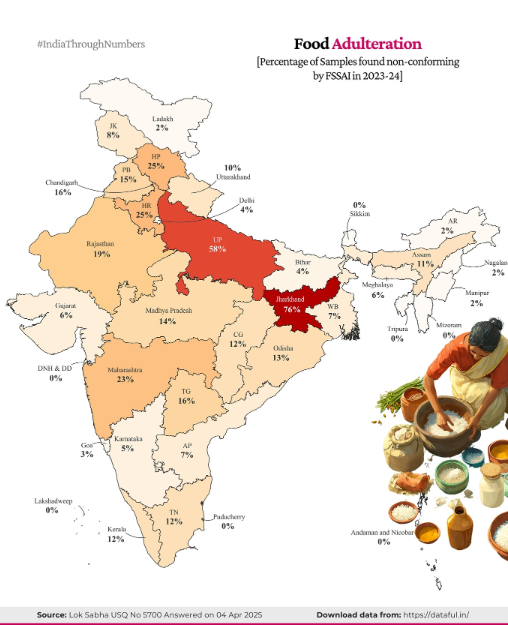
Data paint a grim picture. In Parliament, Member of Parliament Raghav Chadha noted that one in four food samples tested in India fails to meet basic safety standards. A Food Safety & Standards Authority of India (FSSAI) analysis found 71% of milk samples contained urea and 64% had neutralizing agents to hide spoilage. Common contaminants include caustic soda or hydrogen peroxide in milk, industrial dyes in spices, cheaper fats or even vanaspati in ghee, and formalin in fish. Such chemicals can cause immediate illness and long-term harm. A recent review notes that chronic exposure to adulterated foods raises the risk of serious non-communicable diseases from kidney damage and neurological disorders to diabetes, heart disease and cancer. Communities feel the impact. In one Maharashtra outbreak, dozens of villagers suffered kidney failure after drinking laced milk, prompting emergency medical camps. Researchers now stress that adulteration is a “raging health crisis” in India.
Rising adulteration is also linked to a culture of convenience, branding and low-cost consumption, where packaged, branded or ordered food is often perceived as more premium than simple home-cooked fare. This demand, combined with weak source transparency, can incentivise fraudulent practices, while brand trust may create a false sense of safety. Tackling adulteration therefore requires not only stronger enforcement but also a shift towards informed consumption, transparency and renewed confidence in wholesome, home-prepared food.
India has a strong Food Safety Act (FSSAI) on the books, but enforcing it is a challenge. At the national level, FSSAI sets standards and licenses, while state Food and Drug Administrations (FDAs) carry out inspections and seizures. In Maharashtra, new leadership has taken an aggressive stance. Since mid-2026, Commissioner Tukaram Mundhe has declared “zero-tolerance” on milk adulteration. In July 2026 the Maharashtra FDA issued a blanket compliance order covering the entire dairy chain from farms and milk-collection centres to transporters and retailers mandating traceability and hygiene standards. Violating these rules now invites penalties up to ₹10 lakh, license suspensions or even criminal action. Similar drives are launched for the hospitality and retail sectors.
Even at union level, the new FSSAI CEO has asked delivery apps to weed out unlicensed restaurants and comply with standards. By late 2024, FSSAI had warned platforms like Zomato and Swiggy that they could be held accountable; new guidelines on packaging, cold-chain and dark-store warehousing are due. In short, regulators from farm to fork are tightening the net.
Challenges
Yet gaps remain. Enforcement is uneven across states and informal markets. An analysis notes that India’s food-safety oversight is weakened by resource constraints and patchy enforcement. In many areas, enforcement teams are small and food-testing laboratories are scarce. Moreover, the food business operators (FBOs) are numerous and fragmented: everything from multinational dairy firms to tiny street vendors fall under “food businesses”. Audits and recall systems exist, but often take time to act. Without continuous vigilance, older cases simply re-surface.
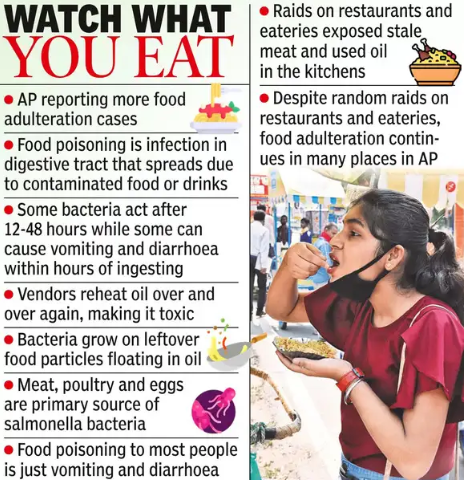
What about food delivery platforms? The explosion of online ordering raises fresh issues. Platforms like Zomato or Swiggy are technically intermediaries, but they now dominate urban consumption. So far, most liability for a tainted meal is placed on the restaurant or seller, per current laws. For example, Swiggy’s own terms claim “all liability” under the FSSAI Act lies with the merchant. However, experts argue this is insufficient. In practice, delivery apps set broad terms that shift risk onto cooks or suppliers. Regulator action is changing this dynamic. Recently FSSAI ordered platforms to remove unlicensed eateries and demanded quality checks on orders. In July 2026 it even slapped nine notices on Swiggy’s quick-delivery arm Instamart, after customers received expired whey protein powder, stale snacks and foul eggs. The message: the food-safety net must extend to these new supply chains as well.
Consumers and citizens are the final link. Regulators now urge the public to act as watchdogs: only buy sealed, well-labelled dairy and grains, and report suspicions to FSSAI or local FDA. Civil society and media also push for transparency. In short, everyone from farmers to app users plays a part in either enabling or stemming adulteration.
India is not alone, and international experience offers lessons. The famous 2008 melamine milk scandal in China (which killed infants) is instructive. After that crisis, China overhauled its system: it introduced strict food safety laws, mandated standardized dairy processing, and empowered a central food authority. India can follow suit by harmonizing rules and building stronger institutions. Global bodies also emphasize new tools. The FAO and WHO’s Codex Alimentarius have urged countries to combat “food fraud” with a combination of legal reform, traceability and technology. For example, blockchain or DNA barcoding are being piloted to ensure farm-to-fork transparency. India is beginning to use some of these: FSSAI’s Food Safety Connect app and a new track-and-trace system for packaged products are steps in that direction.
Way Forward
Enforcement must move from fragmented action to an integrated farm-to-fork system, bringing together FSSAI, State Food Safety and FDA authorities, local bodies, laboratories, police, consumer-protection agencies and regulators overseeing e-commerce and food-delivery platforms through shared data, coordinated inspections and clear accountability. Surprise inspections, faster laboratory testing, stronger prosecutions and meaningful penalties must become routine rather than festival-season responses, backed by greater staffing and food-safety budgets. Businesses, retailers and digital platforms should adopt certified food-safety systems such as HACCP and ISO standards, maintain traceable records and conduct regular supplier audits. At the same time, consumer awareness, media scrutiny and accessible reporting mechanisms must strengthen public vigilance. Economic incentives can further reward compliant producers through credible certification, market access and premium positioning. India’s answer to adulteration, therefore, lies not in another layer of regulation, but in integrating the authorities and closing the gaps between them, so that responsibility is shared, information flows seamlessly and no link in the food chain becomes a blind spot.
*Editor, Focus Global Reporter