Dr. Arvind Kumar*

Global trade is no longer just about tariffs and market access, it is increasingly about food security, water, climate, technology, and geopolitical influence. As the WTO struggles to remain relevant amid a rapidly changing world order, the question is no longer whether the rules should change, but who will shape them. Can a leading voice of the Global South transform from defending its interests to defining the future of global trade?
India has been a steadfast advocate for a fair, inclusive, and development-oriented multilateral trading system at the World Trade Organization (WTO). It champions the interests of developing countries by prioritising food security, public stockholding, fisheries, agricultural reform, and special and differential treatment, while increasingly engaging on digital trade, services, sustainability, and WTO reform. Its engagement with the WTO is a high-stakes balancing act, navigating a complex web of challenges while championing the cause of the Global South.
In Focus
As a nation with a burgeoning economy and a massive population dependent on agriculture, India’s journey at the WTO is marked by persistent friction over its farm subsidies, particularly for rice and sugar, and its recent domestic manufacturing incentives for the solar and IT sectors, which have led to a formal dispute with China. This has unfolded alongside India’s proactive push at the recent 14th Ministerial Conference (MC14) in Yaoundé, Cameroon, where it advocated for a development-oriented overhaul of global trade rules.
At MC14, India’s delegation, led by Minister Piyush Goyal, pushed a development-focused agenda covering WTO reform, e-commerce, fisheries subsidies, and agriculture. Dr. Senthil Pandian, India’s Ambassador and Permanent Representative to the WTO, recently signed a bilateral protocol supporting Ethiopia’s WTO accession, signalling India’s commitment to an open, inclusive, and responsive multilateral trading system for developing nations.
Stumbling blocks
Path for India at the WTO is fraught with challenges that span agriculture, industrial policy, and the very structure of the organization. On the agricultural front, the most significant challenge is the perpetual conflict over public stockholding (PSH) programmes. India, along with other members of the G33 coalition such as China and Indonesia, relies heavily on Minimum Support Prices (MSP) to procure food grains from farmers for its Public Distribution System (PDS). However, WTO rules limit such subsidies to 10% of the total value of production, a ceiling India has repeatedly exceeded. India recently notified the WTO that it had breached the de minimis limit for rice in the 2024–25 marketing year, invoking the “peace clause” for the seventh time to shield itself from legal challenges while continuing to press for a permanent solution to public stockholding.
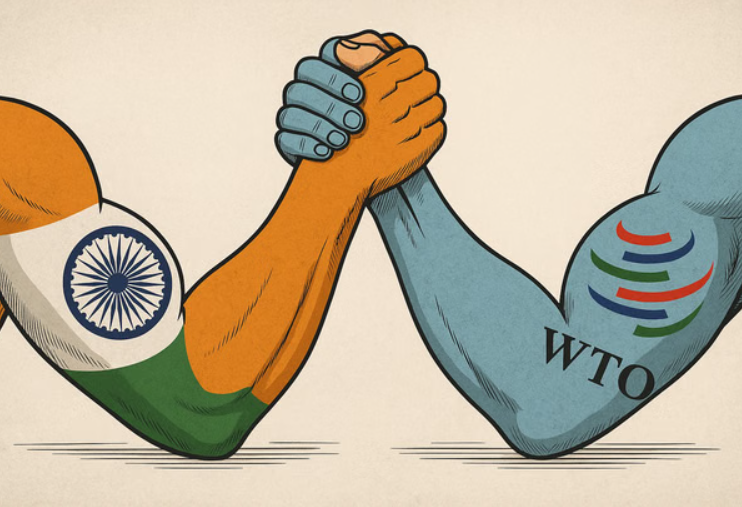
The subsidy amounted to approximately USD 7.6 billion, representing 11.85% of the value of rice production, once again highlighting the inadequacy of the outdated 1986–88 external reference price used under the Agreement on Agriculture. This temporary protection continues to create legal uncertainty while reinforcing India’s argument that food security programmes should not be constrained by obsolete subsidy calculations. Similarly, India’s sugar export subsidies have drawn complaints from Australia, Brazil, and Guatemala, who argue that these measures breach WTO disciplines. Yet these disputes are fundamentally about more than agricultural support they directly influence cropping patterns, irrigation demand, groundwater extraction, and the sustainability of water-intensive agricultural systems.
Beyond agriculture, India faces challenges related to its industrial policy. The country has rolled out a series of measures to promote domestic manufacturing, particularly in the solar sector, including imposing duties on imported solar cells and modules, mandating the use of locally manufactured equipment in government projects, and introducing a production-linked incentive (PLI) scheme. However Beijing alleges that India’s tariffs and incentive measures discriminate against Chinese solar energy and information technology products, violating WTO norms. The WTO’s Dispute Settlement Body (DSB) recently agreed to set up a panel to examine this complaint, a significant development that puts India’s domestic policies under international scrutiny. This dispute comes at a time when China has overtaken the US to become India’s largest trading partner, with bilateral trade reaching USD 151.1 billion, making the stakes even higher. On fisheries subsidies, India advocated for a balanced approach that promotes sustainability while protecting the interests of its millions of small and artisanal fishers. It has also argued for a 25-year exemption for developing countries, arguing that nations engaged in large-scale distant-water fishing should bear greater responsibility.
In the digital domain, India has highlighted the rapidly evolving nature of the digital economy and the need for policy space for developing countries to harness these developments effectively. It has stressed the importance of bridging the digital divide by strengthening digital infrastructure and skill development in least-developed and developing countries. However, India has also shown its independence by opposing the proposed Investment Facilitation for Development (IFD) agreement, which was backed by 128 of the WTO’s 166 members. India argues that instead of benefiting poorer nations, the IFD framework could undermine their policy autonomy, especially where institutional capacity to safeguard domestic interests is limited.
India’s Steadfast Stance
In response to these challenges, India has adopted a firm and principled stance, consistently placing “development at its core”. At the heart of this position is the demand for a permanent solution on public stockholding for food security purposes. India argues that the current WTO rules on agriculture, which were framed during the Uruguay Round, are asymmetrical and favour developed nations. This position is not just about defending existing subsidies but about reforming the system itself. India has proposed “new approaches” for farm talks that are consistent with the Doha mandate and has called for a Special Safeguard Mechanism (SSM) to protect farmers from sudden surges in imports.
India’s stance is also defined by its defense of Special and Differential Treatment (S&DT) provisions for developing countries. New Delhi has firmly opposed the concept of ‘graduation’ from these provisions, which is supported by the US and a few other members. Furthermore, India has been a vocal proponent of restoring the WTO’s dispute settlement mechanism, particularly the Appellate Body, which has been non-functional since 2019. India’s Commerce and Industry Minister, Piyush Goyal, emphasized that “without effective adjudication, rules lose their enforceability, thereby disproportionately disadvantaging smaller economies”.
Way Forward
Going forward, India must adopt a dual-track strategy at the WTO that combines the protection of developmental priorities with proactive rule-shaping leadership. While continuing to seek a permanent solution on public stockholding, safeguarding Special and Differential Treatment provisions, and restoring an effective dispute settlement mechanism, India should simultaneously position itself as a constructive architect of reforms in digital trade, sustainable agriculture, climate-linked commerce, and industrial policy. At the heart of this approach must be the principle of transversality; recognising that trade is intrinsically interconnected with water security, food systems, energy transition, climate action, technology, public health, and industrial development. The WTO increasingly influences water resources through trade in water-related goods, environmental services, agriculture, sanitation, wastewater management, and climate-resilient technologies. As water scarcity intensifies, trade rules can facilitate innovation, investment, and sustainable water management while balancing environmental protection, equitable access, food security, and the developmental priorities of countries.
As global trade increasingly intersects with these sectors, India should champion integrated and cross-sectoral policy frameworks that reflect the realities and developmental aspirations of emerging economies. It must also strengthen coalitions across the Global South while proposing practical alternatives that promote equitable growth, resilience, and sustainable development. Equally important will be aligning domestic industrial and agricultural policies with evolving WTO disciplines, enhancing competitiveness through innovation, infrastructure, and value-chain integration. By moving from a predominantly defensive posture to one of strategic leadership, India can help shape a more inclusive, equitable, development-oriented, and interconnected multilateral trading system where trade serves as a catalyst for achieving broader sustainable development objectives.
*Editor, Focus Global Reporter