Dr. Arvind Kumar*
Introduction
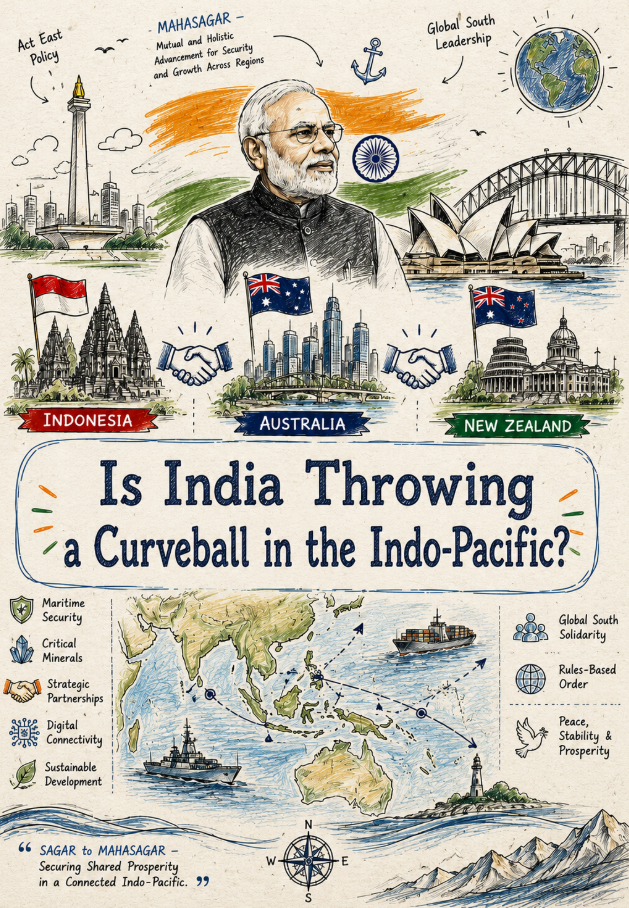
Between 6 and 11 July 2026, Prime Minister Narendra Modi undertook a six-day, three-nation tour of Indonesia, Australia and New Zealand his most consequential Indo-Pacific outreach since assuming office for a third term. Officially framed as an extension of India’s Act East Policy and its newer MAHASAGAR (Mutual and Holistic Advancement for Security and Growth Across Regions) vision, the visit resulted in nearly 55 agreements spanning defence, maritime security, critical minerals, clean energy, trade, education, technology and cultural cooperation. The three destinations represented distinct yet complementary pillars of India’s evolving Indo-Pacific strategy: Indonesia as ASEAN’s largest economy and a leading Global South partner; Australia as a critical strategic, technological and resource partner in the Quad; and New Zealand as an increasingly important Pacific democracy with which India sought to revive high-level political engagement after more than four decades.
The significance of the tour, however, extends far beyond the agreements signed. It must be understood as part of a much broader diplomatic trajectory that has unfolded over the past year. Prior to this Indo-Pacific outreach, Prime Minister Modi had undertaken an intensive series of visits across Europe including France, Slovakia, the Netherlands, Sweden, Norway and Italy followed by engagements in the United Arab Emirates and Seychelles. Viewed collectively rather than in isolation, these visits reveal a coherent strategic design that stretches from continental Europe through the Middle East and the Indian Ocean to Southeast Asia and the Pacific.
This emerging diplomatic arc reflects a fundamental evolution in India’s foreign policy. Rather than pursuing conventional bilateral diplomacy centred on isolated partnerships, New Delhi is increasingly constructing an interconnected network of strategic relationships across multiple theatres. The objective is neither alliance formation nor bloc politics; instead, it is the creation of diversified political, economic and technological partnerships that enhance India’s strategic autonomy while reducing excessive dependence on any single power centre.
Europe has become central to this strategy not merely as a political partner but as a source of advanced technologies, defence industrial collaboration, green transition financing and resilient supply chains. France anchors India’s strategic partnership in defence, space and the Indo-Pacific, while countries such as the Netherlands, Sweden, Norway, Italy and Slovakia contribute to India’s ambitions in semiconductors, advanced manufacturing, clean energy, critical technologies and industrial innovation. Simultaneously, the United Arab Emirates has emerged as India’s principal economic gateway to West Asia, facilitating investment flows, energy security, logistics integration and the broader India–Middle East–Europe Economic Corridor (IMEC), which seeks to reshape Eurasian connectivity.
Further south, Seychelles reinforces India’s maritime security architecture under the SAGAR doctrine by strengthening surveillance, maritime domain awareness and Indian Ocean cooperation. The subsequent visits to Indonesia, Australia and New Zealand complete this broader strategic geography by extending India’s engagement across Southeast Asia and the wider Indo-Pacific. Indonesia occupies a pivotal position astride critical maritime chokepoints while serving as ASEAN’s largest economy and an influential voice of the Global South. Australia contributes indispensable critical minerals, advanced defence cooperation and Quad-based strategic coordination. New Zealand, although smaller in economic scale, represents India’s renewed outreach to the Pacific and reflects New Delhi’s determination to engage every component of the emerging Indo-Pacific architecture.
The timing of the Indo-Pacific tour further underscores its geopolitical significance. It commenced immediately after China conducted a submarine-launched long-range ballistic missile test into the Pacific, unfolded amid growing uncertainty regarding the future trajectory of United States regional commitments and the evolving role of the Quad, and preceded India’s hosting of the BRICS Summit in New Delhi in September 2026. These developments collectively point towards an increasingly fluid strategic environment characterised by intensifying great-power competition, fragmented supply chains, technological rivalry and contested maritime spaces.
Against this backdrop, the three-nation tour illustrates a deliberate recalibration of Indian statecraft. Rather than responding reactively to geopolitical uncertainty, India is proactively constructing what may be described as an extended strategic corridor connecting Europe, the Middle East, the Indian Ocean and the Indo-Pacific. This approach seeks to integrate trade, connectivity, defence cooperation, critical mineral partnerships, technological collaboration and maritime security into a single strategic framework.
Underlying this diplomatic activism is a larger national objective: positioning India as an indispensable bridge power linking major geopolitical theatres while preserving strategic autonomy. Instead of aligning exclusively with any one bloc, New Delhi is deepening relations simultaneously with Europe, the Gulf, ASEAN, Pacific democracies, Africa and the Global South. In doing so, India is gradually transforming its foreign policy from one primarily concerned with balancing great powers into one focused on shaping the political, economic and institutional architecture of the emerging multipolar order.
The Indonesia–Australia–New Zealand tour therefore should not be viewed merely as a sequence of bilateral engagements. It represents another critical building block in India’s long-term strategy to emerge as a central economic, technological, maritime and diplomatic hub connecting the Atlantic-facing economies of Europe, the energy and logistics networks of West Asia, the security architecture of the Indian Ocean and the dynamic growth centres of the Indo-Pacific. As such, it marks an important milestone in India’s transition from a regional balancing power to a globally networked strategic actor capable of influencing the evolving international order.
Context: Why This Tour, Why Now
Three structural shifts set the backdrop:
- China’s assertiveness. On 6 July, the day Modi landed in Jakarta, China’s navy test-launched a nuclear-submarine-fired ballistic missile into international waters — only the second such test in recent years. Canberra and Wellington both criticised it publicly, and it hung over every subsequent stop of the tour.
- A wobbling US-led order. The Trump administration has renamed the US Indo-Pacific Command back to “Pacific Command,” skipped India’s planned Quad Leaders’ Summit, floated a transactional “G2” approach to China, and pressed allies to shoulder more of their own security and trade burdens. Analysts describe this as pushing the Quad “to the brink,” with leader-level summits now likely folded into other multilateral gatherings rather than held as standalone annual events.
- A regional “lattice” of middle-power pacts. In the same window, Australia signed the “Vuvale Union” mutual-defence treaty with Fiji, and an Australia–Fiji “Ocean of Peace” pact emerged with New Zealand indicating it may join — evidence that Pacific and Indo-Pacific states are increasingly building overlapping bilateral and mini-lateral arrangements rather than waiting on a single overarching alliance structure. New Zealand’s Christopher Luxon explicitly described this pattern as an emerging “mini-latticework.”
India’s tour fits squarely into this lattice logic: rather than a formal alliance, New Delhi is stitching together a web of comprehensive strategic partnerships, defence-export relationships and critical-minerals arrangements that let it hedge across Washington, Beijing and everyone in between.
Leg I — Indonesia (6–8 July): Anchoring the Western Pacific Gateway
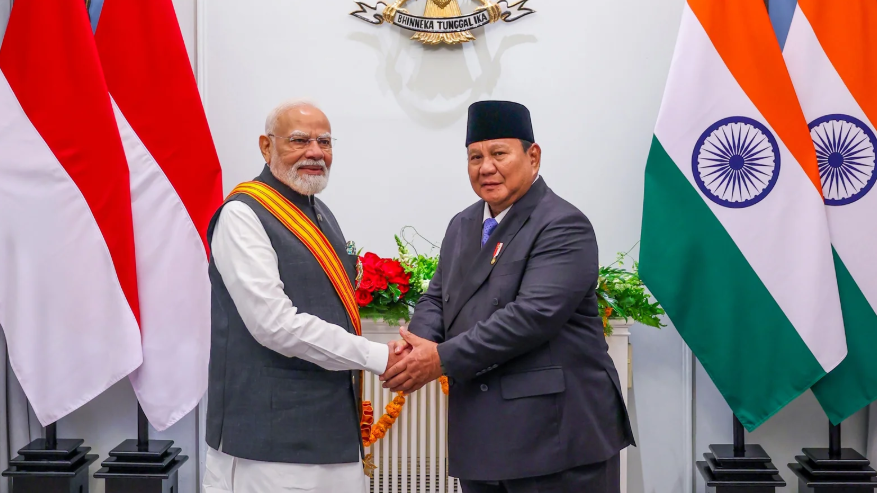
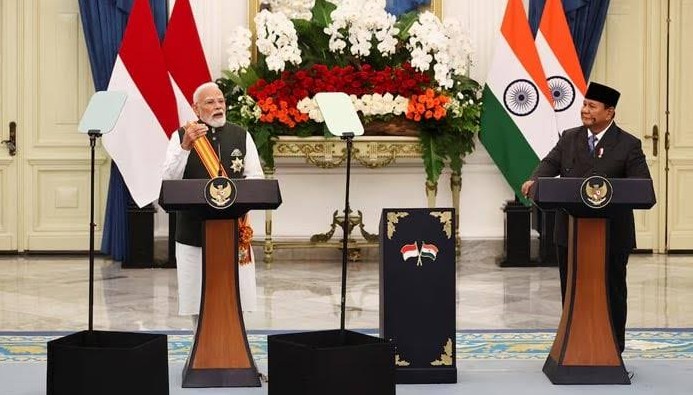
This was Modi’s fourth visit to Indonesia but his first bilateral summit with President Prabowo Subianto, and the first since the two countries elevated ties to a Comprehensive Strategic Partnership in 2018. Modi received a ceremonial fighter-jet escort into Indonesian airspace, a state welcome at Merdeka Palace, and was awarded the Bintang Adipurna, Indonesia’s highest civilian honour. He also became only the third foreign head of government to address Indonesia’s House of Representatives.
Key outcomes (~20 agreements):
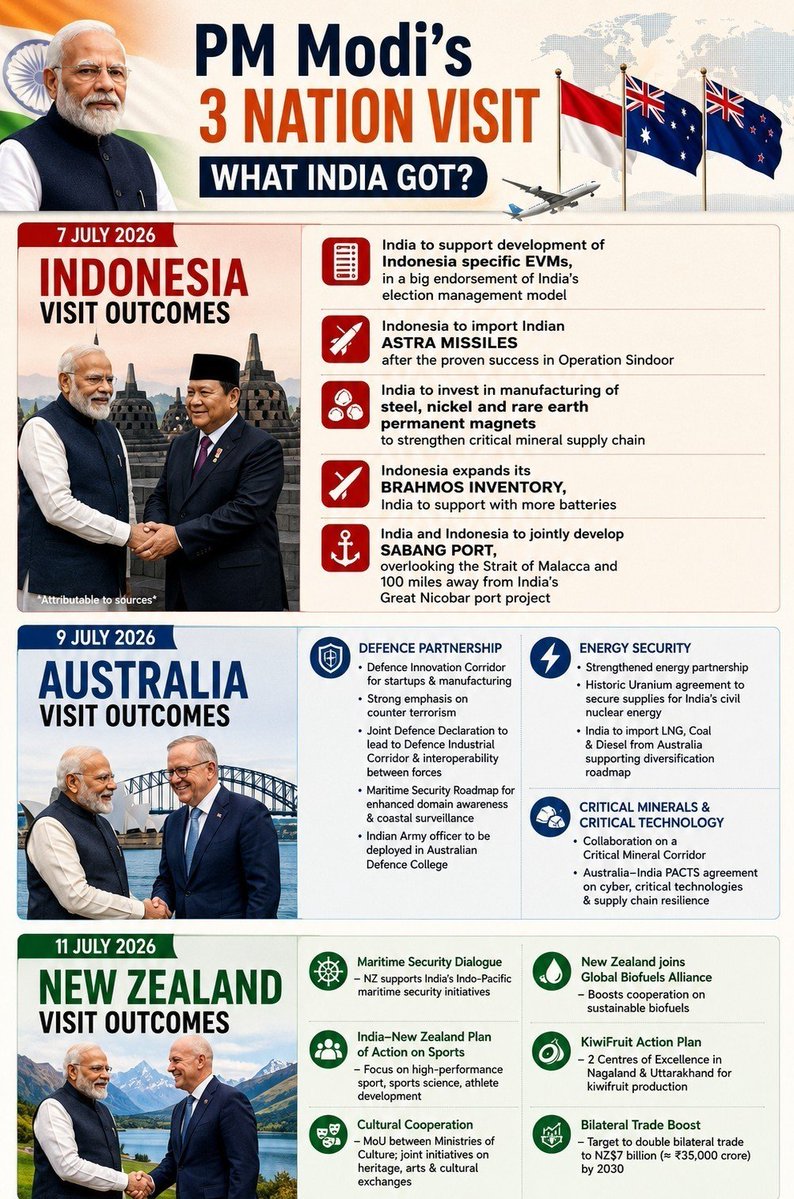
- Defence breakthrough: Indonesia agreed to procure India’s BrahMos supersonic cruise missiles and Astra air-to-air missiles in a deal worth over $600 million; ending nearly a decade of Indonesian hesitation rooted in fear of provoking Beijing. This follows earlier BrahMos sales to the Philippines and Vietnam, reinforcing India’s emergence as a credible mid-tier defence exporter in Southeast Asia.
- Maritime and port cooperation: The two sides revived long-stalled plans to jointly develop Sabang Port on the northern tip of Sumatra roughly 160 km from India’s own Great Nicobar trans-shipment port project and overlooking the entrance to the Strait of Malacca. Coast guard cooperation, maritime domain awareness and search-and-rescue coordination were also expanded.
- Critical minerals and industry: Cooperation on rare-earth magnets and critical minerals, plus a plan for India’s SAIL to help set up a stainless-steel slab facility in Indonesia.
- Digital and financial links: Local-currency settlement arrangements between the RBI and Bank Indonesia, and integration of India’s UPI with Indonesia’s QRIS payment system, alongside support for an Indonesian ONDC-style digital-commerce platform (“ION”).
- Trade push: Both leaders called for early conclusion of the long-pending ASEAN-India Trade in Goods Agreement (AITIGA) review.
- Cultural diplomacy: A joint restoration project for the Prambanan Temple complex in Yogyakarta, and the declaration of 2026–27 as the “Tagore–Dewantara Year” of educational and cultural exchange.
Bilateral trade stands at roughly $25 billion, with over 100 Indian companies already established in Indonesia. Modi explicitly cast the relationship in Global South terms, thanking Jakarta for solidarity after the Pahalgam terror attack, invoking shared advocacy for UN Security Council reform, and noting Indonesia’s recent accession to BRICS (of which India holds the 2026 chair).
Leg II — Australia (8–10 July): From Trade Partner to “Top-Tier Security Partner”
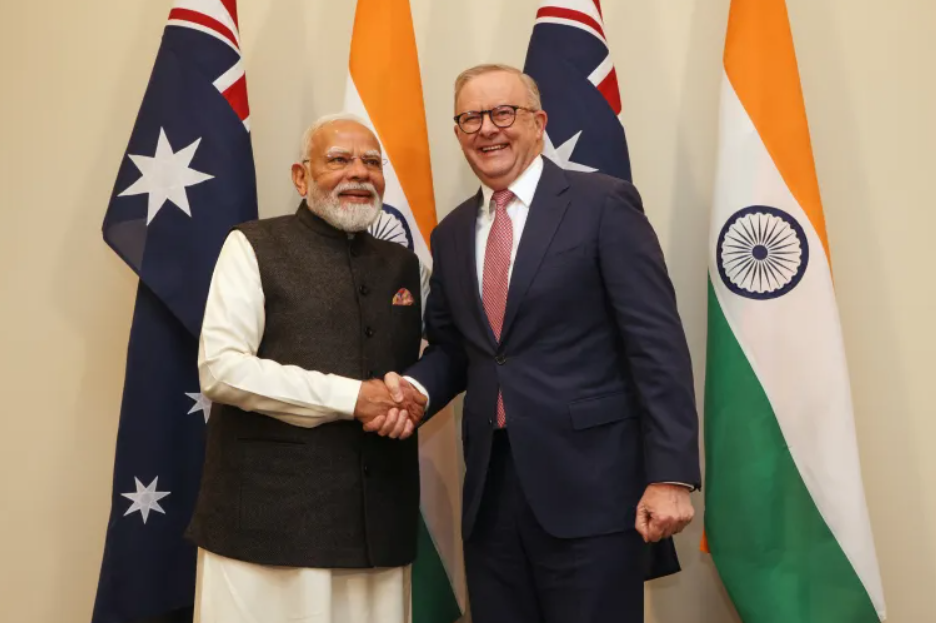
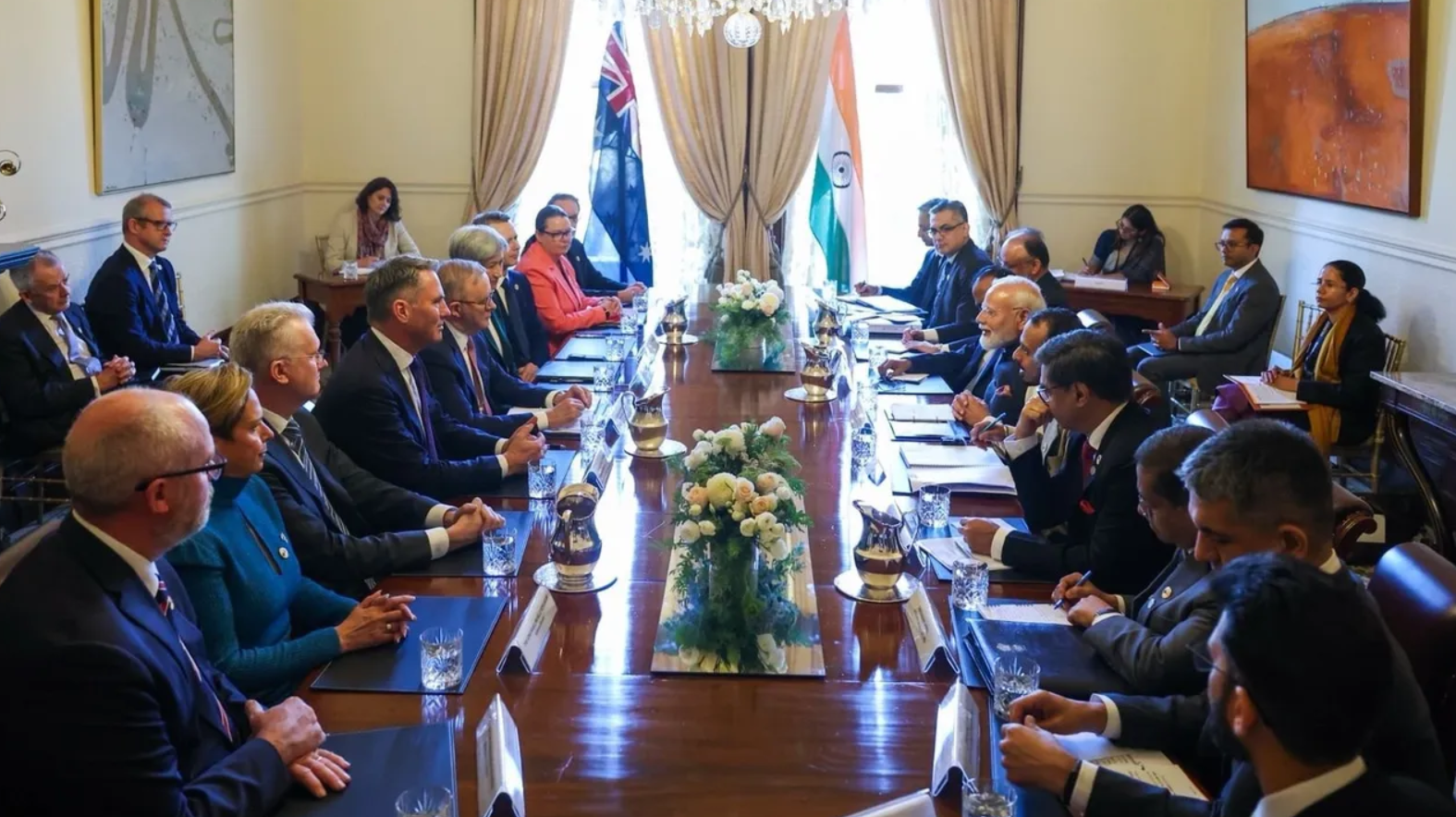
Modi’s Melbourne stop centred on the 3rd India-Australia Annual Summit, marking six years since the Comprehensive Strategic Partnership was launched. It produced 18 outcomes, the most strategically significant tour leg in security terms.
Key outcomes:
- Uranium, finally operationalised: Australia and India finalised the administrative arrangement under their 2015 Civil Nuclear Cooperation Agreement, unlocking Australian uranium exports for India’s civilian nuclear programme after a decade of delay linked to India’s non-NPT status. Canberra cited India’s clean IAEA safeguards record and Quad membership as the deciding factors. This directly supports India’s ambition to scale nuclear capacity toward 100 GW by 2047 under its “Viksit Bharat” roadmap.
- Critical Minerals Corridor: A dedicated India-Australia framework targeting 24 shared-priority minerals (lithium, cobalt, nickel, graphite, gallium, rare earths). Australia supplies roughly 52% of global lithium output and holds 21 of the 49 minerals India has designated critical, a direct hedge against China’s dominance of rare-earth processing (roughly 70% of mining and 85–90% of processing capacity globally).
- Defence architecture: A new Joint Declaration on Defence and Security Cooperation (renewing a 2009 pact), an Annual Defence Ministers’ Dialogue, and a Joint Maritime Security Collaboration Roadmap covering undersea domain awareness.
- PACTS: The Australia-India Partnership for Cyber, Critical Technologies and Supply Chains became operational, aimed at building resilient supply chains and joint capability in digital/cyber security.
- Trade acceleration: Both leaders directed officials to fast-track the long-negotiated Comprehensive Economic Cooperation Agreement (CECA), the successor to the 2022 Economic Cooperation and Trade Agreement (ECTA). India’s trade deficit with Australia has narrowed to about $6.5 billion in FY2026 as exports grow faster than imports.
- People-to-people and cultural gestures: Australia returned several looted Tamil Nadu artefacts (a Nandi sculpture, a Bhadrakali trident, a Kartikeya statue); new education tie-ups included Victoria University’s approval to open a campus in Gurugram and a planned Flinders University campus in Bengaluru.
The “Melbourne Meets Modi” community event at Marvel Stadium drew roughly 30,000 people described as the largest gathering of Indian-Australians in the country’s history, reflecting a diaspora that at 971,000 India-born residents is now Australia’s single largest foreign-born group.
This leg also carried real friction, discussed in Section 9 below visible protests, both from Sikh separatist/Khalistan-linked groups objecting to Modi’s human-rights record and from far-right, anti-immigration demonstrators objecting to the scale of Indian migration itself.
Leg III — New Zealand (10–11 July): Ending a 40-Year Wait
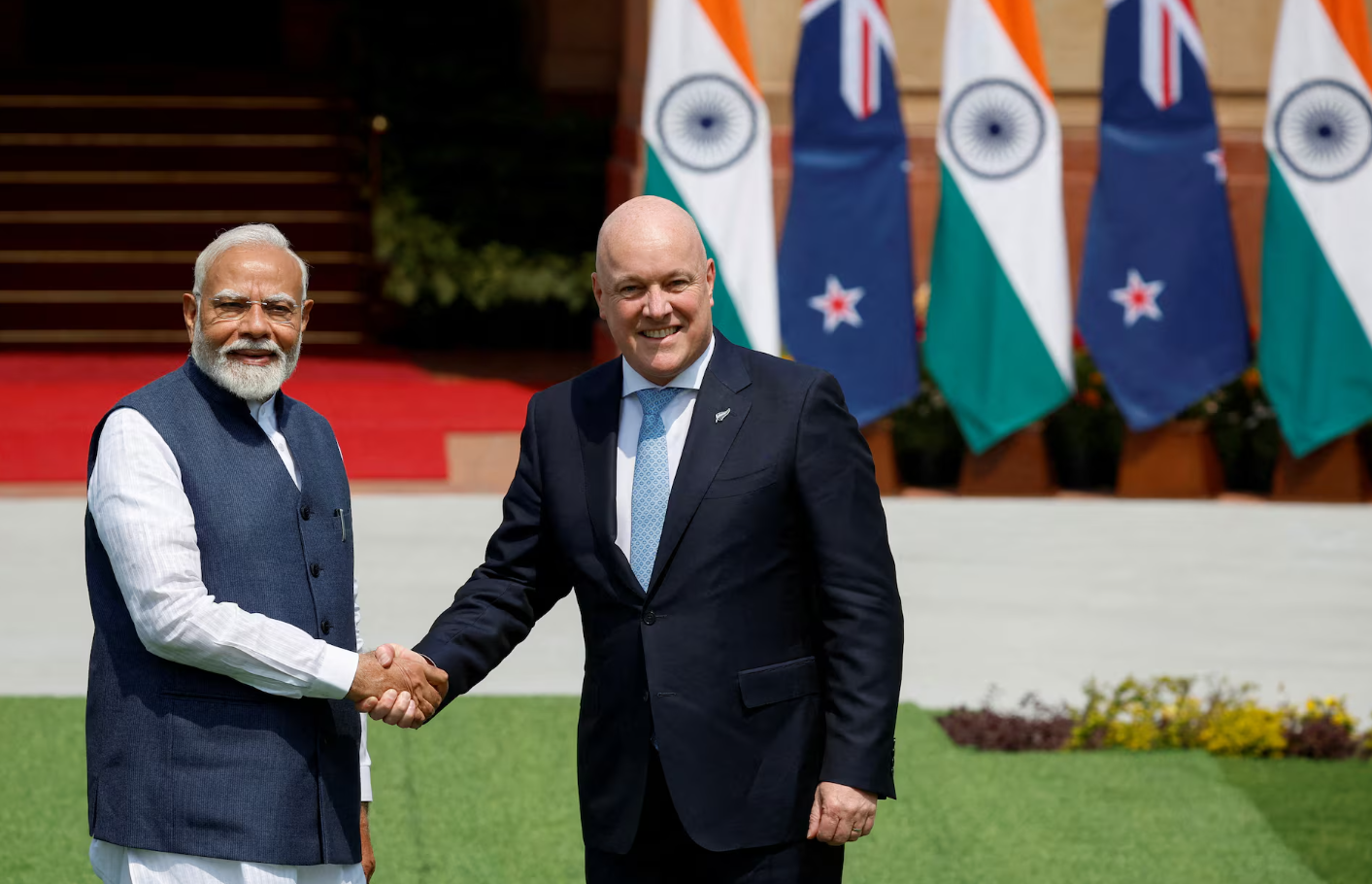
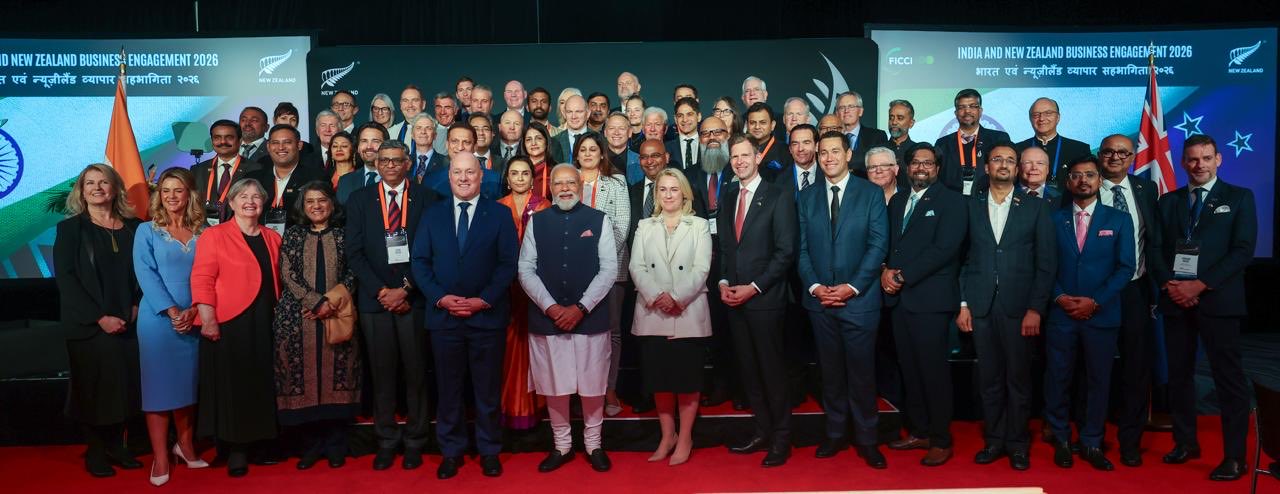
The final and shortest leg carried outsized symbolic weight: it was the first visit by an Indian prime minister to New Zealand in four decades. Modi and Luxon used it to elevate the relationship from a primarily economic one to a full Strategic Partnership, unveiling a “Roadmap to 2030” spanning trade, defence, maritime security, counter-terrorism, agriculture, education and emerging technology.
Key outcomes:
- Building on the newly concluded India-New Zealand Free Trade Agreement, both sides set a target of doubling bilateral trade to NZ$7 billion by 2030 (current trade stands at roughly $2.25 billion).
- The FTA includes a US$20 billion investment commitment from New Zealand firms into India over 15 years, near-total tariff elimination on Indian exports, and duty-free access for 95% of current NZ exports to India (57% duty-free immediately).
- Modi pitched India directly to New Zealand investors as “not just a market… a launchpad for global growth,” highlighting the PLI manufacturing scheme and India’s digital and space sectors.
- New Zealand is home to over 300,000 people of Indian origin (~5% of the population) a diaspora both leaders cited as a strategic asset.
The political undercurrent. Unlike the Indonesia and Australia legs, this one landed amid live domestic controversy. New Zealand First leader and Foreign Minister Winston Peters has repeatedly and publicly criticised the FTA as “neither free nor fair,” objecting to immigration concessions (including a dedicated employment visa track for Indian citizens) and the exclusion of core dairy products from market access, even while remaining, in the coalition’s words, in “agree to disagree” territory with National and ACT, who back the deal. The bill passed its first reading 93–29 with National, ACT and Labour in support and NZ First opposed. Peters was notably out of the country during part of Modi’s visit, drawing local media commentary about his absence given his role as Foreign Minister. This dynamic is a reminder that even India’s most warmly received Indo-Pacific partnerships face genuine, unresolved domestic political contestation not simply diplomatic pageantry.
Geopolitical Significance
- The China Factor: Every leg of the tour unfolded in China’s shadow. Beijing’s ballistic-missile test on the eve of the trip, its dominance of rare-earth processing, its growing naval reach, and its deepening footprint in the Pacific Islands all form the implicit backdrop against which India, Indonesia, Australia and New Zealand are recalibrating. Notably, none of the agreements signed are explicitly anti-China in language — India, Indonesia and New Zealand in particular were careful to frame cooperation as inclusive and “non-confrontational.” As Luxon put it, the approach is to “cooperate where we can, differ where we must.” This mirrors India’s own strategic posture: building resilience and diversifying dependencies rather than pursuing overt containment — a stance analysts have called constructing an “arc of trust” across the Indo-Pacific.
- The Quad in Flux and the US Question: The tour also has to be read against a weakening — or at least more improvised — Quad. India’s planned 2024–25 Quad Leaders’ Summit in New Delhi was repeatedly postponed; President Trump skipped it outright, reportedly for both policy reasons (an unresolved US-India trade deal, tariff disputes) and personal ones (friction over India-Pakistan mediation claims); and the US has since renamed its Indo-Pacific Command back to “Pacific Command” while reportedly weighing a more transactional relationship with Beijing. Quad Foreign Ministers still met in New Delhi in May 2026 and unveiled new initiatives (a Critical Minerals Framework, an Indo-Pacific Maritime Surveillance Collaboration effort, an energy-security initiative) — so the grouping remains functionally alive at the working level even as leader-level momentum has stalled. India’s response has been to deepen bilateral ties with Quad partners (Australia) and non-Quad partners alike (Indonesia, New Zealand) so that its Indo-Pacific strategy does not hinge on Washington’s variable enthusiasm. Indian officials have been careful, however, to ensure this outreach is not read as a pivot away from the US, especially after informal security assurances reportedly exchanged between Modi and Trump at the G7 in Évian-les-Bains in June 2026.
- MAHASAGAR and Act East, Operationalised: The tour is the clearest practical expression yet of the MAHASAGAR vision articulated by Modi — extending the Indian Ocean-focused “SAGAR” (Security and Growth for All in the Region) doctrine outward into the wider Pacific. Paired with a recent visit to Seychelles (Western Indian Ocean) and meetings with Japan’s PM Sanae Takaichi in New Delhi shortly before departure, the Indonesia-Australia-New Zealand trip effectively completes an eastern arc — signalling that India’s maritime strategy now spans from the western Indian Ocean littoral through Southeast Asia and into the South Pacific, independent of any single external power’s blessing.
- A New Regional Security Lattice: The tour coincided with and is best understood alongside a broader wave of middle-power security pacts: Australia’s “Vuvale Union” mutual-defence treaty with Fiji, the Australia-Fiji “Ocean of Peace” framework (which New Zealand has signalled interest in joining), and reported 2026 Jakarta-Canberra defence cooperation. None of these individually rivals a formal alliance, but collectively they represent exactly the kind of “mini-latticework” Luxon described — multiple overlapping bilateral security relationships that, in aggregate, provide much of the deterrent and reassurance value of a bloc without its rigidity. India’s BrahMos sale to Indonesia and its deepening maritime-security work with Australia and New Zealand are threads in this same fabric.
Geoeconomic Significance
- Critical Minerals and Energy Security: The most consequential economic thread running through all three stops is supply-chain diversification away from China. India imported roughly 12.47 million tonnes of critical minerals in FY2024-25 and remains fully import-dependent for lithium, cobalt and nickel — inputs essential to its electric-vehicle targets (30% of new sales by 2030) and semiconductor ambitions. With China controlling around 70% of rare-earth mining and 85–90% of processing capacity worldwide, India’s agreements with Australia (24 shared-priority minerals, a dedicated Critical Minerals Corridor) and Indonesia (rare-earth magnets, nickel — Indonesia holds the world’s largest nickel reserves) are direct hedges against that concentration risk. The Australian uranium deal adds a parallel energy-security dimension, feeding directly into India’s civil nuclear expansion plans.
- Defence Exports as Economic Statecraft: The $600 million BrahMos/Astra sale to Indonesia is as much an economic story as a strategic one: it cements India’s transition from defence importer to credible mid-tier exporter, following earlier missile-package sales to the Philippines and Vietnam. For India’s domestic defence-manufacturing base (a core pillar of “Make in India” and Atmanirbhar Bharat), such exports validate indigenous platforms commercially while generating revenue and industrial scale.
- Trade Architecture: Three Different Tracks: India is running three parallel tracks — with Indonesia, no bilateral FTA yet, relying instead on the ASEAN-India Trade in Goods Agreement (AITIGA), now under review and pushed toward early conclusion, alongside sectoral MoUs in steel, agriculture and digital trade; with Australia, the 2022 ECTA is already in force (duty-free access for all Indian exports since January 2026) and is now being fast-tracked into a fuller CECA covering services, investment and processed minerals; and with New Zealand, a newly concluded bilateral FTA is entering its implementation phase, targeting NZ$7 billion in bilateral trade by 2030, though it remains politically contested domestically.
Notably, India is pursuing three distinct trade tracks simultaneously; a regional bloc-level agreement with Indonesia/ASEAN, a comprehensive bilateral upgrade with Australia, and a freshly signed but politically contested FTA with New Zealand. This reflects New Delhi’s broader 2025-26 pattern of parallel trade diplomacy (an EU FTA was also concluded in this period), suggesting economic diversification has become as central to India’s foreign policy as strategic hedging.
The Unresolved Contradiction
Even as these three partnerships aim to reduce China-dependency, India’s own manufacturing and clean-energy sectors remain deeply reliant on Chinese inputs, machinery and rare-earth processing in the near term — and New Delhi is simultaneously and cautiously working to stabilise ties with Beijing. The tour therefore should be read as long-horizon diversification rather than an immediate decoupling; the economic benefits (mineral security, defence-export revenue, expanded trade access) will accrue over years, not months.
The Global South Dimension
This is where the tour’s significance extends beyond conventional Indo-Pacific security analysis.
Timing with India’s BRICS chair. India assumed the BRICS presidency on 1 January 2026 under the theme “Building for Resilience, Innovation, Cooperation and Sustainability,” and will host the 18th BRICS Summit in New Delhi on 12–13 September 2026 — with Indonesia (a BRICS member since 2025) and China’s and Russia’s leaders expected to attend. Modi and Prabowo explicitly referenced this, noting they will meet again at that summit, and Modi’s Jakarta remarks leaned heavily on shared “Global South” framing — invoking Non-Aligned Movement history (Bandung, the birthplace of NAM, sits in Indonesia) and joint calls for UN Security Council reform.
Indonesia as a Global South peer, not just a security partner. Analysts note India’s Indonesia outreach is explicitly about anchoring ties with “a key global south player” — a space where India and China both compete for leadership. Unlike India’s more fraught relationships elsewhere in South Asia (where anti-India sentiment has risen in some capitals), India is broadly well regarded across Southeast Asia and the Pacific, giving New Delhi more room to build genuine partnerships rather than merely balance rivals.
A dual-track diplomacy. India is simultaneously deepening security and economic ties with US-aligned democracies (Australia, and via the Quad) while chairing BRICS — a bloc whose founding members disagree on its very purpose (Brazil and India lean toward an economic-development framing; China and Russia push a more explicitly anti-Western, geopolitical one). India’s challenge, repeatedly flagged by analysts, is to keep BRICS a “reform-oriented,” “delivery-focused” platform rather than an anti-Western vehicle, even as it hosts Xi Jinping and Vladimir Putin in New Delhi just two months after this tour concludes. The Indo-Pacific trilogy therefore functions partly as a hedge and a signal: proof that India’s Global South leadership is not code for anti-Western alignment, and that New Delhi can hold both tables — Quad-adjacent security cooperation and BRICS chairmanship — at once.
A template for South-South-plus cooperation. The Indonesia leg in particular — local-currency settlement between the RBI and Bank Indonesia, UPI-QRIS digital-payment integration, an ONDC-style digital-commerce platform — offers a working example of the kind of practical, technocratic South-South economic integration India has been advocating for the wider BRICS/Global South agenda (as opposed to symbolic de-dollarisation rhetoric, which India has been comparatively cautious about).
In short, the tour lets India demonstrate to the Global South that its rise is not purely a story of alignment with Washington or Canberra, while simultaneously demonstrating to Washington and Canberra that its Global South leadership is compatible with, not hostile to, their own strategic interests. Threading that needle is precisely the “multi-alignment” doctrine India’s policymakers have pursued since 2014, now being tested on both fronts at once.
Frictions and Counter-Currents
A genuinely deep analysis has to register the parts of this trip that were not straightforward triumphs:
Muted regional media reception. Despite blanket, front-page coverage in India, the trip drew comparatively little attention in the Indonesian, Australian and New Zealand press — with Indonesian outlets running only brief agency copy on the BrahMos deal while devoting more space to unrelated domestic stories, and Australian outlets giving equal or greater prominence to an unrelated corruption story involving an Indian business figure. This gap between India’s self-perception of the trip’s importance and its actual salience in partner-country public discourse is itself a data point about the limits of India’s soft-power reach in these markets.
New Zealand’s FTA remains politically contested. As detailed in Section 5, Foreign Minister Winston Peters and NZ First continue to actively oppose the enabling legislation, centred on immigration concessions and dairy-market exclusions — meaning the “Strategic Partnership” announced during the visit sits atop an economic foundation (the FTA) that is not yet fully secured domestically.
Visible protests in Australia. The Melbourne leg drew both Khalistan-linked/Sikh-separatist protesters raising human-rights concerns and, separately, far-right, anti-immigration demonstrators objecting to the scale of Indian migration to Australia and to proposed “Little India” cultural precincts — including a heckling incident at Modi’s hotel. These are two distinct and not always compatible critiques (one about India’s domestic human-rights record, the other about Australian immigration politics), but both complicate the “rock star welcome” narrative and point to real diaspora-management challenges for both governments as Indian-origin populations become Australia’s largest foreign-born group.
The China-dependency paradox. As noted in 7.4, India’s own economy remains structurally reliant on Chinese inputs even as it signs mineral- and defence-diversification deals aimed at reducing exactly that reliance — a tension that will likely persist for years.
Quad ambiguity persists. None of the three legs produced a breakthrough on reviving Quad leader-level summitry; if anything, the tour’s bilateral emphasis underscores that India is hedging around Quad uncertainty rather than resolving it.
Strategic Assessment: What It Means Going Forward
For India: The tour operationalises a maturing foreign-policy doctrine — multi-alignment backed by concrete deliverables (missiles, uranium, minerals, FTAs) rather than declaratory summitry alone. It strengthens India’s claim to be a “net security provider” in the Indo-Pacific, diversifies critical-input and energy dependencies away from China, and sets up September’s BRICS summit by reinforcing India’s Global South credentials just before it hosts Xi and Putin. The risk is overstretch: sustaining defence-export commitments, critical-minerals partnerships and trade-agreement implementation across three (and, with Japan and Seychelles, five) fronts simultaneously will test institutional bandwidth.
For Indonesia: The BrahMos sale and Sabang Port revival mark Jakarta’s clearest tilt yet toward diversified defence procurement and away from single-supplier dependence, while preserving its traditional non-alignment instincts (the deals are framed as capability-building, not bloc alignment). Indonesia strengthens its position as ASEAN’s anchor state and a genuine Global South counterweight to China’s regional pull.
For Australia: The uranium and critical-minerals deals give Canberra a strategically important, values-aligned customer for resources it has in abundance, while the defence declarations deepen Quad-adjacent security cooperation. Domestically, Australia now has to manage a rapidly growing Indian-origin population (its largest migrant community) amid genuine social friction — a governance challenge as much as a diplomatic one.
For New Zealand: The visit — and the underlying FTA — represents Wellington’s most significant economic and strategic opening toward India in decades, but its durability depends on resolving the domestic political fight over the enabling legislation. If NZ First’s objections harden rather than fade, implementation risk could dilute the “historic” framing both leaders used.
For the Indo-Pacific and Global South more broadly: The tour is a live case study in how middle and rising powers are adapting to an unpredictable US posture — not by choosing a side, but by multiplying bilateral and mini-lateral ties that collectively approximate the stability a weakening Quad was meant to provide. Whether this “lattice” approach can substitute for a more formal architecture in a genuine crisis remains untested.
Conclusion
Modi’s July 2026 Indo-Pacific tour was less a single diplomatic event than a coordinated demonstration of where Indian foreign policy is heading: outward-facing, transactionally concrete (missiles, minerals, uranium, FTAs) rather than merely declaratory, and deliberately multi-directional — reinforcing security ties with a Quad partner (Australia), extending strategic depth with a fellow Global South heavyweight (Indonesia), and rebuilding a long-dormant Pacific relationship (New Zealand), all while positioning India to chair a China-and-Russia-inclusive BRICS summit two months later. Its geopolitical significance lies in showing that India can build meaningful Indo-Pacific ballast independent of Washington’s fluctuating enthusiasm; its geoeconomic significance lies in the critical-minerals and energy-security architecture it begins to put in place; and its Global South significance lies in demonstrating — to Jakarta, to BRICS partners, and to the wider developing world — that deepening ties with the West need not come at the cost of South-South leadership. Whether these threads hold together will depend less on the joint statements signed in July than on how faithfully they are implemented over the next several years, against the twin backdrops of Chinese assertiveness and unresolved domestic political friction in the very countries that hosted Modi so warmly.
*Editor, Focus Global Reporter