
Dr. Arvind Kumar*

India’s CSR landscape has grown significantly over the past decade, but its true potential will only be realised when it evolves from a compliance-driven spending exercise into an ESG-led demand driven framework focused on measurable, long-term impact. Integrating Environmental, Social and Governance (ESG) principles into CSR can make corporate investments more strategic, transparent, and accountable, particularly in addressing interconnected challenges such as water, climate, biodiversity, and livelihoods. It calls for demand-driven, location-specific interventions, robust impact measurement, independent evaluation, and stronger board-level oversight to ensure that CSR not only fulfils statutory obligations but also creates lasting value for communities, businesses, and the nation.
For over a decade, Corporate Social Responsibility (CSR) in India has expanded in scale, but much of it has remained detached from core business strategy often perceived as a statutory obligation under Section 135 of the Companies Act rather than a driver of long-term value. While companies have focused on how much they spend, the more fundamental question is whether those investments create measurable and lasting impact? This is precisely where Environmental, Social and Governance (ESG) principles redefine the conversation by shifting the focus from expenditure to outcomes, accountability, and governance. As Sanda Ojiambo, Assistant Secretary-General and CEO of the UN Global Compact – the world’s largest corporate sustainability platform aptly observed, “ESG is not only about doing good, it is simply good business sense.” Her statement underscores a critical reality: CSR in India can only evolve into a credible instrument of public trust when it is disciplined, structured, measurable, and firmly anchored in ESG.
The scale, and its limits
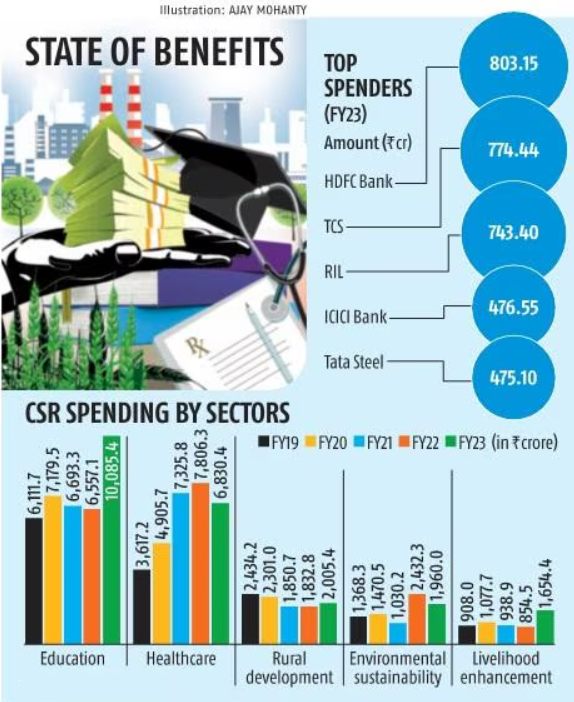
The stakes are no longer marginal. Corporate India’s CSR spending touched a record Rs 40,794 crore in FY 2024-25, up 17% year-on-year, pushing the decade’s cumulative investment past Rs 2.61 lakh crore across 72,233 projects and roughly 29,546 companies. From Rs 10,065 crore in FY 2014-15, spending has grown almost fourfold, and the law now recognises 28 distinct development sectors under Schedule VII. This is serious capital, moving at serious scale.
Yet its composition exposes exactly the imbalance ESG exists to correct. Education (Rs 13,877 crore, 34% of the total) and healthcare (Rs 8,531 crore, 21%) still dominate; environmental sustainability, though growing fastest at 40% year-on-year, remains just Rs 3,397 crore — about 8% of the total. Narrow this to water specifically, and the urgency sharpens. Ministry of Corporate Affairs data suggests Indian companies collectively spend only Rs 7,000-10,000 crore a year on water, sanitation and environmental work combined — 10-12% of total CSR — against a public Jal Jeevan Mission outlay of roughly Rs 3.6 lakh crore, with central budget allocations for drinking water and sanitation climbing from around Rs 20,000 crore in FY20 to over Rs 70,000 crore by FY 2025-26. In a country where 40% of districts already face some degree of water stress, corporate capital remains a supplementary trickle beside the public river.
This matters because water, climate, biodiversity and livelihood are not separate ledger lines they are one system. The IPBES Nexus Assessment, approved by 147 countries in December 2024, concluded that biodiversity, water, food, health and climate are so tightly interlinked that addressing one in isolation routinely damages another; a systematic review of India’s own food-water-biodiversity nexus mapped over 200 such linkages, with biodiversity carrying the highest number of interdependencies. A borewell scheme that ignores watershed recharge, or an afforestation drive that ignores local livelihoods, doesn’t solve a problem, it relocates it. Which is exactly why CSR must stop being a menu of standardised, headquarters-designed projects and become genuinely demand-driven: shaped by what a specific watershed, coastline or drought belt actually needs, through real community needs-assessment rather than a template copy-pasted across geographies.
Challenges
The gaps are well documented. Over 70% of CSR funds concentrate in five or six industrialised states; Gujarat’s CSR spending rose 68% in a single year against a national average of 17%, while remote and disaster-prone regions receive a fraction. Unspent CSR funds hit a five-year high of Rs 1,475 crore in FY23, with nearly a fifth of companies under-spending their statutory obligation. Academic reviews of public-sector CSR describe a pattern of “disguised voluntarism” formal compliance without real accountability and India’s own Parliamentary Committee, reporting this January, called for impact-based disclosure instead of spend-based reporting, transparent public tracking of unspent funds, and independent ESG oversight built into board governance.
This is where ESG stops being a reporting exercise and becomes the operating logic CSR has always lacked. A CSR project without ESG discipline can report expenditure; one built on ESG principles must report outcomes emissions avoided, litres of water recharged, livelihoods sustained beyond the funding cycle and answer for them at board level, not merely to a compliance officer. That is the transformation ESG offers: converting goodwill into a governed, measurable, financially accountable system, which is precisely what public trust demands before it extends credit to corporate claims.
India already has the scaffolding for this. SEBI’s Business Responsibility and Sustainability Reporting (BRSR) framework, mandatory since FY 2022-23 for the top 1,000 listed companies by market capitalisation, requires disclosure across roughly 140 parameters spanning environmental, social and governance performance, built on the National Guidelines on Responsible Business Conduct and aligned with global benchmarks like GRI and TCFD. BRSR Core, introduced in 2023, narrows this to 49 assured indicators; emissions intensity, renewable energy share, water use, gender diversity with third-party assessment being phased in from the top 150 companies toward all 1,000 by FY 2026-27, alongside value-chain disclosures. To stay in step with where global practice is heading, the EU’s Corporate Sustainability Reporting Directive now governs roughly 50,000 companies on a double-materiality standard, and the ISSB’s global baseline is being adopted from the UK to Singapore- Indian compliance cannot remain a box-ticking exercise. Hindustan Unilever and ITC, which now run zero-liquid-discharge plants recycling their entire process water, or Mahindra, Infosys and Tata Steel, which have adopted internal carbon pricing inside real capital-allocation decisions, show what ESG-led CSR looks like when it is operational rather than cosmetic.
The way forward
Three shifts would close this gap. First, genuinely demand-driven design, with baseline surveys and community consultation preceding project sanction rather than following it. Second, geography- and hazard-specific tailoring: Himalayan watershed and glacial-lake risk demands different CSR instruments than coastal cyclone resilience or peninsular drought-proofing, and disaster-linked CSR should shift from post-event relief toward anticipatory resilience, which studies suggest returns roughly five times its cost in avoided losses. Third, hard accountability; third-party assessment, publicly available impact data, and ESG oversight embedded in board governance rather than appended to it as an afterthought.
A stepping stone toward this already exists. Following the second edition of WTGA&C 2026, themed “ESG Transversality for a Sustainable Water, Energy, Health, and Environment Nexus,” the India Water Foundation, together with SEBI, has drafted guidelines that move in precisely this direction aligning ESG not as parallel, sector-siloed compliance tracks but through a transversal lens that treats water, energy, health, and environment as interlocking systems. If CSR frameworks take their cue from this template, the hazard-specific tailoring and cross-domain accountability that disaster-linked CSR needs would shift from aspiration to institutional design.
CSR built on ESG’s language but not its discipline is a trust liability waiting to surface. CSR built on ESG’s actual discipline remains India’s best available route to converting corporate capital into public confidence.
*Editor, Focus Global Reporter