Dr. Arvind Kumar*

Strikes, a fragile ceasefire, renewed strikes, and yet more diplomacy—this has become the defining rhythm of contemporary geopolitics. The real story is no longer that wars erupt, but that they persist because conflict increasingly functions as an industry with its own supply chains, beneficiaries and commercial incentives, while the economic costs are borne largely by the Global South. The Gulf has just demonstrated this reality though disrupted global shipping and economies. As similar anxieties spread towards the Strait of Malacca and the Taiwan Strait, a deeper question emerges: have wars become structural features of the global economy that keep developing nations vulnerable, reinforcing a system in which the Global North continues to shape the terms of growth while the Global South repeatedly pays the price?
The numbers suggest precisely that. The Stockholm International Peace Research Institute recorded a record US$679 billion in revenue for the world’s hundred largest arms manufacturers in 2025. The Quincy Institute has tracked US$2.4 trillion in Pentagon contracts flowing to private firms between 2020 and 2024, with Lockheed Martin alone reporting an order backlog approaching US$194 billion. Conflict has become an ecosystem whose profits are measurable long before peace dividends are. Alongside the formal defence industry operates an equally lucrative shadow economy. Contraband has become the informal wing of modern warfare. Claire Jungman, Director of Maritime Risk Intelligence at Vortexa, tracked “dark” tankers, vessels operating without transponders, verified flags or accountable ownership accounting for more than half of all traffic through Hormuz during the recent crisis, peaking above sixty-five percent in May. Built originally to transport sanctioned Russian and Iranian oil, this shadow fleet now functions as a parallel maritime economy that thrives precisely when legitimate commerce is paralysed. Every disruption to legal trade simultaneously creates opportunities for illicit networks, making instability itself commercially valuable.
Economics of Dependence
As Shashi Tharoor has recently argued, the post-war rules-based international order is no longer as stable or as universally accepted as it once appeared. This transformation is unfolding alongside an accelerating climate crisis, making geopolitical instability even more consequential. Western and Central Europe have just recorded their hottest June on record. Climate change does not carry a passport. It manifests wherever atmospheric conditions permit, irrespective of where the emissions that caused it originated. The IEA projects global electricity demand to grow by an average 3.6 percent annually through 2030, roughly fifty percent faster than during the previous decade, driven by cooling requirements, data centres and rapid electrification. Climate change is increasing demand exactly as geopolitical instability threatens supply. Hormuz has already demonstrated the risks; Malacca and the Taiwan Strait now invite similar concerns among naval planners because global trade still depends upon maritime chokepoints designed without meaningful redundancy or a stable regional balance of power. The consequences are borne disproportionately by the developing world. Mature, financialised economies in the Global North no longer rely upon expanding industrial production in the same manner as rapidly developing economies.
Development economist Jayati Ghosh, now serving on a Vatican-convened commission on sovereign debt, has spent years documenting how the architecture of global finance keeps developing countries borrowing on terms they never determine themselves. Ha-Joon Chang has similarly argued that today’s advanced economies relied heavily upon tariffs and state protection during their own industrialisation before discouraging those very policies elsewhere. Seen through that lens, conflict around the world’s principal energy arteries inevitably raises uncomfortable questions. The International Monetary Fund’s April 2026 outlook illustrates that vulnerability. India slipped from the world’s 3rd-largest economy to sixth, behind the United Kingdom and Japan not because its economy stopped growing, but because an eleven percent depreciation of the rupee and a technical GDP base-year revision affected nominal rankings even while real growth remained 6.5 percent, the fastest among major economies. The decline is real, but it is largely arithmetic rather than evidence of economic failure.
The same asymmetry extends beyond finance and trade into climate responsibility. Research on trade-embodied emissions suggests that wealthy economies have effectively exported a substantial share of their carbon footprint to developing countries by relocating manufacturing while continuing to consume the goods produced there. The Global South thus bears a double burden: sustaining global manufacturing while simultaneously absorbing a disproportionate share of the environmental and developmental costs.
Strategic Diversification
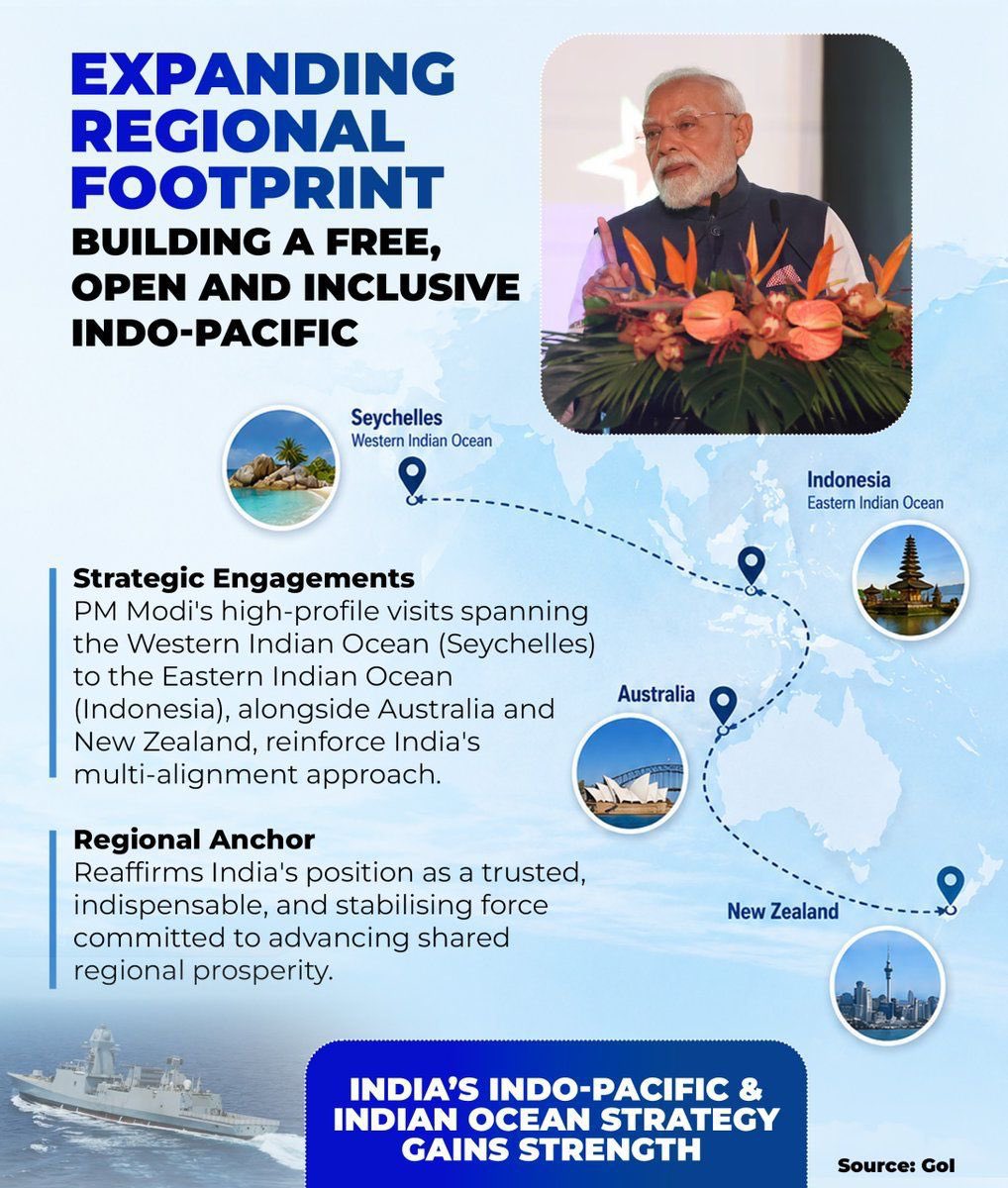
It is against this backdrop that Prime Minister Narendra Modi’s unusually intensive diplomatic itinerary between mid-May and mid-July assumes greater strategic significance. The sequence itself is instructive. Abu Dhabi came first, in mid-May, while uncertainty over the Strait of Hormuz remained acute. Energy cooperation with the United Arab Emirates consequently appeared less like routine diplomacy than an insurance policy against prolonged instability in the Gulf. The focus then shifted towards Europe through visits to the Netherlands, Sweden, Norway and Italy—a five-nation engagement centred on semiconductors, green hydrogen, defence cooperation and the newly concluded India-European Union trade agreement. France and Slovakia followed in June, further diversifying India’s strategic and industrial partnerships beyond its traditional dependence on any single geography. By the end of June, the emphasis had moved decisively towards maritime security. In Seychelles, Modi became the first Indian Prime Minister to address the National Assembly, advancing MAHASAGAR, India’s expanded maritime doctrine for the Indian Ocean. And most recently through Indonesia, Australia and New Zealand under the Act East policy framework, culminating in the first Indian prime ministerial state visit to New Zealand in four decades. Considered collectively, these engagements reveal a consistent strategic objective: creating redundancy across India’s energy supplies, maritime partnerships, technology ecosystems and trade corridors so that no single geopolitical chokepoint can dictate the country’s economic trajectory.
Washington’s own posture only sharpened this evolving strategic landscape, the Pentagon quietly renamed the US Indo-Pacific Command back to its original title, US Pacific Command, first adopted in 1947, underscore India’s centrality within American regional strategy. The preceding year had witnessed tariffs that briefly approached fifty percent on Indian exports over New Delhi’s continued purchases of Russian oil, followed by a bruising trade dispute and only a partial reset that eventually reduced duties to eighteen percent. Earlier still, when President Donald Trump urged treaty allies including Japan, Australia and South Korea to participate militarily in reopening Hormuz, all declined. The episode demonstrated that even formal alliances possess practical limits during crises.
China’s approach has been equally revealing for its complexity. Beijing dismissed the Quad’s new maritime surveillance and critical minerals initiatives, unveiled in New Delhi in late May, as an exclusive grouping designed for “bloc confrontation,” while simultaneously expanding coast guard operations around Taiwan and conducting naval exercises with Russia through the summer.
Way Forward
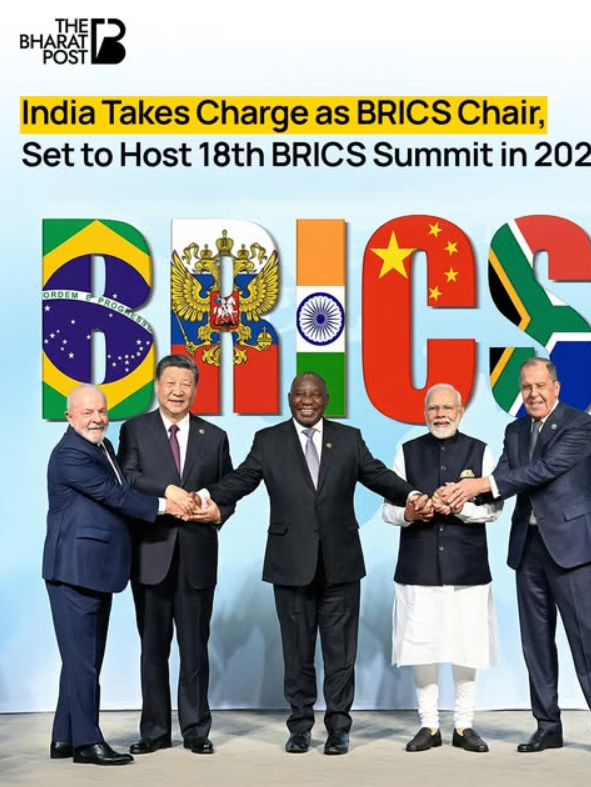
Taken together, these developments suggest that the central challenge facing the international system is no longer simply preventing wars but preventing the emergence of an economic order that benefits from their persistence. It is resolved, by regional security built on a genuine balance of power rather than on any single guarantor’s goodwill, the same logic already visible in India’s own push to diversify its energy and trade routes across the Gulf, Europe and the Indo-Pacific rather than depend on one strait. BRICS meets in Delhi on September with Xi Jinping expected on Indian soil for the first time in seven years alongside Vladimir Putin a fitting stage to ask whether the world arrives there having lived through another Hormuz. For India’s “strategic autonomy” the task ahead is neither alliance nor isolation but multi-alignment, rather than waiting on a rules-based order that has just spent five months demonstrating exactly how little it restrains the powerful. If the Global South is to stop absorbing the shocks of a business model it never agreed to, that unglamorous, bilateral cooperation is where the work will have to start.
*Editor, Focus Global Reporter