
Dr. Arvind Kumar*

Artificial intelligence is reshaping our world – global AI spending is set to reach $2.5 trillion by 2026 – yet leaders warn this rush comes with a dark side. UN Secretary-General António Guterres cautions that “we face two new and profound threats: the climate crisis and the ungoverned expansion of artificial intelligence”. UN experts echo this alarm. The new UNU report stresses that its findings are “not a case against AI, but a call for using it responsibly”. In other words, AI’s promise must be weighed against its footprint.
The artificial intelligence revolution is no longer confined to generating text, images, or videos. AI is rapidly evolving into a foundational infrastructure layer of the global economy, reshaping how societies produce food, deliver healthcare, manage resources, secure national borders, govern cities, and respond to climate change. According to recent estimates, nearly 88% of organizations worldwide now use AI in at least one business function, while more than 72% have moved AI applications from experimentation to real-world deployment.
AI Beyond Chatbots
In healthcare, AI is accelerating disease diagnosis, drug discovery, precision medicine, and clinical decision-making. In agriculture, AI-driven precision farming technologies are helping farmers optimize irrigation, predict pest outbreaks, monitor soil health, and improve crop yields. AI-enabled agritech ecosystems, supported by more than 1,300 startups and the Digital Agriculture Mission, are increasingly transforming rural economies. The water sector, often overlooked in discussions on AI, is also undergoing a profound transformation. Recent UNESCO research highlights how AI is being deployed for groundwater modelling, flood forecasting, hydropower optimization, irrigation management, climate-risk assessment, water governance, and strengthening the water-energy-food nexus. Governments are equally embracing AI to improve public administration, service delivery, taxation systems, urban planning, disaster response, and regulatory oversight. Meanwhile, defence establishments increasingly view AI as a strategic asset capable of analysing vast volumes of intelligence data, monitoring borders, enhancing cybersecurity, and supporting battlefield decision-making. The United States recently accelerated AI integration across national security systems, while AI-powered platforms are already assisting military forces in processing satellite imagery, drone feeds, radar inputs, and other real-time intelligence streams.
Yet herein lies a paradox. It ultimately relies upon vast networks of data centres, semiconductor manufacturing facilities, cloud computing infrastructure, electricity grids, cooling systems, and mineral supply chains. The intelligence may appear virtual, but its foundations are profoundly material.
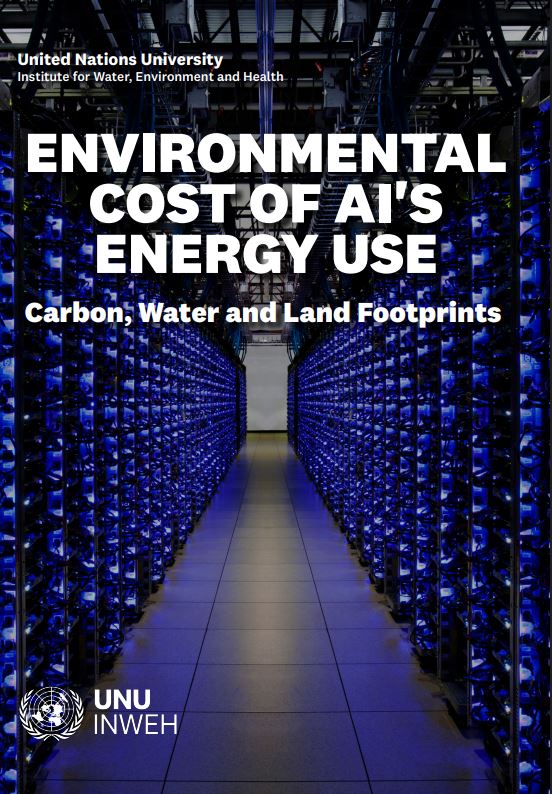
This is precisely the warning emerging from the latest United Nations University report. The report argues that AI should not be viewed solely as a digital technology but as a resource-intensive industrial system with measurable carbon, water, land, and material footprints. The scale is staggering. UN researchers estimate that AI-driven data centres could consume approximately 945 terawatt-hours of electricity annually by 2030—equivalent to nearly 3% of global electricity demand. Recent estimates suggest that ChatGPT alone processes around 2.5 billion prompts every day, consuming approximately 383 GWh of electricity annually. The environmental cost rises exponentially for more compute-intensive applications such as AI-generated videos, autonomous systems, and large-scale scientific simulations.
Consequently, the environmental debate surrounding AI is no longer about chatbots rather it is about whether humanity can build an intelligent future without simultaneously deepening existing crises. The challenge before policymakers is therefore not whether AI should be adopted, but whether the AI revolution can be governed in a manner that is as sustainable as it is transformative.
Global Responses and Policy Initiatives
Governments and institutions are scrambling to catch up. UNEP and UNESCO have flagged AI’s environmental issue: UNEP’s digital chief warns “some of the data we do have is concerning” and urges making AI’s net planetary impact positive. In practice, over 190 countries have signed onto UNESCO’s AI ethics guidelines, which explicitly call for environmental protection and sustainable development in AI’s lifecycle. The EU is moving too: a Climate Neutral Data Centre Pact, signed by AWS, Google and Microsoft, commits signatories to match 75% of their data center energy with renewables and 100% by 2030 (hourly matching). The EU’s new Energy Efficiency Directive will also force data centers to report energy and water use by site. In the US, 2025 Executive Order on AI infrastructure mandates that federal AI campuses be paired with new clean power, effectively making AI data centers on public land require renewable energy.
Industry itself is innovating. In mid-2026, Amazon, Google, Meta and Microsoft launched a Data Center Innovation Initiative to fund startups developing advanced cooling, batteries and other clean technologies for data centers. Their sustainability chiefs emphasize building a “shared playbook” so that clean solutions (solar power, energy storage, efficient chips) scale rapidly across all centers. Cloud providers are also signing huge renewable power deals: together these hyperscalers accounted for over 98% of U.S. corporate renewable PPAs in 2024. In short, both regulators and the private sector are beginning to weave sustainability into AI planning – from footprint reporting to green power sourcing – though many experts warn progress must accelerate.
Meanwhile, India is racing to become an AI powerhouse, but its policies still lag. New IndiaAI and state initiatives aim to triple national data-center capacity (from ~1.5 GW in 2025 to up to 6.5 GW by 2030). Without guidance, that surge could strain grids and deplete resources. Already in 2024, India’s data centers used ~0.5% of its electricity and 150 billion litres of water – numbers projected to more than double by 2030. Experts note that state governments have begun data-center policies (some with sustainability clauses), but there is no national framework yet. As CEEW analyst Vishal Tripathi puts it, “AI-driven data centre growth is inevitable, but India has the opportunity to plan it right from the start. By embedding sustainability in siting decisions on land, water and energy we can avoid global pitfalls”. In other words, India must design its AI future with environmental limits in mind, perhaps by favouring “frugal AI” (efficient, lightweight models) and tying data centers to solar and storage projects.
Way Forward
Critically, the environmental debate surrounding AI should not overshadow its transformative potential. Artificial intelligence is already advancing climate modelling, disaster forecasting, precision agriculture, energy efficiency, biodiversity monitoring, pollution control, and resource management, with organizations such as UNEP deploying AI to detect methane emissions and support environmental protection. Yet the promise of AI cannot be separated from its growing footprint on energy, water, land, and critical minerals. The challenge before policymakers is therefore not whether AI should be adopted, but how it should be governed. Governments must integrate AI into national energy, water, and land-use planning, mandate transparency on environmental impacts, and promote Green AI principles, while industry must prioritize efficient models, sustainable data centres, and responsible supply chains. International cooperation will also be essential to ensure that the benefits and burdens of the AI revolution are shared equitably, particularly with the Global South. The latest United Nations University report is thus not a warning against artificial intelligence, but a call for responsible stewardship of one of humanity’s most powerful technologies. As innovation accelerates at an unprecedented pace, a fundamental question remains: Can the world develop a governance framework that makes artificial intelligence not only smarter, but also greener, fairer and more sustainable?
*Editor Focus Global Reporter