
Dr. Arvind Kumar*

The world is entering a defining phase of the climate crisis, where the challenge is no longer just preventing global warming from crossing critical thresholds, but managing the consequences of overshooting them. With 1.5°C increasingly within reach, the questions of how high temperatures will rise, how long they will persist and who will bear the costs have become central to the global climate debate, as COP31 opened in Antalya on 9 November. UN Secretary-General António Guterres told the Leaders’ Summit that “Science is not telling us to surrender. It is telling us to fight harder.” UNFCCC chief Simon Stiell, opening the conference, warned that “progress is nowhere near fast or fair enough”, while calling methane and electrification a “planetary icepack” able to shave half a degree off projected warming. With Türkiye presiding and Australia’s Chris Bowen steering negotiations, the world expects this “implementation COP” to convert Belém’s promises into financed, measurable delivery on mitigation, adaptation and, crucially, water.
The crises COP31 must answer are converging. Ecologically, the triple planetary crisis is concrete: glacial-lake floods struck Bhutan, Nepal and the United States this year, WMO cites preliminary estimates of over 30,000 excess deaths from European heat, drought and wildfire, and an El Niño forecast to reach record strength by December will amplify all of it into 2027. Geoeconomically, the Iran war and the disruption of the Strait of Hormuz have created what Stiell calls a fossil-fuel cost crisis, making energy security the most persuasive argument for electrification, though also tempting governments to grab whatever fuel is at hand. Geopolitically, Washington has left the Paris Agreement and announced its exit from the UNFCCC itself; UNEP attributes part of this year’s worse warming outlook to that withdrawal, while the Earth Negotiations Bulletin notes that UK and US cuts cost the Green Climate Fund US$5.1 billion in a single year. President Lula warned in Antalya that wars and tariffs are crowding climate off the global agenda.
What the latest evidence says
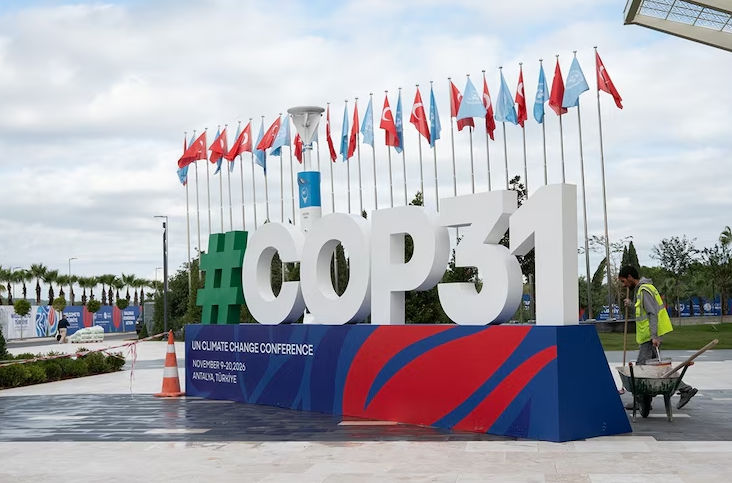
The reports of the past three weeks read as a single argument. UNEP’s Emissions Gap Report 2026, The Point of Return, concludes that holding warming to 1.5°C with no or limited overshoot is no longer possible: current policies point to 2.8°C, full delivery of NDCs to 2.6°C, and even adding every net-zero pledge only to 2.1°C. Its “lowest possible” overshoot pathway, peaking at 1.7–1.8°C before returning to 1.5°C by 2100 with even odds, needs emissions down 18% by 2030, 45% by 2035 and 69% by 2040 relative to 2025; new NDCs deliver 5–8% and 11–15% for 2030 and 2035.
The UNFCCC’s NDC Synthesis Report agrees: 127 new NDCs representing 154 Parties imply 2035 emissions just 6% below 2019. WMO’s update, released on opening day, records 2023–2026 as the four warmest years, January–September 2026 at about 1.47°C above pre-industrial, and record ocean heat and sea level. The Global Carbon Budget adds nuance: fossil CO₂ is projected to fall 0.4% in 2026, the first dip since 2020, but largely because the oil shock suppressed demand, and only about 150 GtCO₂ remain in the 1.5°C budget, roughly four years of current emissions. UNEP’s Adaptation Gap Report 2026, Ready? Not, puts developing-country needs at about US$305 billion a year by 2035 against US$28–32 billion of international public flows in 2024; even tripling, as COP30 urged, would cover just 20–29%. Overshoot changes the grammar of climate diplomacy: the metric shifts from a threshold to defend to a trajectory to manage, where magnitude and duration matter and adaptation moves from margin to centre.
The agenda
Against this backdrop, the agenda is narrower than it looks and weightier than it sounds. COP31 launches the second Global Stocktake, and the Presidency’s flagship is a goal to lift electricity’s share of energy demand from around 20% today to 35% by 2035. Around it sits Belém’s unfinished business: a Just Transition Mechanism still without a design, 59 adaptation indicators whose refinement Bonn left unresolved, the tripling of adaptation finance, a fossil-fuel transition roadmap that Brazil has published voluntarily but which has no formal place in the talks, and a push to align climate, biodiversity and land action across the Rio Conventions. Finance is the hinge for all of it: developing economies outside China received only 18% of clean-energy investment in 2025, where capital can cost several times more (UN News).
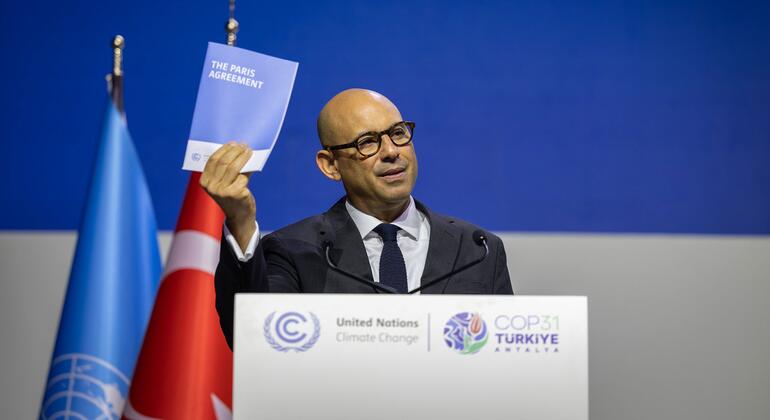
The opening days confirm that delivery, not ambition, is the fault line. The row over the agenda; a standalone Climate Finance Work Programme item, covering developed countries’ Article 9.1 obligations, was adopted over EU objections with the backing of the G77 and China, India and the African Group, while separate items on tripling adaptation finance and carbon-border trade measures were left off. Energy Day then brought momentum: Germany, Norway and Ethiopia endorsed the 35% goal, the UK, Germany, Nigeria and the Netherlands backed a fossil-fuel phase-out push, 21 countries rallied behind 300 million solar homes by 2030, and a coalition pledged US$1.2 billion for electrification. Guterres proposed a climate-justice compact and windfall taxes, noting that the nine largest oil companies earned US$95 billion in one quarter against roughly US$600 million in the loss-and-damage fund. Bowen is now consulting on a political cover decision, with a first draft expected early next week.
This is where water belongs. Climate impacts arrive through water as floods, droughts and glacial collapse, and mitigation leans on it through hydropower, cooling and food systems, yet water remains a sector rather than a thread, and UNEP notes its integration across NDCs and adaptation plans is uneven. India Water Foundation is therefore organising an official COP31 side event, a High-Level Policy Dialogue on Multistakeholder Partnerships for Climate Adaptation and Resilience via Water Transversality, on 16 November 2026, 13:15–14:45, in Side Event Room 8, BERGAMA. It contributes to a wider conversation in Antalya, including UNEP’s event on applying a water lens across the COP31 agenda on 17 November, and builds towards the UN Water Conference in Abu Dhabi on 8–10 December.
The way forward
What should Antalya deliver? Four moves would make it a genuine point of return. First, pair electrification with a delivery architecture: grids, guarantees and concessional capital that cut the cost of capital in the Global South, linked explicitly to the Stocktake’s fossil-fuel benchmarks, since UNEP’s lowest-overshoot path cuts coal’s share of energy supply by at least 55% by 2035; electrification that merely adds to fossil supply is not mitigation. Second, turn adaptation into an accountable system: a task force to operationalise the 59 indicators, a baseline and annual trajectory for tripling finance, and priority for least developed countries and small island states, where tripling could meet 49–83% of needs yet small island states receive just 0.2% of global climate finance for adaptation, as Bowen notes.
Third, use the Finance Work Programme to make Article 9.1 predictable, grant-based and debt-neutral, and scale the Loss and Damage Fund, whose first round drew requests roughly eight times its US$342 million envelope. Fourth, mainstream water as a cross-cutting enabler, embedding water metrics in NDC 3.0, adaptation plans and early-warning investment so Antalya hands Abu Dhabi a coherent mandate. Above all, the cover decision should name overshoot honestly, set 2035 and 2040 benchmarks for the Stocktake, and prove multilateralism can still deliver amid shocks. Judged that way, Antalya will be remembered less for the temperature it conceded than for the resilience it financed.
*Editor, Focus Global Reporter