Dr. Arvind Kumar*

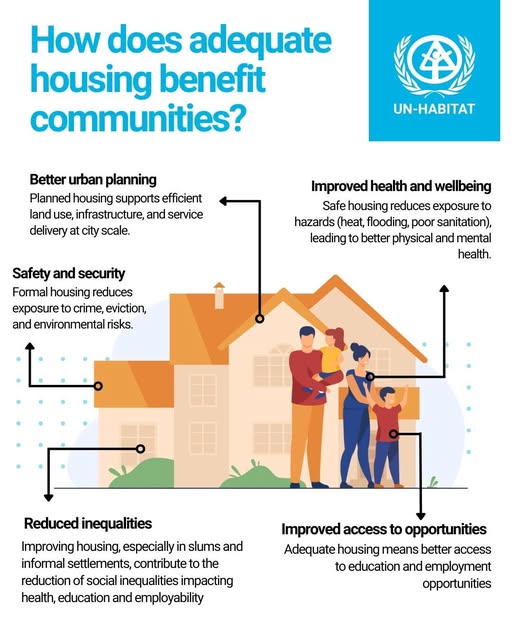
Every civilisation begins in much the same way: someone lights a fire, and the circle of its warmth becomes home. Perhaps that is why, across cultures and generations, home has meant more than shelter, it has been synonymous with safety, belonging and happiness. Housing, therefore, is not merely a construction statistic or a measure of units delivered. It is the first architecture of human well-being, the foundation on which health, education, safety, livelihoods, relationships and happiness are built. A house can be constructed with concrete and steel; a home is created through belonging, memory and human connection. As UN Secretary-General António Guterres observed, “A city is more than bricks and mortar. It is the promise of home.” That promise is ultimately about more than having a place to live; it is about having a place where life can flourish.
Today, that promise is being tested by overlapping storms. Climate change floods the ground-floor lives of the poor first. Pollution turns every breath into a daily tax. Biodiversity loss quietly pulls threads from the green safety net on which our settlements depend. Wars turn homes into rubble and families into figures: conflict, political instability and the climate emergency have forced 123 million people from their homes, most seeking safety in cities already under pressure. Geoeconomic turbulence, with costly materials and tight credit, places even modest homes beyond reach, while geopolitical fractures make shared solutions harder to forge. In such a world, “housing for all” is no longer merely a welfare aspiration. It is a load-bearing wall of global stability. Yet stability is only the beginning. A roof can protect us from the storm, but can it give us a sense of belonging? A house can provide shelter, but can it make us happy? The deeper question, therefore, is not simply whether humanity has enough places to live, but whether the places we build allow people to live well.
Where Housing Meets Happiness
Here lies the paradox of our age. Humanity has become a master builder but remains an apprentice at belonging. We have travelled from caves to condominiums, from hearths to high-rises, and our floor area per person has grown even as our hours of neighbourly conversation have shrunk. Many of us know our neighbours by the hum of their lift, not the sound of their laughter. So, pause and ask: are we truly happier? India’s own answer is sobering: it ranks 116th among 147 nations in the World Happiness Report 2026, only two places better than last year, a reminder that a booming economy and a blooming heart do not always travel on the same road. Once, home was happiness itself: a courtyard tree, a grandmother’s voice, a verandah where evenings went to gossip, a meal that smelled of being loved. Somewhere between the blueprint and the balance sheet, we outsourced that warmth to square footage. India’s own tongue knows better. Ghar never meant merely a structure, and Vasudhaiva Kutumbakam dares to call the entire world one household. A house is made by contractors; a home is made by contact.
Look closely at our settlements and the cracks widen. About one in eight people live in informal settlements, and more than 300 million have no home at all. At the World Urban Forum in Baku this May, Guterres warned that a crisis affecting nearly 3 billion people is accelerating amid wider economic and geopolitical instability. Our cities have swelled faster than their sewers, and land has quietly turned from a place to live into a place to invest. Slums have become cities within cities: vibrant, resourceful and starved of water, sanitation and secure tenure. Flood plains cradle the homes of the poor, while heat-trapping concrete roasts everyone else. Women, migrants, the elderly and the disabled live at the margins of our planning maps. We have built skylines for investors and shadows for workers. So the question is blunt: who builds our cities, and who is allowed to live in them?
From Housing to Habitat
India’s habitat story begins with a paradox of numbers. A land of over 1.4 billion people is urbanising at breakneck speed, with its urban population projected to nearly double from 461 million in 2018 to 877 million by 2050. The last full slum count, in 2011, found about 65 million people living in slums, roughly 17% of urban India. Yet today no one can say whether the true figure is near that or closer to the 200 million some analysts estimate, because the country is navigating by an old map and several competing definitions of a slum. The cruelest irony is that housing backlogs sit beside vacant stock: houses without people and people without houses, as if we had built a lock for every door but misplaced the keys. Still, the government has refused to look away. By mid-July 2026, PMAY-Urban had sanctioned about 127.68 lakh homes and completed 99.07 lakh, while PMAY-Gramin had delivered nearly three crore rural homes by March 2026, together among the largest housing drives the world has seen. Through the Light House Projects, six cities (Indore, Rajkot, Chennai, Ranchi, Agartala and Lucknow) raised nearly a thousand homes each using six different global technologies, turning them into live laboratories for building faster, greener and safer. When a nation experiments with how to build, is it not also learning how to care?
But a roof means little if it cannot survive the weather or the builder. Across the country, informal settlements stand on the front line of a warming planet. Heatwaves raise illness and death among their residents, hitting the elderly, women, children and informal workers hardest, while poor drainage and insecure tenure leave families helpless before floods. City climate plans rarely map these neighbourhoods street by street or set aside dedicated budgets for them. Unsafe construction adds its own toll: between 2018 and 2022, structural collapses claimed around 1,700 lives in Uttar Pradesh and nearly 1,500 in Maharashtra alone. Too often the shelter meant to protect becomes the first casualty of the storm. Yet the response is gathering muscle.
Under SVAMITVA, drones have mapped over 3.29 lakh villages, and by March 2026 about 3.10 crore property cards had been prepared and 2.65 crore distributed, giving rural families a paper shield for homes they have lived in for generations. In February 2026, the Cabinet cleared a ₹1 lakh crore Urban Challenge Fund, meant to catalyse nearly ₹4 lakh crore of investment in resilient, climate-responsive cities, with water and sanitation among its priorities. Census 2027, India’s first digital census, is set to count who lives where, and how. A nation that maps its villages from the sky, funds its cities for the future and counts its people afresh is rewriting its habitat story from the ground up. The task ahead is vast, but the direction is clear: from counting to building to protecting, India is learning to treat a home as a right rather than a roof.
Way Forward
The way forward, then, must be holistic, not merely hardware. Guterres told Baku that what is needed is a systematic approach connecting housing with infrastructure, basic services, climate resilience, financing and inclusive planning. That calls for integration and transversality: housing must run through health, education, energy, water, jobs and climate policy like a thread through cloth, not sit in a silo like a lonely ministry. It calls for decoupling, breaking the old bond between housing growth and the consumption of carbon, land and resources, through low-carbon cement, fly ash, recycled aggregates, bamboo, earth and passive cooling borrowed from vernacular wisdom, so that a roof for one never costs the planet for all.
It calls for rewilding, returning to wetlands, rivers, urban forests and green corridors the space concrete took, until sparrows and streams are our neighbours again. It calls for ecosystem-based adaptation, letting mangroves, lakes and trees serve as nature’s infrastructure against floods and heatwaves, cheaper and wiser than walls. It calls for sustainable housing that is energy-efficient, repairable, secure in tenure and wired to water, sanitation and transport. And above all, it calls for happiness as a design brief: parks, courtyards, libraries, markets and walkable lanes, planned with the people who will live there, because community cannot be delivered by courier. If every ministry asked, “Will this make a family happier?”, how different our cities might look.
*Editor, Focus Global Reporter