Dr. Arvind Kumar*
India’s festivals have long reflected a deep cultural connection with nature, community and collective well-being. From lighting lamps to worshipping rivers and sharing traditional delicacies, these celebrations embody a spirit of prosperity and renewal. Yet every festive season, India lights its lamps under a dimming sky. Smog stings our eyes, rivers froth with detergent and sewage, and sweets arrive with a question mark. Air pollution, water pollution and food adulteration are usually filed as separate problems in separate ministries, but in the human body they are not separate. They affect the same lungs, the same stomachs, the same children and grandparents, and their consequences compound. As Union Environment Minister Bhupender Yadav said in May, “Air pollution control requires collective responsibility and continuous action at every level.” While referring to air pollution, this principle applies equally to water quality and food safety. The solution lies in replacing fragmented interventions with integrated, preventive planning across urban development, environment, public health, water, food safety and waste management. This must also involve recognising and sustainably capitalising on environmental capital as an economic asset. Ultimately, progress means celebrating festivals with clean rivers, safe food, breathable air and star-filled skies.
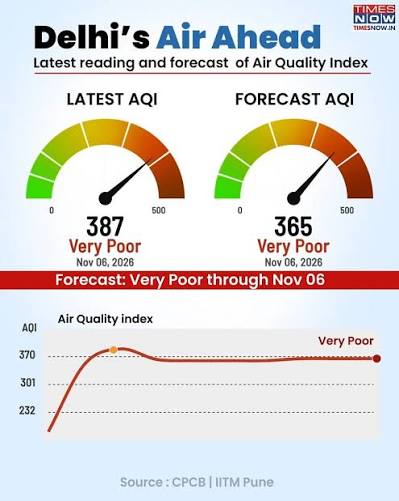
This week Delhi’s AQI touched 482, its worst reading in 288 days, with “severe” levels forecast around Diwali on 8 November. But Delhi is only the loudest alarm. IQAir’s World Air Quality Report 2025 ranked Loni, in Ghaziabad, the world’s most polluted city, at 112.5 µg/m³, over twenty times the WHO guideline. Byrnihat in Meghalaya came third, and five Indian cities made the global top ten. Mumbai touched an AQI of 322 on 24 October. The State of Global Air 2025 links roughly two million Indian deaths in 2023 to polluted air, about one in four worldwide.
Recent developments indicate a renewed rise in crop-residue burning, with NASA satellite data detecting 2477 farm fires across Punjab and Haryana since October 1. North-westerly winds are carrying smoke from these agricultural belts towards Delhi-NCR, adding to the city’s existing pollution burden. Low wind speeds and temperature inversion are continuing to trap pollutants close to the ground, with forecasts warning of severe air quality conditions through 8 November.
The Cost of Celebration
We prefer a single villain, usually the tailpipe, sometimes the farmer. The evidence is messier. Studies under the National Clean Air Programme, summarised in FICCI’s 2026 report, attribute 14–58% of PM10 to road and construction dust, 8–34% to industry and 8–29% to waste and biomass burning, depending on the city. A 2026 modelling study in Atmospheric Chemistry and Physics found industry the largest domestic source nationwide, with household fuel dominant across the Indo-Gangetic Plain. Crop residue matters, and seasonally it dominates: stubble supplied about 18.5% of Delhi’s pollution on 1 November, and Punjab recorded 9,771 wheat-residue fires this spring, against 5,114 in last year’s paddy season. Yet the Environment Minister told the Lok Sabha last December that local sources, meaning vehicles, industry, construction dust and biomass burning, rather than stubble, account for the bulk of NCR’s pollution. Every line of the pollution budget needs auditing.
Each autumn we stand in rivers we call mothers. Delhi Pollution Control Committee readings of 30 September found biochemical oxygen demand at 30 mg/L near ISBT Bridge, ten times the 3 mg/L benchmark, while Asgarpur showed no dissolved oxygen and 19,000 faecal coliform per 100 ml. Chhath, from 13 to 16 November, will again bring froth: detergent surfactants, phosphates, ammonia and sewage, which anti-foam sprays can hide but not cure.
The arithmetic explains it. Urban India generates about 72,368 million litres of sewage a day, according to CPCB’s latest national inventory. Installed treatment capacity is 31,841 MLD, and actual treatment about 20,236 MLD, roughly%. Delhi generates around 3,596 MLD and its 37 plants are built for 3,474 MLD, yet only 2,955 MLD was used and about 641 MLD of sewage still reached the Yamuna’s drains. CPCB still counts 296 polluted river stretches. Namami Gange has created 4,263 MLD of capacity by June 2026, real progress, but capacity is not treatment.
Festive demand turns adulteration into a seasonal industry. Delhi’s food safety department destroyed about 6,700 kg of foul-smelling khoya at Mori Gate; 35 of 44 samples failed preliminary mobile-lab tests, and festive drives have destroyed 10,660 kg of khoya this season. Nationally, 40,023 of 2,23,808 food samples analysed in 2025-26 (provisional) were non-conforming, nearly one in five. Among milk and milk products in 2024-25, 12,780 of 33,405 failed, about 38%. “Non-conforming” includes substandard and mislabelled food, not only toxic food, but the pattern is plain. During Navratri 2025, nearly 200 people in northwest Delhi fell ill after eating buckwheat flour while fasting. FSSAI’s 29 September directive to states speaks of assuring consumers “safe and quality food products during the festive season”, a goal that needs stating because it cannot be assumed. Contaminated food assaults the gut just as contaminated water does, in bodies already breathing smoke.
Is it celebration when a grandparent with asthma stays indoors to escape our fireworks? When a child bathes in foam in the name of devotion, then eats sweets of unknown origin? When we offer plastic and idols to a river, then demand it be spotless by next year? This week the Supreme Court directed authorities to report post-Diwali hospital admissions across Delhi-NCR; even the State now treats our festival as a public-health event. A festival is meant to nourish. How did we turn it into a stress test for hospitals?
A Push for Accountability
The Centre and the states have moved harder on air and water. CAQM tightened its Graded Response Action Plan on 28 September with stricter construction and vehicle curbs. Delhi made a fixed winter regime permanent, and from 1 November to 28 February it requires 50 per cent work-from-home, staggered office hours, doubled parking charges and a “no valid PUC, no fuel” rule. The Supreme Court allowed certified green crackers only for two days around Diwali, with the complete ban returning on 9 November. On water, Namami Gange had created 4,263 MLD of sewage treatment capacity by June 2026, and the Jal Shakti ministry says polluted river stretches fell from 311 in 2022 to 296 in 2025. Delhi approved over ₹1,000 crore in May for 12 new decentralised STPs and a Keshopur upgrade.
Food enforcement has been pushed too. FSSAI’s 29 September letter asked states for a Navratri–Diwali drive at hotspots, with Food Safety on Wheels vehicles in markets, and it has proposed banning non-dairy analogue products from being sold as paneer. Authorities conducted a provisional 5,20,566 inspections in 2025–26, up from 4,01,391, and Delhi seized nearly 7,000 kg of suspected adulterated paneer and khoya before Diwali. The strain still shows. Delhi’s AQI touched 350 on 3 November, its worst in 287 days, and CAQM issued show-cause notices to Punjab officials in Gurdaspur and Kapurthala over farm fires. And only 1,918 of 40,023 non-conforming food samples in 2025–26 ended in convictions.
Way Forward
Solutions must match the shape of the problem. Integrated planning means cities plan air, sewage, drinking water and food safety together: sewer and water lines laid and maintained apart, since Indore’s tragedy began with a leak, and dust and waste-burning controls beside vehicle norms. Transversality means environment, urban development, Jal Shakti, health and agriculture sharing targets and data. Maintenance matters as much as construction, because a plant that underperforms treats nothing. Technology helps: real-time monitoring, open data on rivers and air, Food Safety on Wheels labs, rapid adulteration test kits. But technology is a tool, not a conscience. Citizens must carry their share responsibly.
What we need is a mass movement, whole-of-society and not selective, and a change in how we count wealth. Clean air, living rivers and safe food are environmental capital that we must recognise, protect and capitalise upon to secure public health, strengthen economic resilience and advance sustainable development. The Diwali lamp symbolises knowledge dispelling darkness. This year, let it light our conscience before it lights our courtyards.
*Editor, Focus Global Reporter