
Dr. Arvind Kumar*
India is entering the next phase of its economic transformation with an ambition that is as consequential as it is formidable. Addressing the graduating class of IIT Roorkee this month, National Security Advisor Ajit Doval placed a striking number on that trajectory: from a GDP of $4.015 trillion today, India could reach $38 trillion within the next two decades, forming part of the country’s longer journey towards the 2047 vision of “Amrit Kaal.” The significance of that projection lies not merely in the number itself, but in what a $38 trillion economy would represent for India’s place in the global order. It would imply an unprecedented expansion of productive capacity, infrastructure, technological capability and strategic influence. Yet the scale of the ambition also raises a more fundamental question: what foundations will be required to sustain such growth?
The answer extends beyond GDP. Currency stability, infrastructure, geopolitical positioning, energy security, water availability and ecological resilience will increasingly determine whether economic scale can translate into durable national prosperity.
Start with the paradox in the numbers themselves. Real GDP grew 7.8% in the June quarter, the fastest start to a fiscal year in four years, with manufacturing up 9.2% and investment up nearly 12%. Yet that strength has barely touched what a rupee buys. The currency slid through 2026, repeatedly hitting record lows near 96–97 to the dollar, down roughly 7% in the year’s first five months alone — the steepest slide since 2022. A weaker rupee raises the cost of imported fuel and inputs, and that shows up fast at the till: retail inflation, which had cooled to multi-year lows in 2025 on GST rationalisation and a strong monsoon, climbed back to 4.45% by July 2026, breaching the RBI’s own 4% target, with food inflation running higher still at 5.52%. Growth that doesn’t show up in the wallet struggles to buy the patience everything else on this list still needs.
Cost of Fragmentation
Infrastructure tells a similarly two-sided story. Over the past decade, India has expanded its national highway network from roughly 91,000 km to nearly 1.47 lakh km, electrified 99.6% of its rail network, grown its metro system more than fourfold to over 1,155 km across 26 cities, and nearly doubled major port capacity to about 1,728 million tonnes a year, while national waterways jumped from five to 111 among the largest infrastructure build-outs anywhere right now. But scale has brought slippage: as of March 2026, 831 centrally monitored mega-projects were running behind schedule by an average of 36 months, pushing cumulative cost overruns past ₹5.61 lakh crore. Pouring concrete faster isn’t the same as building institutions that execute on time.
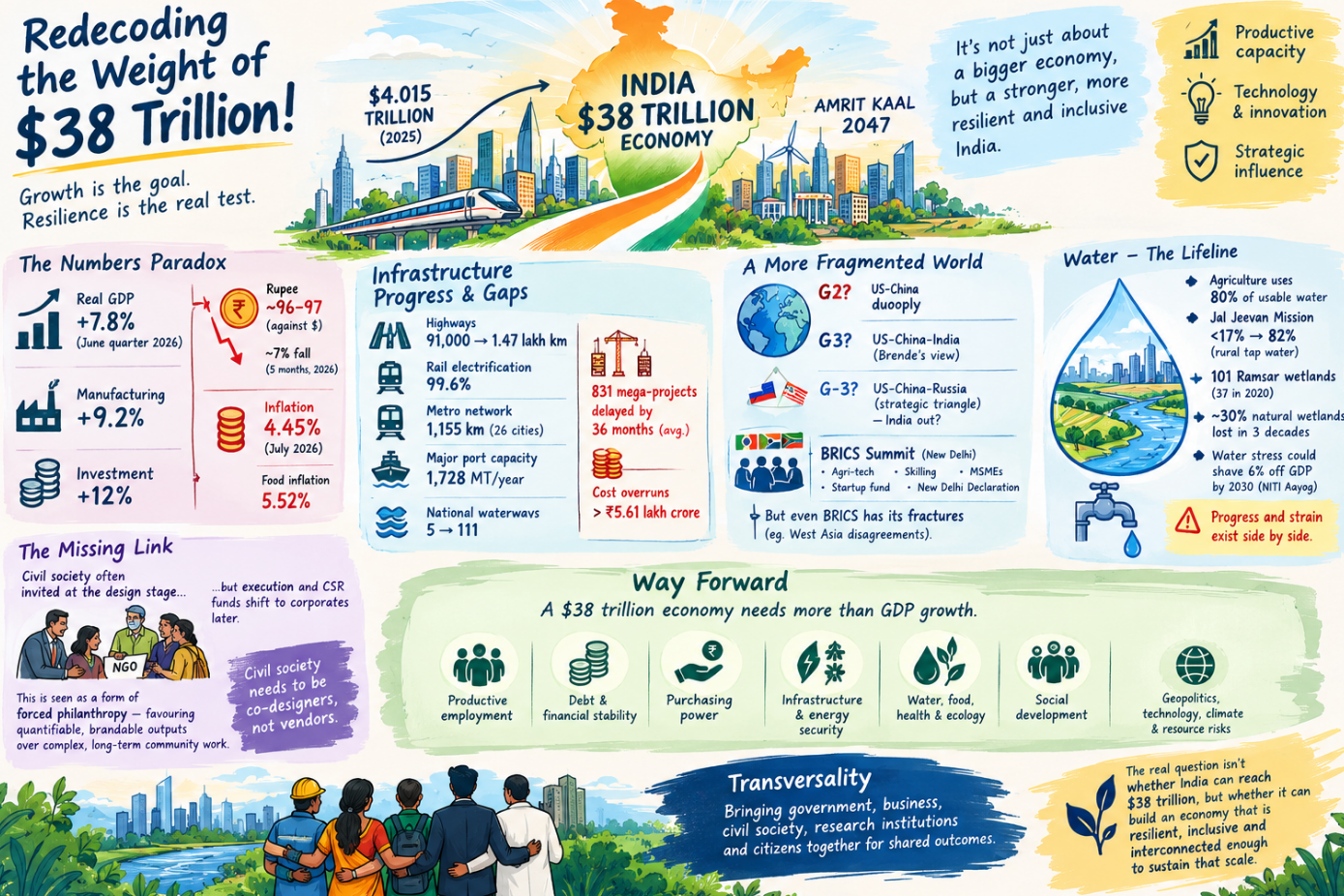
That patience is being tested abroad too. Donald Trump has repeatedly revived talk of a “G2” a US-China duopoly managing trade, technology and security bilaterally. Ironically, the same numbers that make India anxious about G2 are what the World Economic Forum’s Børge Brende has used for years to argue for a “G3” instead the US, China and India as the century’s three demographic and economic poles. That framing now competes with a starker one: analysts increasingly describe an emerging US-China-Russia strategic triangle as its own “G-3,” one that, unlike Brende’s version, leaves India out. India’s answer has been to build its own table rather than wait for a seat at someone else’s; hosting the 18th BRICS Summit in New Delhi this September, adopting the New Delhi Declaration, and launching initiatives spanning agri-tech, skilling, MSME cooperation and a startup fund. Yet BRICS isn’t immune to the same fractures over disagreements on West Asia, a reminder that convening power and consensus aren’t the same thing.
Water remains the resource none of this can do without, it’s what agriculture’s 80% share of usable water depends on, what cools manufacturing plants and AI data centres alike (a single 100-megawatt facility can use 800,000 litres a day), and what healthcare and construction need just to function. Achievement and strain sit side by side here too. The Jal Jeevan Mission has lifted rural tap-water coverage from under 17% in 2019 to over 82% in 2026, even as the government’s own auditor has flagged uncertified “Har Ghar Jal” villages and thousands of crores in scheme overruns. India now counts 101 Ramsar wetlands, up from 37 in 2020, even as nearly 30% of the country’s natural wetlands have vanished in three decades leaving cities like Chennai and Mumbai to flood in the very monsoons meant to replenish them. NITI Aayog itself has warned that unresolved water stress could shave 6% off GDP by 2030, a cost baked directly into the $38 trillion arithmetic.
A quieter thread runs beneath water, infrastructure and welfare delivery alike: how India brings different actors to the table. Civil society groups are routinely invited in as pro bono knowledge partners at the design stage of social projects, only to see execution and the CSR budgets attached to it shift to corporates once contracts are signed. Researchers studying India’s mandatory CSR law describe this as a form of forced philanthropy, where firms favour quantifiable, brandable outputs while community groups compress complex work into standardised deliverables. Practitioners across sectors have increasingly called for treating civil society as genuine co-designers, not vendors.
Way Forward
None of this argues against India’s ambition; it argues for building the wider ecosystem capable of sustaining it. A $38 trillion economy will require more than headline GDP growth: it will depend on generating productive employment, managing debt, preserving purchasing power amid inflation and currency depreciation, strengthening infrastructure and energy security, and ensuring that water, food systems, public health and ecological resilience keep pace with industrialisation and urbanisation. At the same time, India will have to navigate a more fragmented geopolitical order, technological disruption, shifting supply chains, climate risks and resource pressures over the next two decades.
These challenges cannot be managed in isolation. India therefore needs a systemic and integrated development approach in which economic policy, employment, infrastructure, technology, energy, water, ecology, social development and foreign policy are understood as interconnected parts of one national trajectory. This is where transversality becomes critical not simply as a sustainability principle, but as a governance approach that brings government, business, civil society, research institutions and citizens into greater convergence around shared outcomes. The question, ultimately, is not only whether India can reach $38 trillion, but whether it can build an economy resilient, inclusive and interconnected enough to sustain that scale.
*Editor, Focus Global Reporter