Dr. Arvind Kumar*

The global climate agenda is reaching an important juncture in its pursuit of sustainable water security, and the UN Water Conference, scheduled next month in Abu Dhabi, UAE, could prove to be a defining turning point. As I prepare to participate in this landmark gathering, I carry with me the conversations and lessons from COP31 in Antalya, Türkiye, where water found a stronger voice in climate diplomacy but has yet to secure the political weight and financial commitment its importance demands. Antalya brought water closer to the negotiating table through dedicated dialogues, institutional partnerships, the Baku Dialogue on Water for Climate Action and discussions on adaptation finance; yet, the distance between promises and implementation remained unmistakable. The challenge now is to ensure that Abu Dhabi does not merely keep the conversation afloat but gives it the current needed to move from commitments to action. With the UAE and Senegal co-hosting the third UN Water Conference, the stakes extend beyond accelerating SDG 6. It must help bridge fragmented governance, unlock investment, strengthen international cooperation and give the more than voluntary commitments under the 2023 Water Action Agenda a tangible direction.
The thread begins at COP27. Thirty years after the climate convention was drafted without a word on water, Egypt’s presidency staged the first dedicated Water Day and launched the AWARe initiative, with a Water Pavilion that hosted 59 events. Water also slipped into the cover decision. It was a small breakthrough with a large flaw: the text spoke of adaptation but ignored water’s role in mitigation. Antalya inherited that unfinished sentence. Under a split presidency, Türkiye hosting and Australia steering negotiations, and a self-declared “Implementation COP”, water earned a formal place in the Action Agenda, a Water for Climate Pavilion run by SIWI, and UN-Water sessions on coherence that floated the idea of an International Water Organization.
A Trillion-Dollar Crisis
The numbers explain the urgency. The UN World Water Development Report 2026 counts 2.1 billion people without safely managed drinking water and 3.4 billion without safe sanitation, finds four billion enduring severe scarcity at least a month each year, and confirms no SDG 6 target is on track. Infrastructure spending of roughly $300 billion a year faces an estimated $700 billion annual gap. The Global Commission on the Economics of Water warns that over half of world food production is at risk by 2050, with GDP losses averaging 8% and reaching 15% in poorer nations. Antalya made it personal: COP31 President Murat Kurum put global drought costs above $300 billion a year, a Himalayan glacier collapse killed nearly 1,500 people in Nepal, and half of Türkiye’s own population is at risk of water shortages by 2030.
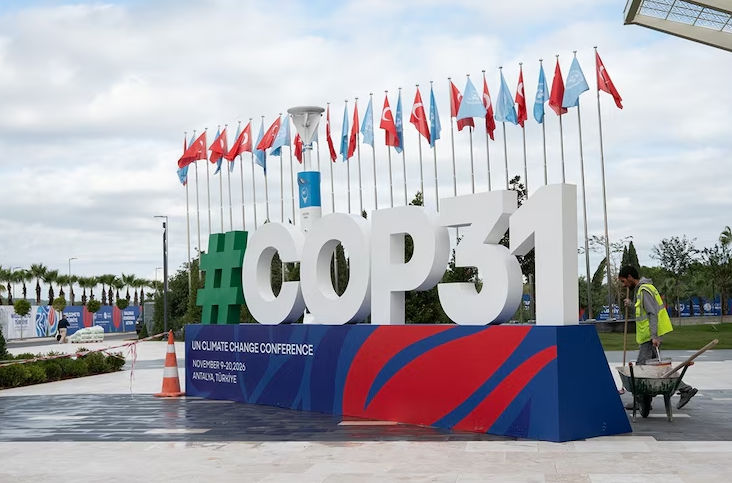
Yet the plenary tells a more sobering story than the pavilions. One analysis noted that energy and finance held the spotlight at the Leaders’ Summit while water waited in the wings, a gap between water’s strategic weight and its political billing. The draft cover decision proposes an Antalya-to-Addis Ababa Roadmap on Adaptation and Resilience Finance, but the second draft dropped a number for tripling adaptation finance, and Guterres cautions that even tripling would meet less than a third of vulnerable countries’ needs. Water is the orphan of climate finance: early-warning systems and rural water supplies may offer investors little return, so private capital walks past while public money arrives late. That is money down the drain, and the drain is deep.
Prospects for Cooperation
India’s national statement, delivered by Environment Minister Bhupender Yadav, struck familiar Global South chords: the shrinking carbon budget must be shared equitably, a point he called non-negotiable, and developed countries must discharge their finance obligations, while developing countries cannot be made to pick between climate action and their right to development. Water entered as a bridge rather than a barrier. India’s growth, he said, is a rising tide that can lift others, and working together on rivers that cross borders can spread prosperity. He added that such cooperation can rest neither on “archaic mechanisms” nor be divorced from the wider context, remarks reports read as a call to honour existing water-sharing agreements, though neither side named the Indus Waters Treaty. Elsewhere, India’s partnership offer to small island states listed water security among its priorities, and Delhi insisted that adaptation indicators stay voluntary rather than become conditions for finance.
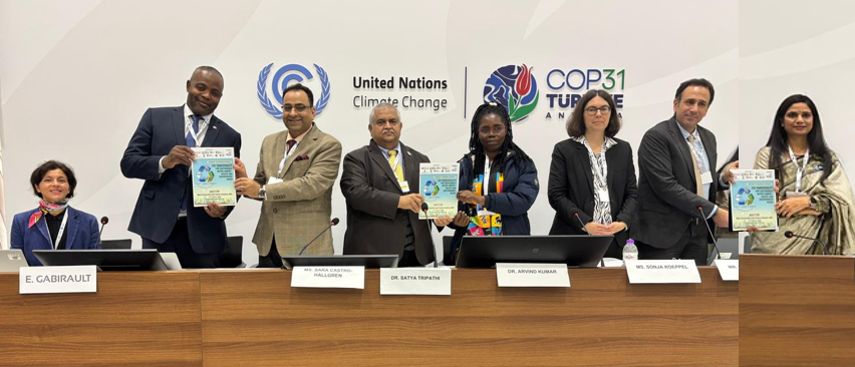
Image Source/Credit/Courtesy: India Water Foundation
Where governments speak in communiqués, civil society stitches the connective tissue. India Water Foundation’s high-level dialogue in the Blue Zone, on multistakeholder partnerships for adaptation through Water Transversality, gathered the Meghalaya’s Chief Minister , World Bank, OECD, UN-Water, UNECE, ESCAP, the World Water Council, SIWI and others. Its President, Arvind Kumar, pitched Water Credits to make conservation pay; Dr. Satya Tripathi flagged the growing thirst of AI and data centres; the World Bank’s Mr. Saroj Jha underlined that sound water stewardship is itself climate adaptation. The foundation’s release says the room converged on five priorities: policy coherence, integrated financing, nature-based solutions married to resilient infrastructure, stronger data and early warning, and genuine community participation. Water Transversality extends integrated water resources management by pulling disconnected sectors into the same decisions.
Now the baton passes to Abu Dhabi. The UN Water Conference is only the third in almost fifty years, and the first led by two Global South nations, the UAE and Senegal, the first dedicated to accelerating SDG 6, and the first with a dialogue entirely devoted to investment. It builds on the 2023 Water Action Agenda’s 700-plus voluntary commitments, but there is a catch: it will close with a summary from the President of the General Assembly, not a negotiated text. The hosts want success judged by practical outcomes rather than dialogue alone. Without a legal anchor, momentum has to be engineered rather than assumed, and pledges without a scoreboard are ships without rudders.
Way Forward
So what should travel from Antalya to Abu Dhabi? First, a water lens on every national plan: COP27 urged Parties to integrate water into adaptation efforts, and UNEP’s planned “water lens” session at COP31 shows how; Abu Dhabi should turn this into a checklist for NDCs and adaptation plans. Second, a dedicated water window inside the Antalya-to-Addis Ababa roadmap, so COP32 inherits a bankable pipeline and a start on the $700 billion gap, with instruments such as Water Credits and blended finance. Third, governance: since 60% of freshwater resources are shared between two or more countries, the cooperation dialogue should marry data-sharing to the UNECE Water Convention, and the proposed International Water Organization deserves a feasibility mandate rather than polite applause. Fourth, measurement: Belém’s water and sanitation indicators should be workable yet voluntary, reconciling the Global South’s fear of conditionality with the sector’s need for accountability. Fifth, people: women and girls spend an estimated 250 million hours every day collecting water, so community co-design is infrastructure, not charity. India can be the bridge, offering Transversality as a shared grammar and the Global South’s voice at both tables.
The strategic lesson is that water sets the pace of every other agenda; an energy transition without water is a car without a fuel line, and food, health and cities are no different. Simon Stiell’s verdict on post-Paris progress, “nowhere near far enough or fair enough”, fits water equally well. Antalya gave water a seat at the table. Abu Dhabi must give it a budget, a scoreboard and a steward.
*Editor, Focus Global Reporter