Dr. Arvind Kumar*

The 16th India-Japan Annual Summit, beneath its ceremonial pageantry, marks a deliberate strategic pivot where defence and security now supersede traditional economic ties—exemplified by the first-ever joint defence project (Unicorn) and AI/Economic Security frameworks—as both status-quo powers hedge against an uncertain Asia by binding themselves closer together, yet the true measure lies not in the ¥10 trillion investment target or yen-rupee settlement mechanism but in whether Japanese capital actually flows based on business fundamentals, whether co-production deepens beyond symbolism, and whether visible infrastructure emerges in the neighbourhood to credibly counter China’s influence, with the upcoming 2+2 dialogue serving as the real litmus test for converting this summit’s promises into lasting results.
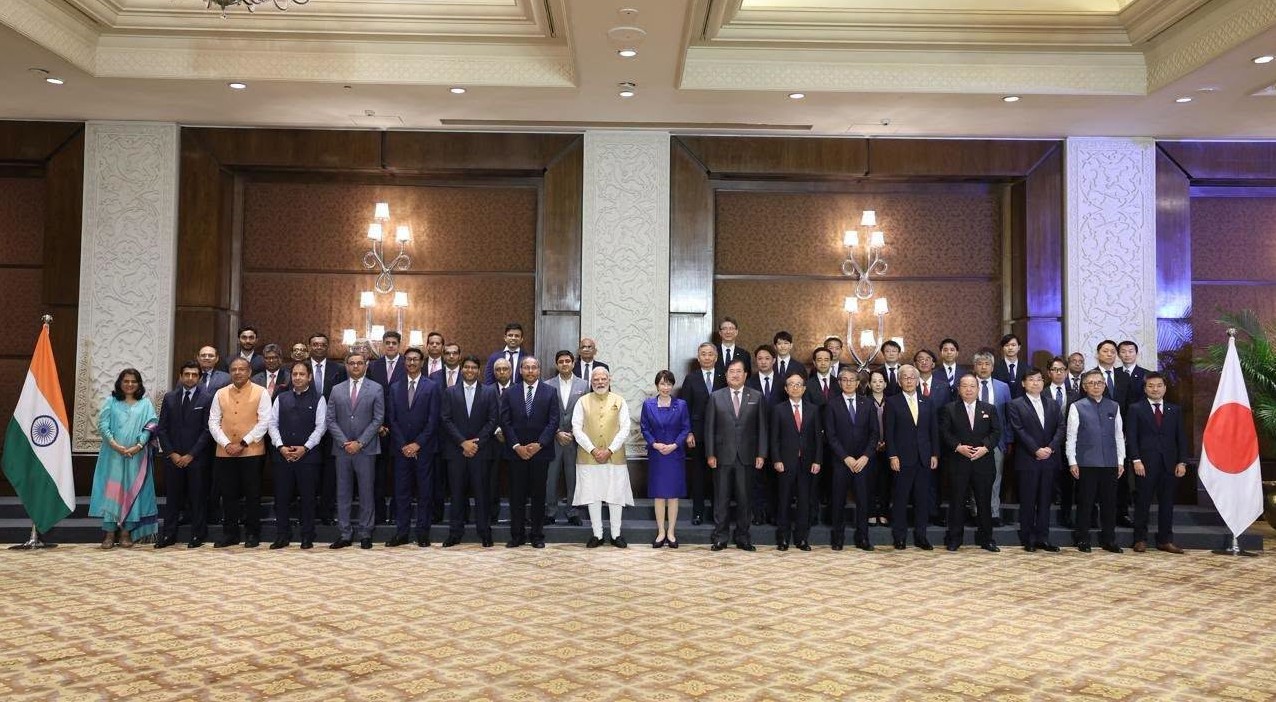
The images from Her Excellency Sanae Takaichi’s three-day visit to New Delhi, a ceremonial welcome at Rashtrapati Bhavan, 16th summit outcomes, a decade-spanning investment number will read, on first pass, like the choreography every high-profile bilateral visit produces. That reading undersells what actually happened. The more interesting story of the 16th India-Japan Annual Summit is not the pageantry but what it reveals about how two status-quo powers, both uneasy about the direction the world is taking, have chosen to hedge: by binding themselves closer together, deliberately and in writing, at a moment when almost every other major relationship in Asia feels less certain than it did a year ago.
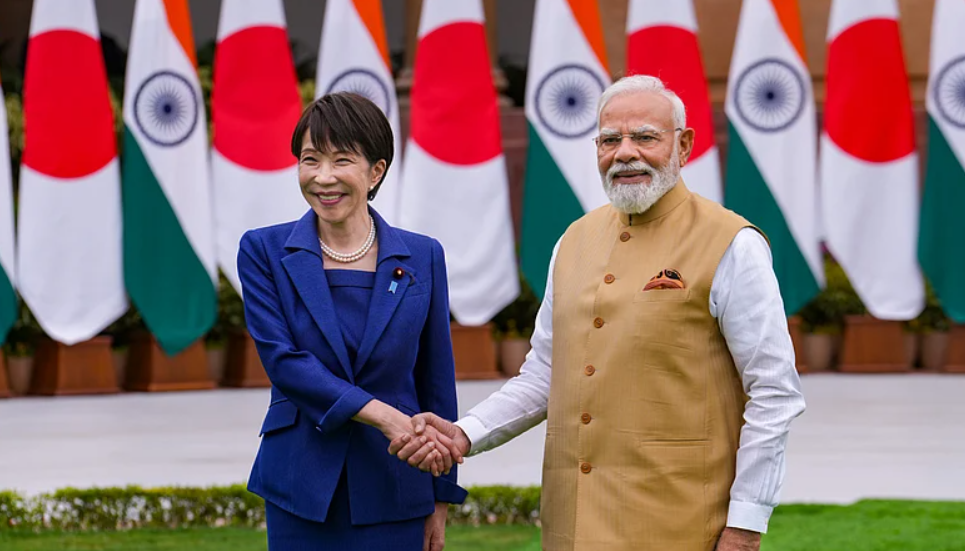
It helps to remember how unusual this relationship is by regional standards. India and Japan established formal ties in 1952, building on older Buddhist and trading links, and Japan quietly became India’s most reliable development financier, the Delhi Metro exists substantially because of JICA. What is genuinely striking, though, is the relationship’s imperviousness to domestic political churn on either side. It survived the transition from the Abe-Modi era, arguably the emotional high point of the partnership, through Kishida and Ishiba and now to Takaichi, without losing momentum or being renegotiated from scratch each time. Few of India’s major partnerships, and few of Japan’s, can claim that kind of continuity. That alone should tell us this is not a relationship of convenience.
Beyond Economics
The structure of this year’s summit made the strategic logic explicit rather than incidental. Cooperation was organised around three pillars defence and security; economic security, energy resilience and technology; and people-to-people exchange and that ordering is itself a small piece of analysis worth noting: security concerns now sit ahead of, not behind, the investment conversation that has traditionally defined this relationship. Takaichi’s own language to Japanese business leaders, framing the visit around the “current international situation” rather than routine diplomacy, was a tell. This was less a courtesy call than a hedge being placed in public.
The specific deliverables matter less individually than what they add up to. A Joint Statement on AI Cooperation, an Economic Security Declaration spanning semiconductors, critical minerals, ICT and pharmaceuticals, and the first-ever India-Japan defence co-development project, a naval radar antenna called “Unicorn” read separately as a fairly standard MoU list. Read together, they describe two economies trying to build redundancy into every system a hostile environment could exploit: chips, minerals, data, energy, and now, tentatively, weapons technology. The ¥10 trillion (roughly $68 billion USD) ten-year investment target, the yen-rupee settlement mechanism to bypass dollar dependency, the push to fast-track the fifteen-year-old CEPA review, and the biogas, mobility and high-speed rail commitments sitting alongside all of this are less a shopping list than evidence of a shared conviction that economic and security resilience have become the same problem.
The Strategic Calculus
What does each side actually get out of this, beyond the headline figures? India gets capital and a manufacturing partner actively looking to diversify away from China under its own “China+1” logic useful, but not unconditional, since Japanese capital goes where the ease-of-doing-business math works, not where diplomatic warmth alone points. Japan gets something harder to manufacture domestically: a young, capable engineering workforce and a market that can eventually offset a shrinking home population, plus a partner whose institutions are predictable enough for long-horizon investment. The AI framing Japanese hardware precision meeting Indian software depth is the cleanest expression of this complementarity, and probably the area with the most genuine upside if it is resourced seriously rather than treated as another declaration to sign.
It is also worth being honest about where this partnership is still more symbolic than deep. The Unicorn project is India and Japan’s first joint defence co-development effort, full stop a notable first, but a modest one next to the kind of technology-sharing India already has with, say, the United States or France. Framing it as a breakthrough is fair; framing it as evidence of a mature defence-industrial relationship is not yet.
The geopolitical subtext, though rarely stated in these terms in the official language, is not hard to read. The summit’s language explicitly welcomed the convergence of Japan’s Free and Open Indo-Pacific policy with India’s Indo-Pacific Oceans Initiative and its newer MAHASAGAR framework diplomatic phrasing for a shared discomfort with an assertive China. Many Indian strategists read Beijing’s “String of Pearls” footholds from Gwadar to Hambantota to Mongla and Chittagong as a slow tightening around India’s maritime periphery, and recent developments have sharpened that reading rather than eased it. Bangladesh’s politics have been unsettled since the 2024 ouster of Sheikh Hasina, and its interim leadership has since signed a first-of-its-kind intelligence-sharing pact with Islamabad while entertaining a proposed China-Myanmar-Bangladesh Economic Corridor that would push Belt and Road infrastructure toward India’s vulnerable north-eastern corridor. Sri Lanka tells a more encouraging story for New Delhi: India’s rapid disaster response after Cyclone Ditwah did more for its standing in Colombo than a decade of competitive port financing had managed. Set against that map, the summit’s emphasis on North-East connectivity, Bay of Bengal linkages through BIMSTEC, and Quad-coordinated maritime surveillance looks less like routine bilateral housekeeping and more like a deliberate attempt to build counter-geometry into a region where China has had the run of the field.
There is a genuine Global South argument here too, and it is probably underused by both governments. India speaks credibly for developing economies; Japan’s development finance is transparent and largely free of the debt-trap criticism that dogs Chinese lending. A jointly resourced, rules-based alternative to Belt and Road financing has real appeal to smaller economies from Africa to the Pacific Islands who would rather not choose a single patron and the Asia-Africa Growth Corridor showed the model can work. It has simply never been scaled to match its own rhetoric, and this summit does not change that on its own.
So what would it actually take to convert this summit’s promise into results, rather than another item on the long list of bilateral pledges? On the economic side, the track record is more encouraging than sceptics assume; Abe’s 2014 pledge of $35 billion was largely delivered, Kishida’s $42 billion followed, and the ¥10 trillion target unveiled last year built on an earlier ¥5 trillion goal that was met ahead of schedule. But as analysts tracking the relationship have pointed out, these are directional signals rather than guaranteed capital pools, and actual yearly disbursement depends on business-case fundamentals land acquisition, labour rules, logistics costs, regulatory predictability not political goodwill. If Delhi wants the ¥10 trillion figure to be more than a headline, the CEPA review needs to move on an actual timeline, not an indefinite one, and the ease-of-doing-business gap that has historically slowed mid-sized Japanese manufacturers needs closing faster than large flagship projects alone can manage.
Way Forward
On the strategic side, the follow-through that matters most is the scheduled Foreign and Defence Ministerial “2+2” dialogue later this year, which will show whether the Unicorn project becomes a template for deeper co-production or stays a one-off. Equally important is whether India and Japan are willing to co-finance visible infrastructure in third countries; ports, connectivity, energy in Bangladesh, Sri Lanka and beyond, rather than only reacting to Chinese moves after the fact. A partnership that positions itself as a credible alternative to Belt and Road has to be seen building things in the neighbourhood, not just signing statements in New Delhi. Japan, for its part, will need to manage its own political volatility, five prime ministers in roughly a decade is not the picture of the steady, long-horizon partner its India strategy depends on projecting.
None of this diminishes what just happened in New Delhi. A relationship this durable, elevated further at a moment of genuine global uncertainty, is worth calling a new dimension. But the real verdict on whether it deserves that title won’t be written in this week’s joint statement, it will be written in whether the plants get built, the antenna gets deployed, the yen actually moves, and the neighbourhood notices the difference. Declarations are the easy part. What comes next is the one that counts.
*Editor, Focus Global Reporter