Dr. Arvind Kumar*

India enters with a headline that its official communication machinery would prefer you not dwell on too long. The nation that spent a decade loudly chasing a $5 trillion economy but as per IMF’s April 2026 World Economic Outlook, slipped to sixth-largest, behind Japan and a resurgent United Kingdom. Yes, the rupee’s 11% depreciation against the dollar mechanically compressed genuine rupee-term growth into a smaller dollar figure but let us not be too generous with that excuse. The wars in West Asia, the crude price spiral, the capital flight these did not create India’s vulnerabilities, they merely exposed what a decade of fast growth quietly refused to fix. Fast growth, it turns out, is not the same as resilient growth. A ranking that a favourable exchange rate can gift and an unfavourable one can take back is less an achievement than a revolving door. The G7 seat, in this context, is less a laurel and more an urgent necessity, a forum where India must fight, with far greater aggression than it has shown before, for the structural reforms that would make its economic story dollar-proof, war-proof, and worthy of the aspirations it spent a decade selling to its own people.
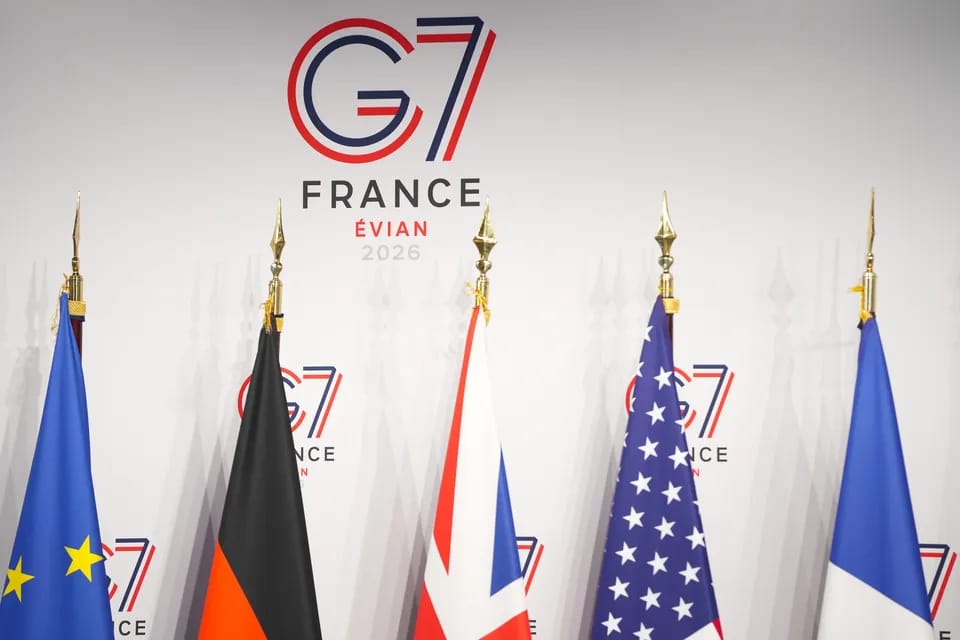
Against the backdrop of escalating global conflicts and deepening geopolitical fault lines, India will participate in the G7 Summit at Évian-les-Bains, France, from June 15–17, 2026. France’s own diplomatic briefings have called the current situation a moment where “there have never been so many armed conflicts since World War II.” The Russia-Ukraine war grinds into its fifth year with no durable peace architecture in sight. The US-Israel military campaign against Iran and the ensuing Iranian blockade of the Strait of Hormuz through which 20% of the world’s energy trade flows has produced the most severe energy price shock since the 1970s oil crisis. French President Emmanuel Macron, who holds the G7 chair this year, has been unambiguous: “The great risk of the times we are living in is the risk of seeing the ‘might is right’ mentality prevail.” This is the turbulent theatre into which India now walks not as a spectator, but as a confirmed invited partner described as an “acceleration for partnership.”
India enters with a headline that its official communication machinery would prefer you not dwell on too long. The nation that spent a decade loudly chasing a $5 trillion economy but as per IMF’s April 2026 World Economic Outlook, slipped to sixth-largest, behind Japan and a resurgent United Kingdom. Yes, the rupee’s 11% depreciation against the dollar mechanically compressed genuine rupee-term growth into a smaller dollar figure but let us not be too generous with that excuse. The wars in West Asia, the crude price spiral, the capital flight these did not create India’s vulnerabilities, they merely exposed what a decade of fast growth quietly refused to fix. Fast growth, it turns out, is not the same as resilient growth. A ranking that a favourable exchange rate can gift and an unfavourable one can take back is less an achievement than a revolving door. The G7 seat, in this context, is less a laurel and more an urgent necessity, a forum where India must fight, with far greater aggression than it has shown before, for the structural reforms that would make its economic story dollar-proof, war-proof, and worthy of the aspirations it spent a decade selling to its own people.
The Geo-economic Shock & India’s New Standing
There is a telling evolution in India’s own self-description in global forums. Not long ago, the dominant official vocabulary was aspirational “$5 trillion economy by 2025” was the headline goal that framed India’s ambitions. That number was missed, reshaped, and quietly retired. What replaced it is considerably more powerful: India is now the world’s fourth-largest economy in nominal terms, having overtaken Japan, and is on trajectory to surpass Germany within years. Canadian Prime Minister Mark Carney, at the 2025 Kananaskis G7, stated plainly: “There are certain countries that should be at that table for discussions, and it makes sense that India should be there.” But economic size alone does not explain the intensity of Western courtship. Professor Andrew Cooper of the University of Waterloo has argued that India’s G7 invitation is fundamentally about geopolitics, not courtesy that “participation consolidates images of India’s elevated status, especially important in the context of the India-China rivalry.” EU Commission President Ursula von der Leyen, upon signing the historic India-EU Free Trade Agreement, described it as “the mother of all deals” an agreement representing nearly 25% of global GDP and two billion people. That deal, struck after 20 years of negotiation, was driven not merely by commerce but by what the European Policy Centre’s analysts called “shifting geopolitical pressures from Washington and Beijing.” India, in short, has become the variable that both the West and the non-West are recalibrating their equations around.
The Dollar, Oil & Structural Vulnerabilities
India imports 85% of its crude oil and prices much of that trade in US dollars, the Strait of Hormuz blockade is not an abstraction. It is a fiscal and inflationary crisis unfolding in real time. The energy price and supply shock is expected to constrain household consumption over the medium term, particularly for durable goods. McKinsey’s 2026 Geopolitics and Trade Update notes that “major emerging economies continued to expand trade across the geopolitical spectrum,” even as G7 economies began “derisking” from China, a pattern that creates opportunity, but also exposure for countries like India caught between blocs. The dollar’s continued dominance as the invoicing currency for oil compounds this: every rupee depreciation triggered by oil-driven current account pressures is a transfer of economic sovereignty. At Évian, India has both the platform and the political legitimacy to push for discussions on diversifying energy settlement mechanisms and for accelerated G7 commitments on green energy financing that would reduce India’s structural oil dependency over the medium term.
The Strategic Opportunities
India’s most tangible geoeconomic opportunity at Évian lies in the critical minerals architecture that the G7 has been quietly but systematically constructing. The G7 Critical Minerals Action Plan, launched at Kananaskis, explicitly targets diversification away from China which dominates between 47% and 80% of global refining capacity across lithium, cobalt, and rare earths. Union Minister Ashwini Vaishnaw, who attended the G7 Critical Minerals Ministerial in Washington framed it unambiguously: “Secure supply chains for critical minerals are essential to achieving Viksit Bharat.” Business Today’s pre-Évian analysis notes that India could position itself as “an alternative manufacturing and investment destination” under the broader China+1 strategy if it converts diplomatic access into concrete investment commitments, technology transfer agreements, and supply-chain partnership frameworks at the summit table. Geopolitically, India also enters Évian as the most credible counter-terrorism voice in the room. Having used the 2025 Kananaskis India secured the G7’s explicit condemnation of the Pahalgam attack. At Évian, therefore India must push this further from rhetorical solidarity to structural commitments that prevent terrorism-sponsoring states from accessing multilateral financial lifelines.
The Challenges India Cannot Ignore
Intellectual honesty demands acknowledgement of the constraints. India’s continued purchase of Russian oil at discounted rates economically rational, given the energy crisis creates ongoing friction within a G7 that has built its Ukraine policy around sanctions and economic pressure on Moscow. Russia’s Lavrov visited New Delhi for BRICS consultations just weeks before Évian; India will need to calibrate its summit language on Ukraine carefully enough to avoid alienating its most critical defence supplier while not being seen as a sanctions-buster. The EU-India FTA, while historic, embeds a structural tension: the EU’s Carbon Border Adjustment Mechanism remains intact despite Indian objections, imposing new carbon costs on Indian steel and aluminium exporters. Professor C. Raja Mohan of the National University of Singapore has noted that India is “under pressure to recalibrate great power relations” while simultaneously gaining from Western de-risking from China managing both simultaneously at a single summit table is a formidable diplomatic ask. And domestically, the critical minerals weak domestic exploration, slow timelines, and policy gaps limit India’s ability to operationalize the international commitments it seeks; a reminder that summitry without structural reform is diplomacy without delivery.
The Way Forward
India’s Évian strategy must be guided by a single overarching principle: convert diplomatic access into durable structural architecture. This means, first, using the BRICS chairmanship and G7 outreach simultaneously to push for reformed multilateral financial institutions including IMF reforms that prevent bailouts of states designated as terrorism sponsors rather than treating the two forums as mutually exclusive. Second, it means anchoring the India-EU FTA in summit-level investment commitments on critical minerals, semiconductors, and green hydrogen translating a trade agreement into an industrial partnership with G7 capitals as co-investors. Third, on energy, India must use Évian to secure concrete G7 financing commitments for the International Solar Alliance and its clean energy transitio reducing long-term dollar-denominated oil import dependence through multilateral investment rather than bilateral charity. And on geopolitics, India must resist the temptation of being merely articulate. The G7 is not a debating society; it is a commitments forum. India should table specific, verifiable proposals on counter-terrorism financing, on supply chain architecture, on AI governance that allow it to claim measurable outcomes rather than ringing endorsements.
In times of war and geo-economic disorder, the nations that emerge stronger are not those that hedge most elegantly, but those that build the most durable coalitions around their own interests. India, at Évian, has the standing, the moment, and the agenda to do exactly that.
*Editor Focus Global Reporter