
Dr. Arvind Kumar*

The next disaster may already be taking shape beneath our feet. From collapsing glaciers and raging floods to burning forests, sinking cities and drought-stricken villages, disasters are no longer isolated natural events, they are interconnected consequences of a changing planet and vulnerable development choices. The real crisis is not the hazard alone, but the exposure we create through fragile infrastructure, degraded ecosystems and fragmented planning. The answer lies in sustainability through building resilience into every city, village, river basin and landscape. And it demands transversality, breaking institutional and geographical silos to move from reacting after disasters to anticipating risk, investing in resilience and designing development that can withstand an increasingly volatile future.
A few days back, a two-thousand-foot slab of the Langtang Lirung glacier sheared off a Himalayan ridge and thundered nearly a hundred kilometres down Nepal’s Bhote Koshi and Trishuli valleys, killing hundreds and leaving thousands unaccounted for, burying a China-Nepal highway and entire settlements under mud and boulders. It is the starkest recent proof of what UN Secretary-General António Guterres had already warned from those same mountains months earlier, telling Nepal bluntly: “Nepal today is on thin ice,” having lost nearly a third of its ice in just over thirty years, its melt now far faster than a decade ago. That single warning captures the crux of the moment: what looks like a purely natural event is, increasingly, a human-authored one, magnified by what UNEP calls the triple planetary crisis of climate change, nature and biodiversity loss, and pollution that must be tackled together, as a single, indivisible emergency. Nepal’s tragedy is not a freak accident; it is one flashpoint in a worldwide pattern of disasters that are physical in origin, social in impact, and economic in consequence.
The Cost of Exposure
Geologists are careful to say glaciers have always calved and mountains have always slid. But scientists analysing Langtang note that a rapidly warming climate and retreating ice are demonstrably raising the odds of exactly this kind of collapse, as thawing permafrost loosens rock that once held slopes together. The same story is repeating everywhere, just wearing different costumes. Europe’s 2025 wildfires burned over a million hectares the largest area on record, with Spain, Cyprus, Britain, the Netherlands and Germany all recording their worst fire seasons ever; while heat crept inside the Arctic Circle. The world’s eleven warmest years on record have all fallen since 2015, and 2025 closed roughly 1.43°C above pre-industrial levels. Pakistan’s monsoon killed over 880 people; Los Angeles’s January wildfires alone caused an estimated $53 billion in losses, the costliest single event of the year. Munich Re tallied $224 billion in global disaster losses for 2025 and roughly 17,200 deaths, up sharply from 2024, even in a year insurers considered comparatively fortunate because no hurricane made US landfall.
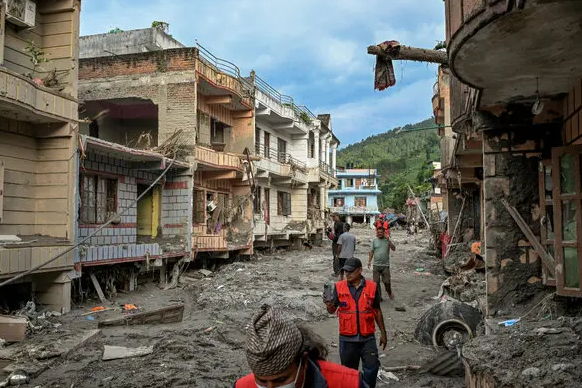
These are not isolated weather events; they are symptoms of one overheating, degraded, polluted planetary system, and their costs never land evenly displaced families, disrupted harvests, informal workers who lose a season’s income, and municipal budgets drained by rebuilding roads and power lines fall hardest on those least responsible for the emissions driving it all.
What turns a hazard into a catastrophe is rarely nature alone; it is what humans build in harm’s way. Himalayan hydropower is a case study: over a fifth of the region’s dams sit in the path of glacial lake outburst floods, and roughly two-thirds of Himalayan-state hydropower plants lie directly in these flood tracks, because developers keep pushing dams further upstream, closer to unstable lakes, to meet rising power demand. Sikkim’s 2023 South Lhonak lake breach didn’t just kill dozens, it destroyed the Teesta-III dam, the state’s largest hydropower plant, turning an engineered asset into a battering ram. Researchers studying 2025’s catastrophic South Asian monsoon found rainfall alone doesn’t explain the death toll: vanishing forest cover, unplanned urban sprawl into floodplains, and poorly engineered roads cut into fragile slopes have all multiplied the exposure of people who did nothing to cause the warming now endangering them.
Building India’s Resilience
India sits at the sharp end of this convergence. The 2025 monsoon dumped 27% more rain than average across northwest India, and landslides and floods killed over 1,500 people nationwide that season alone. Himachal Pradesh’s July 2025 cloudbursts killed 51 and severed over 400 roads in days. In July 2026, fresh flooding and landslides across northern and northeastern India killed at least 25 and displaced tens of thousands in Assam. These sit alongside older scars; Kedarnath’s 2013 cloudburst and glacial-lake breach that killed over 6,000, and Sikkim’s dam-destroying flood of 2023 a grim reminder that India’s mountains, coasts, and river plains are all simultaneously exposed, and that each new event chips away at farmland, pilgrimage economies, hydropower revenue and insurance markets alike.
India’s disaster challenge extends far beyond the mountains into both its rapidly expanding cities and vulnerable rural landscapes. Urbanisation is sealing wetlands, floodplains and open spaces under concrete faster than drainage, housing, transport and public infrastructure can adapt, turning extreme rainfall into cascading failures across roads, electricity, hospitals and livelihoods while intensifying heat through the urban heat-island effect. Rural communities face a different but equally severe risk: a washed-out bridge can isolate villages from markets and hospitals, floods and droughts can destroy crops and water systems, and fragile roads and housing can prolong economic distress long after a disaster ends.
Yet India is also where some of the world’s more inventive adaptation is happening. Mission Mausam, a ₹2,000-crore modernisation of forecasting launched in 2025, is fusing AI, denser radar networks and supercomputing to sharpen forecasts to 5×5 km resolution. Its Multi-Hazard Early Warning Decision Support System now pushes impact-based, location-specific alerts to roughly 80% of the population in India and neighbouring countries, cutting forecast preparation time in half and shrinking cyclone evacuation costs to a third of what they once were. A National GLOF Risk Mitigation Programme has been approved to map and stabilise dangerous glacial lakes before they burst, backed by the NDMA-SDMA-DDMA institutional chain built under the 2005 Disaster Management Act. It is real progress but progress built for yesterday’s hazard map, while the hazard map itself keeps shifting.
Way Forward
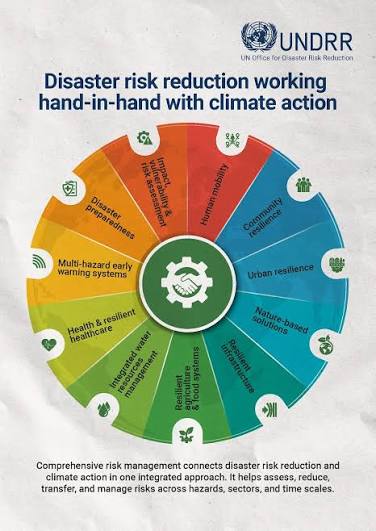
It lies in embedding sustainability at the centre of disaster resilience by recognising the nexus between water, energy, food, health, ecosystems, infrastructure and climate. Development can no longer be planned around historical weather patterns or through isolated sectoral interventions. Cities need climate-resilient drainage and restored wetlands, rural areas require secure water systems and resilient livelihoods, coasts need ecosystem-based protection, and mountains demand risk-sensitive infrastructure and land-use planning. Every major investment must be designed not merely to withstand today’s hazards but to reduce tomorrow’s exposure.
This demands transversality; breaking institutional and geographical silos so that disaster risk, climate adaptation and sustainable development become shared responsibilities across ministries, communities and borders. Integrated early-warning systems, real-time data sharing, AI and satellite monitoring, risk-sensitive infrastructure, ecosystem restoration, innovative finance and strong last-mile community networks must work together rather than separately. Resilience should therefore become a principle embedded in every development decision, shifting disaster management from reacting after catastrophe to anticipating risk and designing societies capable of absorbing, adapting to and recovering from multiple, interconnected shocks.
*Editor, Focus Global Reporter