Shweta Tyagi*
There was a time when books were an inseparable part of childhood. I waited eagerly for storybooks, comics and magazines. Once I began reading, I entered a world of our own. If a story described an old castle, a mysterious forest or a distant village, I created the entire scene in my mind. I imagined how the characters looked, what they wore, how they spoke and even how their surroundings felt.
Interestingly, no two readers imagined a story in exactly the same way. The book provided the words, but our imagination brought them to life.
Today, things seem very different. Many children and young adults find it difficult to sit with a book for even a short time. They are more attracted to reels, videos, online games and other visual content. Entertainment is available instantly, and every swipe brings a new image, sound or story. There is no waiting and very little effort involved.
It would be unfair to say that today’s generation lacks intelligence or curiosity. Young people are growing up in a world very different from ours. Screens surround them from an early age, and digital platforms are deliberately designed to hold their attention. When the mind becomes accustomed to fast-moving content, reading a book can naturally begin to feel slow.
But this shift comes at a cost.
When we read, the mind does not remain passive. It works with the words and creates its own pictures. A writer may describe a character in only a few sentences, but each reader forms a different image of that person. In a film or video, the character’s face, voice, clothes and expressions are already decided for us. We receive someone else’s imagination instead of using our own.
This is why the decline in reading should concern us. Imagination is not needed only for enjoying stories. It helps us think creatively, solve problems and look at life from different perspectives. Every invention, work of art and social change began as an idea in someone’s mind. Before we can create something new, we must be able to imagine it.
Books also teach patience. A story takes time to develop. We turn the pages, become familiar with the characters and gradually understand their emotions. In contrast, digital content must attract us within the first few seconds. If it does not, we simply swipe to the next video. Slowly, this habit can make it harder to focus and concentrate on anything that requires time and attention.
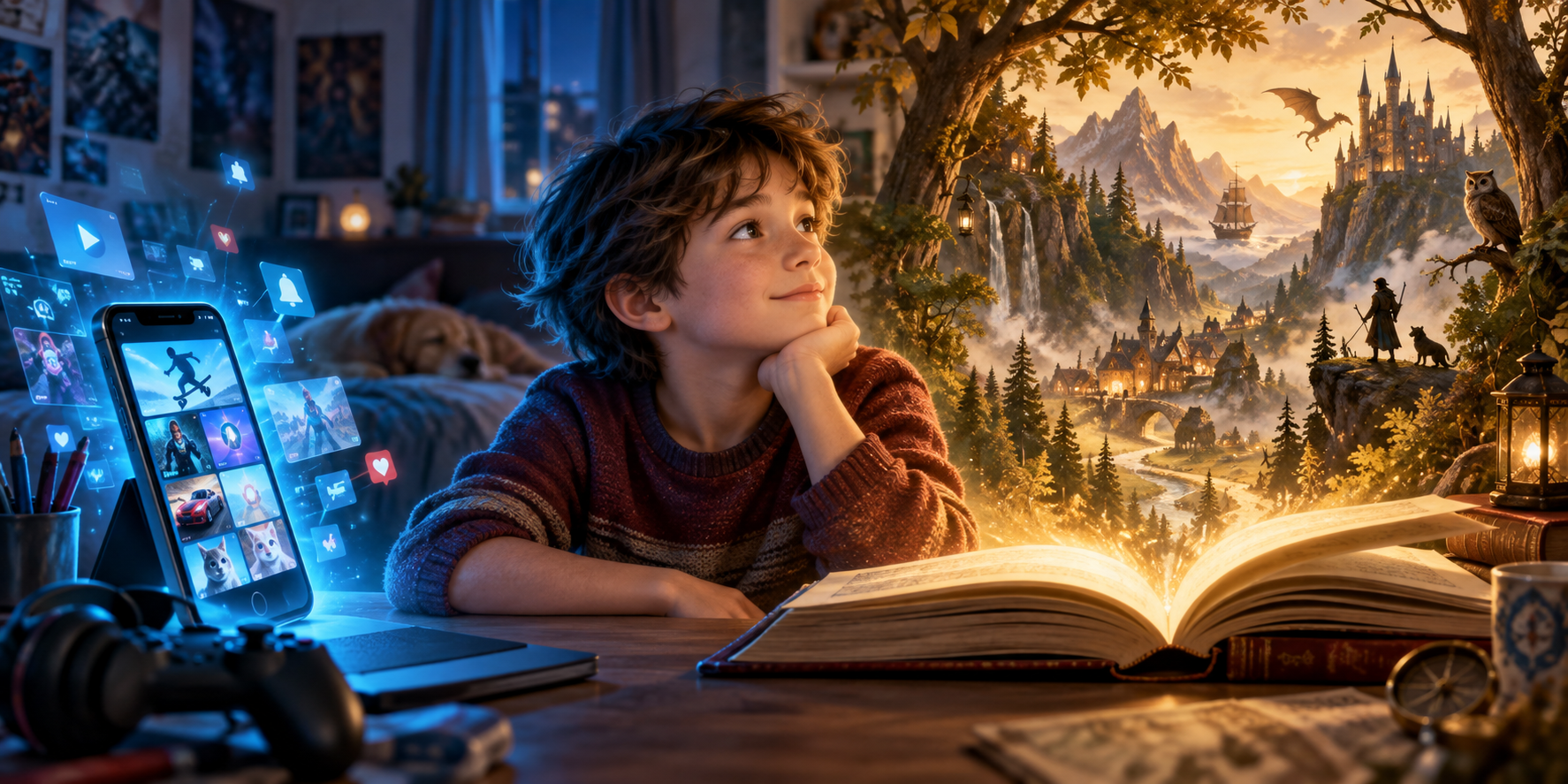
Reading also helps us understand people. When we follow a character’s journey, we share that person’s fears, disappointments and hopes. We begin to see the world through another person’s eyes. This quietly develops empathy, something that cannot always be gained from a short video clip.
However, children alone cannot be blamed for moving away from books. Adults and educational institutions must also accept some responsibility. We often present reading as a duty rather than a pleasure. Children are asked to memorise chapters, learn difficult words and prepare answers for examinations. Somewhere in this process, the simple joy of reading is lost.
Parents may also ask children to put away their phones while remaining busy with their own screens. Children learn far more from what they observe than from what they are told. If they see books being read and discussed at home, they are more likely to become curious about them.
This does not mean that visual media is entirely harmful. Films, documentaries and educational videos can be informative and inspiring. Technology has also made books more accessible through e-books and audiobooks. The real problem begins when screens become the only source of learning, entertainment and comfort.
In our childhood, boredom often pushed us towards creativity. We made up stories, invented games, drew pictures or simply allowed our minds to wander. Today, even a few free minutes are immediately filled by a phone. The mind is rarely left alone long enough to wonder, observe or create.
The answer is not to reject technology or constantly tell children that our childhood was better. Instead, we must help them discover that books can offer a different kind of pleasure. Let them choose what they want to read, comics, mysteries, fantasy, biographies or science fiction. Not every book has to be educational, and not every reading session needs to end with questions and answers.
Even twenty minutes of screen-free reading each day can make a difference. Families can read together, schools can organise informal storytelling sessions, and adults can talk about books with genuine enthusiasm. A screen shows children a world already created for them. A book gives them the freedom to create that world for themselves. If reading disappears from their lives, they may lose more than a good habit. They may lose some of their ability to pause, reflect, empathise and imagine.
Our responsibility is not merely to place books in children’s hands. It is to help them experience the quiet magic of turning words into worlds.
*Associate Editor, Focus Global Reporter