Dr. Arvind Kumar*
Introduction
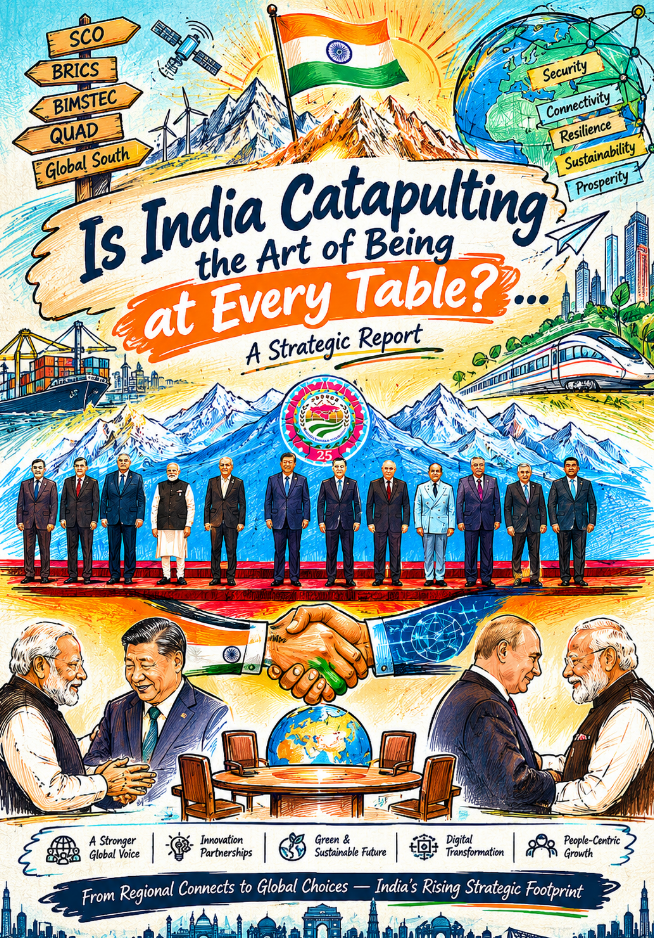
India’s recent diplomatic architecture the SCO summit in Bishkek, its 2026 BRICS presidency, deepening BIMSTEC ties, continued Quad engagement, its tariff standoff with Washington, and now Russia’s proposed overland rail corridor to the Indian Ocean is best read as one coherent strategy of multi-alignment without dependence, rather than a series of disconnected events. Each platform performs a distinct function (the SCO for continental reach, BRICS for Global South influence, BIMSTEC for the immediate neighborhood, the Quad for Indo-Pacific technology and maritime cooperation), while the same themes of security, connectivity, resilience, and diversification run through all of them; Russia’s rail proposal fits squarely into this pattern, offering India a potential alternative to maritime chokepoints like the Strait of Hormuz and Bosphorus and reinforcing energy-security ties with Moscow even as India also expands ties with Washington, Tokyo, and the Gulf. The underlying goal is “autonomy through interdependence” access to American technology, Russian energy and connectivity, Chinese markets, and Global South goodwill simultaneously, without dependence on any single power but India’s influence remains real yet bounded, since projects like the Russia-India rail link face severe geopolitical bottlenecks, meaning the true test of India’s networked diplomacy is not the number of proposals or summits, but whether they eventually translate into functioning, resilient infrastructure and reduced vulnerability to disruption from any one actor.
Bishkek Was No Side Note
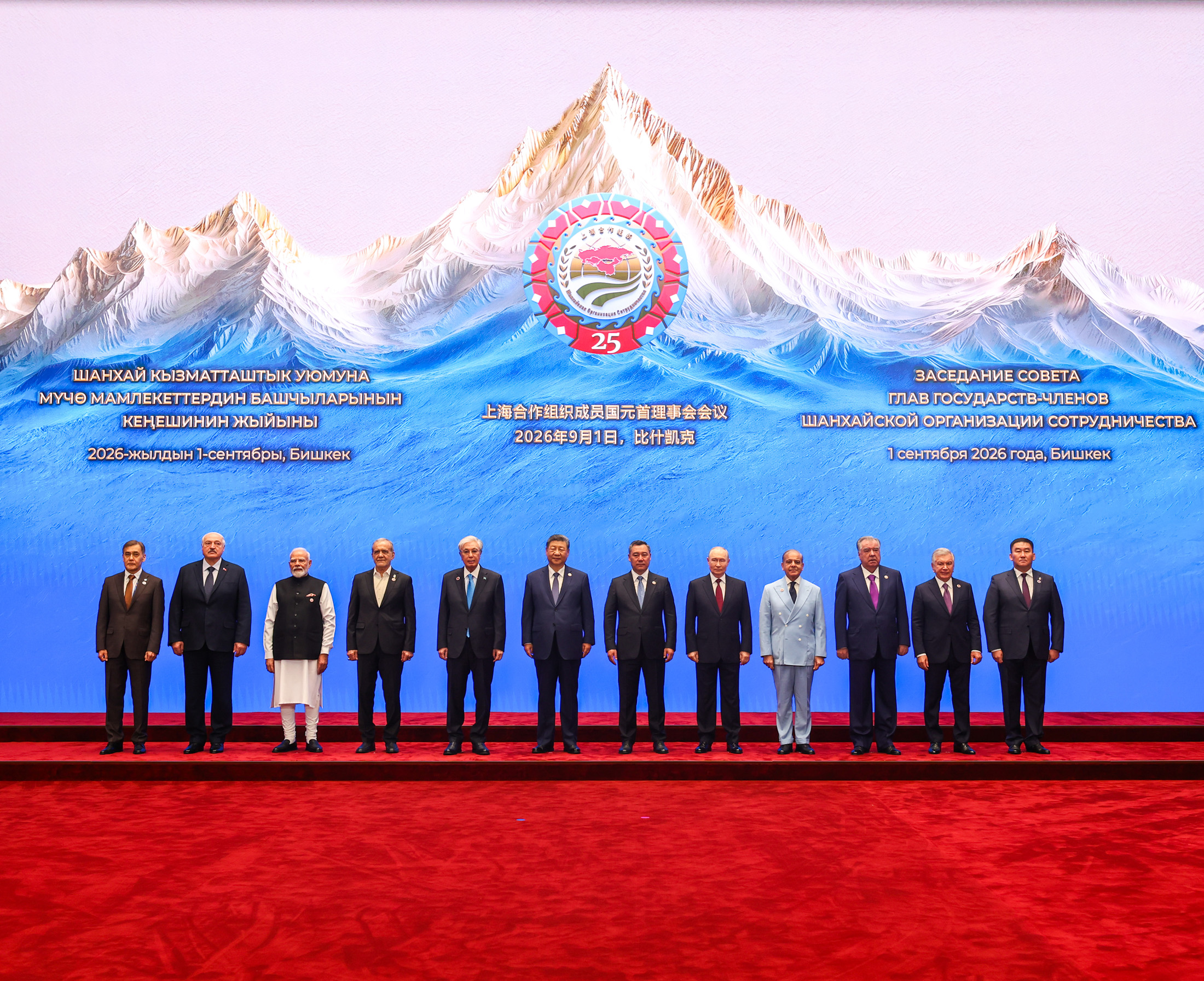
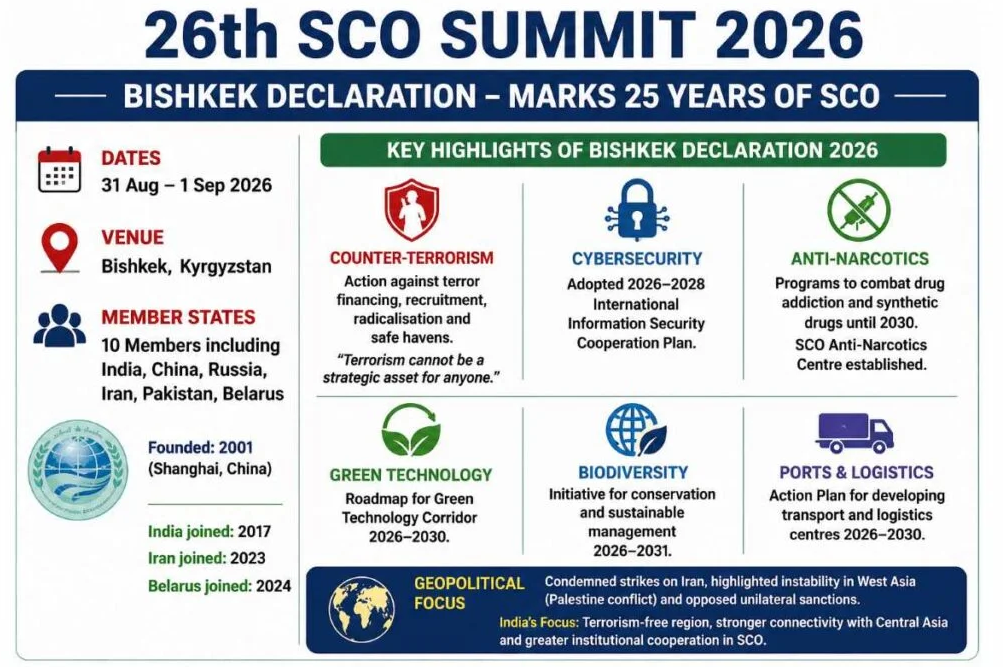
The 26th Meeting of the Council of Heads of State of the SCO was held in Bishkek, Kyrgyzstan, on 31 August–1 September 2026, marking the organisation’s twenty-fifth anniversary. The summit brought together all ten member states China, Russia, India, Pakistan, Kazakhstan, Kyrgyzstan, Tajikistan, Uzbekistan, Iran and Belarus alongside a wider SCO Plus grouping. Leaders adopted the Bishkek Declaration and 28 documents covering security, emergency assistance, economic cooperation and other areas of the organisation’s expanding agenda.
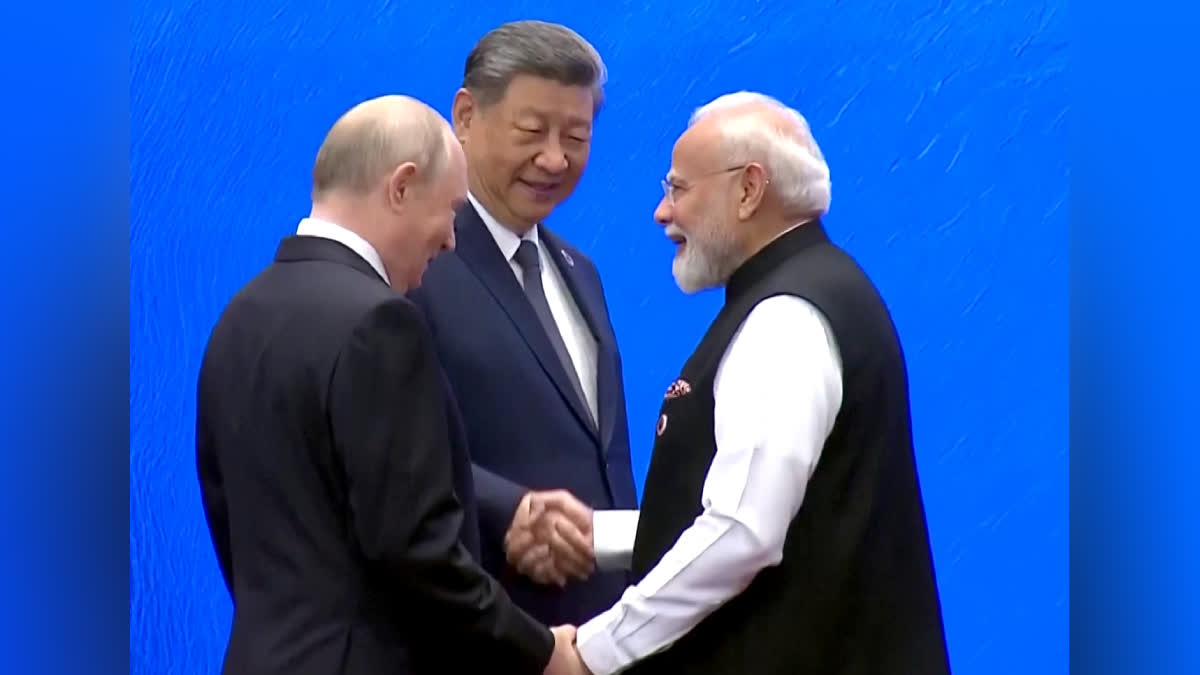
That expansion of the SCO agenda is itself significant. An organisation originally constructed around security concerns is increasingly discussing development finance, logistics, technology, energy, climate, biodiversity and other transnational questions. The proposed SCO Development Bank is particularly revealing. Consultations on its establishment had already advanced during 2026, including discussions on its institutional design and financial mechanisms.
This matters because the contemporary security environment can no longer be separated neatly from economic resilience. A country whose energy supplies can be disrupted, whose trade routes can be blocked, whose technology systems can be denied access or whose financial transactions can be constrained is strategically vulnerable even without a military confrontation.
Security, therefore, is increasingly inseparable from connectivity, finance, technology and energy.
That is precisely where India’s approach at Bishkek becomes analytically important. Prime Minister Narendra Modi returned to a framework India had articulated earlier for the SCO: Security, Connectivity and Opportunity. The formulation was not simply rhetorical. It represented an attempt to redefine regional cooperation around the proposition that shared geography should generate shared economic and developmental possibilities.
The underlying logic is straightforward: insecurity constrains connectivity; poor connectivity constrains trade; weak trade constrains development; and developmental weakness creates further sources of insecurity. Breaking that cycle requires treating these issues as parts of a single strategic ecosystem.
India’s SCO approach therefore contains two simultaneous messages.
- The first is that security cooperation must be uncompromising on terrorism and transnational threats. Modi again emphasised the need to address the entire ecosystem surrounding terrorism, including financing, recruitment, radicalisation and safe havens.
- The second is that connectivity cannot be divorced from sovereignty and territorial integrity. India supports greater regional connectivity, but not connectivity projects that disregard its core territorial concerns. The distinction is particularly relevant in relation to corridors passing through Pakistan-administered Kashmir.
This is an important feature of India’s diplomatic method: it does not reject connectivity; it seeks to shape the rules under which connectivity takes place.
That approach also explains why India’s SCO engagement increasingly extends beyond traditional security diplomacy. The promotion of English within the organisation, cultural and civilisational exchanges, scientific cooperation and the proposed SCO Civilisation Dialogue Forum all widen the constituency through which India can exercise influence. The objective is not simply to negotiate with governments, but to build institutional, intellectual and societal linkages.
The significance of Bishkek, therefore, lies less in any single declaration than in the strategic vocabulary it reinforces. And that vocabulary travels.
The same ideas become visible on a much larger canvas through India’s 2026 BRICS presidency.
India assumed the BRICS chair on 1 January 2026, inheriting a grouping that has itself changed dramatically. BRICS now comprises eleven full members, while its agenda extends well beyond its original economic rationale into technology, climate, health, finance, governance and development.
India has organised its presidency around four pillars: Resilience, Innovation, Cooperation and Sustainability.
At first glance, these appear different from the SCO’s Security, Connectivity and Opportunity framework. At a deeper level, however, they address the same strategic problem.
How can states retain policy autonomy when the international system itself has become increasingly vulnerable to disruption?
Resilience addresses supply chains, health and economic shocks.
Innovation addresses technological dependence and the digital divide.
Cooperation addresses the fragmentation of global governance.
Sustainability addresses the energy, climate and environmental pressures that increasingly determine economic security.
The connection with the SCO becomes especially visible in India’s emphasis on digital public infrastructure, artificial intelligence, capacity building and technology cooperation. Under India’s BRICS presidency, the ICT track has focused on sustainable and resilient digital ecosystems, cybersecurity, digital skills, innovation and entrepreneurship, while discussions have also advanced cooperation on Digital Public Infrastructure.
This is more than a technology agenda. India is effectively attempting to turn developmental capabilities into instruments of diplomatic influence.
The proposition is that countries of the Global South do not necessarily need to reproduce Western institutional models or become dependent on Chinese infrastructure and technology ecosystems. There is another possibility: interoperable, affordable and locally adaptable public digital systems built around national ownership.
That is why the BRICS agenda should not be understood merely as an exercise in reforming global institutions. It is simultaneously an attempt to expand the menu of choices available to developing countries.
India’s preference for reform rather than replacement is equally significant. New Delhi advocates changes to institutions such as the UN Security Council, IMF and World Bank rather than abandoning the existing multilateral architecture altogether. This allows India to challenge asymmetries in the international system without positioning itself as an outright revisionist power.
The same calibrated approach is visible in the financial sphere.
India remains cautious about the idea of a common BRICS currency, even while participating in discussions on greater use of national currencies and more resilient financial arrangements. That is not necessarily inconsistency. It reflects an effort to reduce vulnerability without creating a new form of dependence.
In other words, India seeks diversification rather than decoupling.
And that distinction becomes particularly important when the story moves from BRICS to Washington.
The Economic Dimension of Strategic Autonomy
The 2025–26 confrontation with the United States exposed the limits and the practical value of India’s strategy more starkly than any summit declaration could.
Washington first imposed a 25% tariff on Indian goods in August 2025 and subsequently imposed an additional 25% tariff linked to India’s purchases of Russian oil. The combined burden reached 50%. The dispute was therefore not simply a trade disagreement. It became a test of whether economic interdependence could be used as geopolitical leverage.
India’s position reflected a familiar principle: external partnerships could not automatically determine its domestic economic choices or energy security. But the subsequent settlement also demonstrates why strategic autonomy should not be confused with strategic isolation.
In February 2026, Washington and New Delhi reached an interim trade framework under which the US reciprocal tariff on Indian goods was reduced to 18%, while India agreed to reduce barriers to American products and committed to stop directly or indirectly importing Russian oil. The United States also removed the additional 25 percent punitive tariff.
The lesson is therefore more nuanced than either side’s triumphalist narrative. India did not demonstrate that American economic power had become irrelevant. Nor did Washington demonstrate that India could simply be compelled to abandon strategic autonomy. Instead, the episode demonstrated something more important: interdependence itself has become an arena of strategic bargaining.
India’s ability to negotiate depended partly on the fact that it possessed multiple external relationships and multiple sources of strategic value. Its relationship with Russia remained important; its relationship with the United States remained indispensable; its role in BRICS continued; its participation in the SCO provided another channel of engagement; and its wider partnerships across Europe, the Indo-Pacific, West Asia and the Global South prevented the relationship with any single power from becoming the sole determinant of Indian foreign policy.
Strategic autonomy, therefore, is increasingly less about standing apart from power blocs and more about ensuring that no single bloc possesses decisive leverage over India. That is the deeper connection between the tariff episode and the summit diplomacy.
From Eurasia to the Bay of Bengal
If the SCO gives India access to the Eurasian strategic space and BRICS gives it a wider Global South platform, BIMSTEC performs a different but complementary function.
It anchors India’s multi-alignment strategy in its immediate neighbourhood. This distinction is crucial.
India cannot translate global influence into durable power unless it is able to shape the regional environment around it. BIMSTEC provides a mechanism to connect South Asia with Southeast Asia through the Bay of Bengal while avoiding the structural paralysis that has constrained SAARC.
The organisation has also become more institutionalised. Its Charter entered into force in 2024, while India leads the Security pillar, encompassing counter-terrorism and transnational crime, disaster management and energy security. Other members lead areas including connectivity, environment and climate change, agriculture and food security, science and technology, and trade and investment.
That division of labour reveals another important connection.
BIMSTEC effectively translates the broad vocabulary of India’s global diplomacy into a regional development framework.
Security is linked to disaster management.
Energy security is linked to regional connectivity.
Climate resilience is linked to economic development.
Trade is linked to transport infrastructure.
People-to-people contact is linked to cultural and economic integration.
The result is a more integrated conception of regional security, one in which military preparedness is only one component of resilience.
The planned first BIMSTEC Maritime Security Exercise in the second half of 2026 is illustrative. Preparatory work has already included agreement on guiding principles for maritime law-enforcement interaction and coordinated marine oil-spill response.
Maritime security in the Bay of Bengal is consequently not merely about naval power. It is about shipping, energy flows, disaster response, environmental risks, law enforcement and the protection of economic corridors.
Once again, security becomes connectivity, and connectivity becomes economic resilience.
The Quad Completes
The apparent contradiction between India’s participation in the SCO and the Quad disappears once the two are viewed according to function rather than ideology. The SCO provides India with a platform in which China, Russia, Central Asia and Iran are central actors. The Quad provides a platform through which India works with the United States, Japan and Australia across the Indo-Pacific.
BIMSTEC anchors India’s regional neighbourhood.
BRICS expands its influence across the Global South.
These are not interchangeable organisations, and India does not expect them to become one.
Their value lies precisely in their differences.
The Quad’s agenda illustrates this broader conception of security. Its cooperation extends beyond traditional defence to resilient infrastructure, critical technologies, cybersecurity, health security, clean energy, maritime security and humanitarian assistance. India’s engagement with the Quad has included cooperation through the Coalition for Disaster Resilient Infrastructure and projects involving clean energy and resilient infrastructure.
This creates a fourth layer in India’s emerging strategy.
If the SCO manages India’s continental strategic exposure, BIMSTEC manages its immediate maritime neighbourhood, BRICS expands its Global South influence, and the Quad strengthens its Indo-Pacific partnerships, India is effectively constructing a network rather than choosing a camp.
That distinction is perhaps the most important analytical insight.
The Architecture Is Not a Set of Circles; It Is a Network
It is tempting to describe these institutions as concentric circles, but even that understates the degree of overlap.
The same themes pass through all of them.
Security appears in the SCO, BIMSTEC and Quad, but increasingly includes cyber threats, terrorism, maritime risks, energy security and disaster resilience.
Connectivity appears in the SCO’s Eurasian corridors, BIMSTEC’s Bay of Bengal architecture and the Quad’s infrastructure and digital initiatives.
Resilience appears in BRICS discussions on supply chains and finance, in Quad cooperation on infrastructure and technology, and in BIMSTEC’s disaster-management agenda.
Technology links India’s digital public infrastructure diplomacy with BRICS, critical and emerging technology cooperation through the Quad, and the SCO’s growing interest in artificial intelligence and digital systems.
Sustainability links BRICS’s environmental agenda with BIMSTEC’s climate pillar, the Quad’s clean-energy initiatives and the SCO’s expanding environmental cooperation.
This repetition is not redundancy.
It is strategic interoperability.
India is taking concepts developed in one institutional setting and carrying them into another, adapting them to different memberships and different political circumstances.
That is why the Bishkek summit should not be treated as an isolated diplomatic event. It is one node in a much larger network.
From Non-Alignment to Multi-Alignment
The historical comparison with non-alignment is useful, but only if handled carefully.
Cold War non-alignment was principally concerned with avoiding formal alignment with either of the two dominant blocs.
The contemporary environment is fundamentally different.
There are no two neatly bounded blocs.
China is simultaneously an economic competitor, a major trading partner and a member of the same multilateral institutions as India.
Russia remains a major energy and defence partner even while its war in Ukraine has reshaped global geopolitics.
The United States is a strategic partner in technology, defence and the Indo-Pacific while also being capable of using trade and financial instruments to pursue its interests.
Europe is an increasingly important economic and technological partner.
The Gulf is central to India’s energy and investment interests.
The Global South is simultaneously a diplomatic constituency and a development partner.
Under these circumstances, choosing one camp would itself reduce India’s strategic options.
India’s response has consequently been to maintain relationships across competing power centres while building issue-specific coalitions around its interests.
This is multi-alignment. Its effectiveness, however, does not arise simply from having many partnerships. It arises from the ability to ensure that those partnerships reinforce rather than undermine one another. That is the strategic challenge.
Autonomy Through Interdependence
Seen from this perspective, India’s foreign policy is moving away from the old conception of strategic autonomy as distance from great-power rivalry.
The emerging model is closer to autonomy through interdependence.
India wants American technology without becoming strategically dependent on Washington.
It wants Russian energy and defence cooperation without becoming politically subordinate to Moscow.
It wants economic engagement with China without accepting Chinese strategic primacy.
It wants participation in BRICS without turning the organisation into an anti-Western bloc.
It wants cooperation with the Quad without transforming it into an exclusive military alliance.
It wants BIMSTEC to deepen regional integration without reproducing the institutional weaknesses of older South Asian arrangements.
The common denominator is choice.
The purpose of multi-alignment is to enlarge India’s choices.
That also explains India’s emphasis on resilience. A resilient state is not one that avoids interdependence; it is one that can absorb disruption because it has diversified its relationships, supply chains, technologies, markets and strategic partnerships.
The 2025–26 tariff dispute illustrated the vulnerability created by concentrated dependence.
The SCO’s connectivity agenda illustrates the search for alternatives.
BRICS illustrates diversification of economic and institutional partnerships.
BIMSTEC illustrates regional integration.
The Quad illustrates technological, maritime and infrastructure partnerships.
Together they form an ecosystem of strategic risk management.
From Summitry to Strategy
This is ultimately why the sequence from Bishkek to BRICS, from BRICS to BIMSTEC and from BIMSTEC to the Quad is more significant than the individual meetings themselves. India is gradually constructing a foreign-policy architecture in which no single institution has to accomplish everything. The SCO does not have to provide India with a complete economic alternative to the West. BRICS does not have to become an anti-Western alliance. BIMSTEC does not have to replace every South Asian institution. The Quad does not have to become a formal military bloc.
Instead, each platform performs a particular strategic function while reinforcing India’s larger objective. The SCO expands India’s continental diplomatic reach. BRICS expands its voice in global governance. BIMSTEC strengthens its immediate neighbourhood and Bay of Bengal position. The Quad expands its Indo-Pacific technological, maritime and infrastructure partnerships. Bilateral relationships with the United States, Russia, Europe, Japan, the Gulf and other partners then provide additional connective tissue between these institutional platforms.
The result is not a bloc. It is a networked strategy. And that may be the most appropriate foreign-policy architecture for a genuinely multipolar century. India’s ambition, therefore, should not be understood simply as becoming a leader of the Global South, a counterweight to China or a bridge between East and West. Those descriptions capture pieces of the picture but miss the underlying strategy. The larger ambition is to become a pivotal power capable of operating simultaneously across competing systems without becoming captive to any one of them.
The question for India is no longer whether it can navigate between competing poles. It is whether it can turn that navigation into durable institutional influence, economic resilience and tangible public goods for the countries with which it partners. That is where the distinction between diplomatic visibility and strategic leadership will ultimately be decided.
*Editor, Focus Global Reporter