
Dr. Arvind Kumar*
What does it transcribe when one prime minister is expected to travel to Miami, Brussels and Ottawa within a single December, and why is the world reading a diplomatic calendar as if it were a manifesto? The answer lies in the strategic choices India is making at a moment when the international order is becoming increasingly transactional, contested and unpredictable. In September, at the BRICS summit in New Delhi, Prime Minister Narendra Modi warned against the weaponisation of technology and critical minerals. Twelve days later, at the United Nations General Assembly in New York, External Affairs Minister S. Jaishankar argued that the world would not be defined by binary choices. Read together, these statements articulate a central proposition of Indian statecraft: strategic autonomy is not secured by choosing between competing powers, but by preserving the ability to engage with them without surrendering independent judgement.
The stakes extend beyond great-power rivalry. Unilateralism, economic coercion and the triple planetary crisis are compounded by energy insecurity, mounting debt, supply-chain disruptions and El Niño-related risks. These interconnected pressures threaten food and water security, economic stability and the development prospects of vulnerable countries, making resilience as important as diplomatic manoeuvring.
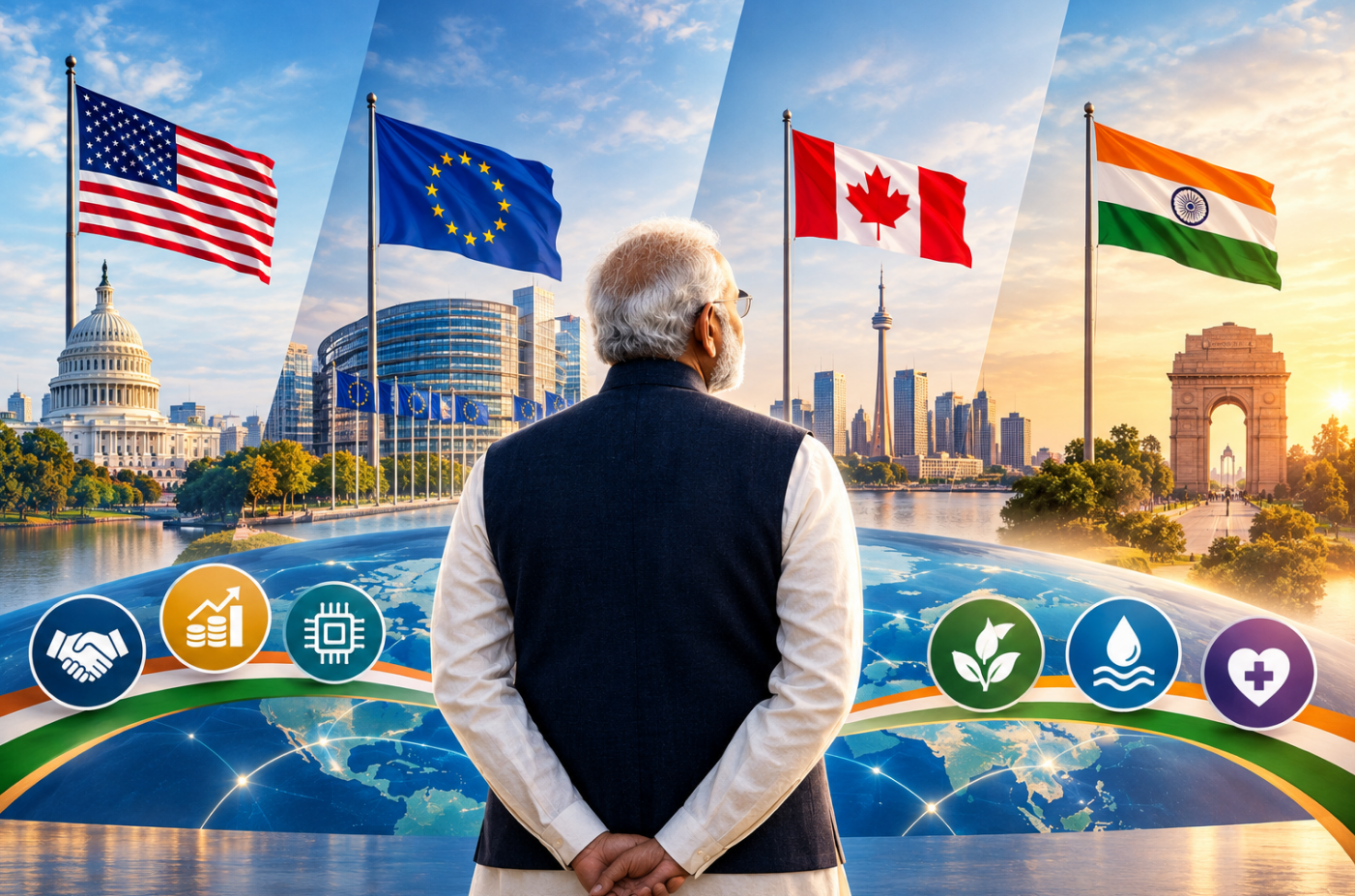
Against this backdrop, reports have pointed to Prime Minister Modi’s expected participation in the G20 Summit at Doral, Florida, on 14–15 December, a possible India–EU FTA signing in Brussels on 16 December, and renewed engagement with Canada. Together, these engagements reflect a strategy of diversification: Washington offers market and security ties, Brussels economic alternatives, and Ottawa opportunities in energy and critical minerals.
This is strategic hedging not equidistance, but the cultivation of multiple partnerships to preserve India’s freedom of action and reduce dependence on any single power.
Scope of Heralding New Partnerships
Brussels represents one of the most consequential opportunities. Following the conclusion of India–EU free trade negotiations in January 2026, the proposed agreement has acquired significance beyond conventional market access. The agreement connects two major economic centres at a time when both are seeking to diversify commercial relationships, strengthen supply chains and reduce exposure to concentrated geopolitical risks. For India, improved access to European markets could support manufacturing, services, investment and the integration of Indian firms into global value chains.
Ottawa offers a different, though complementary, opportunity. Relations between India and Canada deteriorated sharply in 2023 following security allegations, making the restoration of diplomatic confidence an important test of both countries’ willingness to separate immediate political tensions from longer-term interests. Prime Minister Mark Carney’s visit to India in March 2026 helped establish a basis for renewed engagement, including a reported uranium supply agreement with Cameco valued at approximately $2.6 billion, a new defence dialogue and an ambition to raise bilateral trade to $50 billion by 2030.
Canada brings potential cooperation in uranium, energy, critical minerals, education and investment. India brings a large consumer market, skilled professionals, industrial demand and opportunities for Canadian businesses seeking diversification. Both countries also have an interest in more resilient supply chains. Their partnership, however, will require sustained diplomatic engagement and credible mechanisms for managing disagreements over security, migration and political sensitivities.
Strategic Balancing Amid Uncertainty
Washington remains the most difficult component of India’s diplomatic balancing act. The possibility of further tariff action linked to India’s energy trade with Russia also illustrates how commercial relations can become entangled with strategic disagreements. India must negotiate for predictable market access without allowing short-term concessions to compromise longer-term economic or energy security.
The pressures extend beyond trade. The Trump administration’s extension of restrictions associated with a $100,000 payment requirement for certain new H-1B workers entering the United States has added uncertainty for employers and internationally mobile professionals, including many Indians. The measure remains subject to legal contestation, making its practical effects a matter to monitor rather than a settled outcome.
Energy security adds another layer. India’s need for affordable and reliable energy must be reconciled with exposure to geopolitical shocks, sanctions and changing trade conditions. Currency depreciation, imported-energy costs and global financing pressures can further narrow the space available for domestic investment. These pressures do not make engagement with the United States less valuable; they make diversification and careful negotiation more necessary.
A Modi–Trump meeting, therefore, would be less a victory lap than an exercise in calibration: maintaining cooperation where interests converge, defending India’s core economic and security interests where they diverge, and ensuring that engagement does not become dependence. Strategic autonomy is meaningful only when India can sustain relationships without allowing any single one to determine the limits of its choices.
From Hedging to Leadership
The decisive question, however, extends beyond India. Mr Jaishankar has described a Global South in the front row of crises but the back row of decision-making. India chaired BRICS this year, hosting Xi Jinping and Vladimir Putin in New Delhi in September; Shri Modi ji told the G7 at Evian that developing nations want “to become participants” rather than beneficiaries; and Finland’s President Alexander Stubb told the Raisina Dialogue that the Global South, with India central, will decide whether the world tilts towards “conflictual multipolarity” or a cooperative order. A leader who can speak in Miami, sign in Brussels and negotiate in Ottawa demonstrates something the Global South seldom sees: a developing power that is courted rather than conscripted, and that writes terms rather than merely accepting them. If India can show that tariff-free access, technology and energy can be secured without surrendering autonomy, the template is portable to Africa, Southeast Asia and Latin America. In a G20 whose American host has narrowed the agenda, India’s voice may be the nearest thing the South has to a seat at the table. But a bridge that carries only its owner’s traffic is merely a toll road, and the Global South will judge accordingly.
Candour also demands that we name the self-interest beneath the vocabulary of multipolarity. Bilateral deals are fragmentation’s native tongue: every agreement written by two parties leaves third parties outside its walls, and India’s red lines on agriculture and dairy, its Russian energy purchases and its refusal of binding dispute settlement with Europe reveal a state hedging first and harmonising second. The measure of statecraft is whether today’s bargains harden into institutions others can inhabit.
Way Forward
Sequence and substance. Delhi should bank what is ready, the Brussels signature and a Canadian CEPA, so that each agreement strengthens its hand in the harder American negotiation. In Miami, a narrow interim deal that secures a tariff advantage over competing exporters, with agricultural and dairy red lines intact, is worth more than a sweeping one signed under pressure. And India should carry the Global South’s priorities of debt, energy transition and technology access into every room through issue-based coalitions rather than rhetoric, sharing its standards and digital public infrastructure so that bilateral gains become collective ones.
The questions, finally, belong to all of us. Is “strategic autonomy” a genuine doctrine, or a dignified euphemism for transactional hedging? Can India carry the concerns of debt-laden and climate-exposed nations into a room whose host has little appetite for them, without being dismissed as a guest at someone else’s banquet?
*Editor, Focus Global Reporter