Dr. Arvind Kumar*

India, through its capital city, New Delhi, finds itself hosting two major multilateral events – the 11th Quad Foreign Ministers’ Meeting and BRICS leaders’ summit in September 2026. These platforms offer New Delhi an opportunity to advance its economic, security and diplomatic interests, but also expose challenges of consensus, strategic autonomy and implementation. Quad is an informal “non-treaty” grouping (as EAM Jaishankar notes) with no binding commitments, and India is wary of being drawn into an alliance that might provoke China. In BRICS, India must balance China and Russia’s larger agendas for instance, resisting an “anti-Western” tilt that some analysis warns is “not to India’s liking” even as it tries to steer the bloc toward issues like health, supply chains and climate. India is indeed benefiting from both forums but unevenly: it can leverage Quad’s technology and security cooperation and BRICS’s finance and South–South ties, yet its own influence is constrained by competing member interests and domestic capacity.
The global context makes Quad and BRICS more salient for India as they come at a moment when supply shocks and climate issues directly affect India’s economy and security. Quad discussions are now shifting from broad talk to concrete agendas on energy and maritime security, given the recent disruptions in West Asia. For example, Quad ministers agreed to a new “Critical Minerals” framework and an Indo-Pacific Energy Security initiative, reflecting India’s interest in securing raw materials and resilient energy supplies. Australia’s foreign minister Penny Wong even hailed the Quad as a “vital partnership” for peace and prosperity in the Indo-Pacific. Hosting the meeting allowed India to spotlight issues like undersea connectivity and Pacific-island resilience. Overall, New Delhi’s active role in Quad events signals its determination to shape a rules-based regional order, even as it seeks tangible deliverables to protect trade and security.
Rules-based regional order
India’s chairing of BRICS (with the theme “Building Resilience and Innovation for Cooperation and Sustainability”) gives it a prominent platform and can leverage strategic advantages, including increased influence over global governance reform, alternative financial mechanisms and enhanced cooperation on critical issues such as energy security, technology and climate change”. India’s participation in both Quad and BRICS reflects a balanced “multi-alignment” strategy: it secures Western technology and support while also deepening ties with non-Western powers and the Global South.
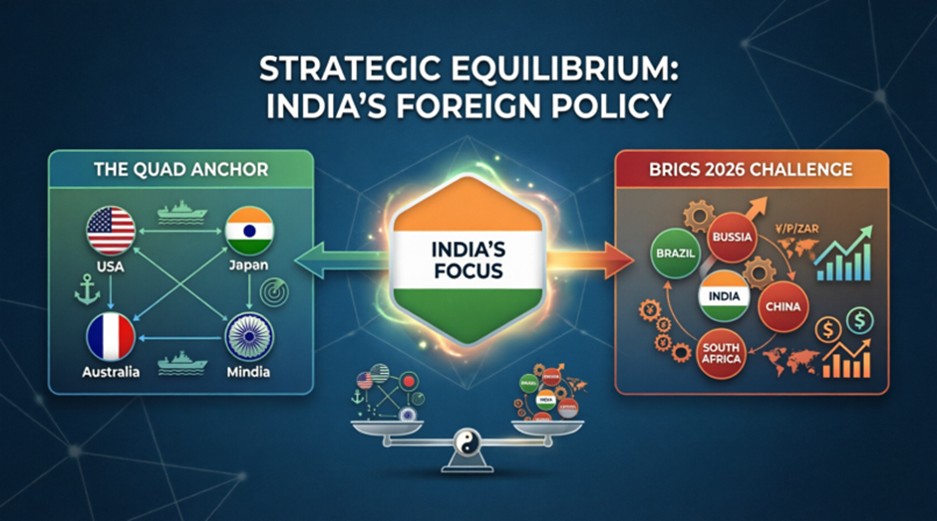
Both the Quad and BRICS provide India with significant economic, strategic, and diplomatic benefits through different approaches. The Quad strengthens India’s access to advanced technology, resilient supply chains, maritime security cooperation, and growing trade and investment with major economies such as the United States, Japan, and Australia, thereby supporting India’s economic and Indo-Pacific ambitions. In contrast, BRICS enhances India’s influence within the Global South by promoting reforms in global financial institutions, expanding development financing through the New Development Bank, and improving energy security through closer ties with major oil exporters such as Saudi Arabia, the UAE, and Russia. While the Quad reinforces India’s strategic and technological alignment with advanced democracies, BRICS helps India project itself as a leader of emerging economies and balance China’s influence in the developing world. India’s dual participation in Quad and BRICS is both a strength and a squeeze. It ensures New Delhi is “at every table” as a Quad founder and a BRICS leader which magnifies its global voice. But to fully capitalize, India must convert rhetoric into results. It must use both platforms strategically: for example, in Quad India should propose concrete projects that match its own development goals. It should also press for more inclusive agendas adding climate and health cooperation to Quad plans so these forums remain relevant to Indian priorities. In BRICS, India can leverage its chair status to accelerate NDB financing for its infrastructure needs, and to build coalitions on shared issues like reforming global financial architecture and resisting economic coercion.
Challenges
Despite the opportunities offered by both the Quad and BRICS, India faces significant structural limitations in maximizing gains from either platform. The Quad remains an informal, non-treaty grouping, allowing India to preserve its strategic autonomy but limiting its ability to shape the bloc’s direction or secure firm security guarantees. While the grouping strengthens India’s Indo-Pacific partnerships, its agenda largely avoids India’s core bilateral security concerns with China and Pakistan, focusing instead on broader regional stability, technology cooperation, and maritime security. As a result, India often adopts a cautious and incremental approach within the Quad, balancing its strategic interests against the risk of economic retaliation from China and avoiding deeper alliance commitments. Conversely, within BRICS, India must navigate growing internal divergences as China and Russia increasingly push the bloc toward an anti-Western orientation that does not fully align with India’s multi-alignment strategy. Expanding membership has made consensus more difficult on issues such as Ukraine, sanctions, global financial reforms, and trade coordination, while China’s overwhelming economic dominance continues to shape the bloc’s priorities. Although India uses BRICS to advocate reforms in global governance and strengthen its Global South leadership, its influence remains constrained by competing national interests and power asymmetries. Consequently, India’s simultaneous engagement with the Quad’s democratic strategic framework and BRICS’s emerging-market coalition reflects a complex balancing act that is becoming increasingly difficult as geopolitical polarization intensifies.
Way Forward
India needs to bolster its institutional capacity speeding up project approvals and investing in manufacturing and digital systems so that bilateral promises yield faster outcomes. As commentators emphasize, India should also deepen ties beyond the big blocs: expanding partnerships in Africa, Southeast Asia and the Middle East can diversify its dependencies. Ultimately, its approach should remain constructive and pragmatic. Both Quad and BRICS can help cushion external shocks by helping secure supply chains and maritime lanes, and by offering alternative financing and energy. India’s recent moves (such as championing a free Indo-Pacific order while also bridging ties with Eurasia) suggest it is already navigating this balance. The key is to align these memberships with India’s domestic imperatives: turn strategic autonomy into “selective proximity” that delivers trade, technology and security dividends. The coming Quad and BRICS summits are thus highly relevant: they test how effectively India can shape multilateral platforms to its benefit while remaining a fulcrum between East and West.
*Editor, Focus Global Reporter