Excerpts from an interview of Dr. Shaji Krishnan V, Chairman, NABARD by Dr. Arvind Kumar, Editor, Focus Global Reporter

Dr. Shaji Krishnan V has been serving as Chairman of the National Bank for Agriculture and Rural Development (NABARD) since December 2022. With over three decades of distinguished experience spanning commercial banking, development finance, and rural banking, he brings deep domain expertise and strategic leadership to India’s apex development finance institution for agriculture and rural development.
Prior to his appointment as Chairman, he served as Deputy Managing Director at NABARD, where he led several transformational initiatives. These include the establishment of NABARD’s Climate and Sustainability vertical, development of fintech engagement strategies, creation of a comprehensive data warehousing system, digitisation of supervisory processes, and strengthening of enterprise-wide risk management frameworks.
Dr. Shaji has over a decade of board-level experience and currently serves on the boards of key national institutions, including the Sahakar Sarathi Private Limited (SSPL), the Open Network for Digital Commerce (ONDC), and the National Cooperative Development Corporation (NCDC). He also chairs NABARD Consultancy Services Ltd. (NABCONS) and NABVENTURES Ltd., the institution’s venture capital arm supporting agri-food and rural innovation. In addition, he is Chairman of the Bankers’ Institute of Rural Development (BIRD), Lucknow, and serves on the governing bodies of the Entrepreneurship Development Institute of India (EDII), Ahmedabad, and the National Institute of Bank Management (NIBM), Pune.
His past board engagements include the National Payments Corporation of India (NPCI), Canara HSBC Life Insurance Company Ltd., and Canara Bank Securities Ltd. He has also chaired key NABARD subsidiaries such as NABKISAN Finance, NABFoundation, and NABSanrakshan. At the international level, he has served as Chairman of the Asia-Pacific Rural and Agricultural Credit Association (APRACA) and has led several expert committees constituted by the Government of India on rural finance, cooperative reforms, and sustainable development.
Before joining NABARD, Dr. Shaji had a distinguished 26-year career with Canara Bank, where he held senior leadership positions, including General Manager and Head of Business Development. He played a key role in the amalgamation of Syndicate Bank with Canara Bank and served as Chairman of Kerala Gramin Bank, then the largest Regional Rural Bank in India, where he advanced financial inclusion and digital transformation.
EDITOR: NABARD has completed 44 years, and you have spoken about driving inclusive growth through digital transformation, rural enterprise support, and mission-mode projects. Under the national vision of Viksit Bharat 2047, how do you define NABARD’s strategic positioning for rural transformation over the next decade?
DR. SHAJI KRISHNAN V: As India advances towards the vision of Viksit Bharat 2047, rural transformation must be viewed through a much broader lens than agriculture alone. The future of rural India will be shaped by the convergence of digital infrastructure, climate resilience, entrepreneurship, financial inclusion, strong local institutions, and innovation-led growth. In this evolving landscape, NABARD is positioning itself not merely as a development finance institution but as a catalyst for integrated rural transformation.
Our strategy over the next decade is anchored in five key shifts.
First, we are moving from being a credit provider to a rural economic architect. The focus is expanding beyond agricultural finance to strengthening entire rural value chains through FPOs, agri-processing, and non-farm enterprises. Our objective is not only to raise productivity but to sustainably enhance rural incomes. In this direction, NABARD has partnered with the National Skill Development Corporation (NSDC) to facilitate the creation of 4,000 rural enterprises over the next three years, with similar collaborations being explored with UNICEF’s YuWaah initiative.
Second, climate resilience will be a defining pillar of rural transformation. Through our Climate Strategy 2030, dedicated climate-focused department, and financing instruments such as NABARD Green Lending Facility (NGLF), NABARD Green Impact Fund (NGIF), Climate Change Fund-Interest Differential (CCF-ID) and NABARD Carbon Asset Financing (NCAF) under NABARD Carbon Fund (NCF), NABARD is building a robust climate finance ecosystem to support water security, regenerative agriculture, renewable energy, and resilient livelihoods.
Third, we are strengthening digital and financial inclusion ecosystems. Initiatives such as the Centralised Digital Credit Infrastructure, including Jan Sethu and Sahakar Sethu, will improve efficiency, transparency, and customer experience while enhancing the competitiveness of rural financial institutions.
Fourth, NABARD will continue to build stronger rural institutions at scale. Accelerator programmes for FPOs, PACS, and MFIs, along with initiatives such as Sahakar Sarathi Pvt. Ltd., are aimed at improving governance, market linkages, and institutional sustainability.
Fifth, we will increasingly act as a mobiliser of blended finance, leveraging public resources to attract private and impact capital for rural infrastructure, climate action, and enterprise development.
NABARD will also strengthen its role as a policy thought leader through data-driven insights and field-based evidence. Our objective is to build a rural economy that is inclusive, climate-resilient, market-linked, and digitally empowered, with success measured by stronger institutions, higher incomes, and sustainable livelihoods.
EDITOR: NABARD has launched its Climate Strategy 2030, built on four pillars: accelerating green lending, shaping markets, internal green transition, and strategic resource mobilisation. How would you assess the on-ground progress of these pillars so far, and what have been the biggest implementation challenges?

DR. SHAJI KRISHNAN V: Climate change is one of the most significant risks facing India’s rural economy, particularly affecting small and marginal farmers, women, and vulnerable communities. Recognising this challenge, NABARD operationalised its Climate Strategy 2030 to integrate climate action into rural finance and development while strengthening resilience and promoting sustainable growth.
Under Accelerating Green Lending, we have moved from pilot interventions to a more structured climate finance architecture through initiatives such as the NABARD Green Lending Facility (NGLF) and the NABARD Green Impact Fund (NGIF). Strategic partnerships with institutions such as Bank of India, REC Limited, and NIIF have strengthened our ability to scale climate-positive investments. However, challenges remain in building a pipeline of bankable green projects and addressing the risk perceptions associated with long-gestation investments.
Through the Market Making pillar, NABARD is helping build the ecosystem required for climate finance to flourish. The NABARD Carbon Fund, expansion of the DiCRA platform, AI-enabled climate analytics, and innovation initiatives such as the National Climate Stack Innovation Challenge are creating stronger foundations for climate-informed decision-making. At the same time, gaps in MRV systems, limited climate data, and high transaction costs continue to constrain participation by smallholders.
The Internal Green Transformation pillar focuses on embedding climate considerations across NABARD’s own systems. ESG policies, climate risk frameworks, green taxonomy integration, and portfolio-level green tagging are helping us evolve into a climate-aligned institution. The principal challenge here is building capacity across the ecosystem to effectively operationalise these frameworks.
Under Strategic Resource Mobilisation, NABARD has expanded engagement with international climate funds and development partners to attract concessional finance. However, project execution delays, compliance requirements, and co-financing challenges remain areas requiring attention.
The progress achieved so far has laid a strong foundation. Going forward, our focus will be on strengthening project pipelines, scaling blended finance solutions, enhancing climate data infrastructure, and building institutional capacities. Ultimately, our objective is to ensure that climate action translates into resilience, sustainable livelihoods, and inclusive rural growth.
EDITOR: Agricultural credit reached ₹28.7 lakh crore in FY25 and is projected to cross ₹32 lakh crore in FY26. What are the key drivers behind this growth, and how do you ensure that incremental credit actually reaches small, marginal, and tenant farmers rather than being concentrated among large agri-corporates?
DR. SHAJI KRISHNAN V: The strong growth in agricultural credit reflects a combination of policy support, institutional reforms, and increasing demand from a diversifying rural economy. As agriculture becomes more market-oriented and resilient, demand for both working capital and investment credit has expanded across crops, livestock, fisheries, and rural enterprises.
Several factors have contributed to this growth, including Priority Sector Lending mandates, interest subvention schemes, increasing investments in allied sectors, digitalisation of credit delivery, and growing investments in agriculture and rural infrastructure.
NABARD’s field experience demonstrates that improvements in livelihoods directly translate into increased demand for institutional credit. Across our watershed development interventions, a study covering 34 projects found that credit flow nearly tripled, while agricultural term lending increased fivefold, driven by improvements in water availability, productivity, diversification, and farm incomes.
Equally important is ensuring that the benefits of credit growth reach small, marginal, tenant, and tribal farmers. Encouragingly, the share of credit flowing to small and marginal farmers has increased from 41.5% in 2015–16 to 54.5% in 2025–26, indicating a clear shift towards greater inclusion.
This has been supported by policy measures such as PSL sub-targets, the Kisan Credit Card programme, interest subvention schemes, collateral-free loans, and NABARD’s refinance support to cooperative banks and RRBs. At the institutional level, SHGs, JLGs, FPOs, and tribal development programmes are enabling small producers to access credit collectively and overcome constraints related to scale and collateral.
Digital innovation is further strengthening inclusion through initiatives such as e-KCC and integration with the National Fisheries Digital Platform, which are making credit delivery faster, paperless, and more accessible.
Our objective is not simply to expand the volume of agricultural credit but to ensure that every additional rupee of credit supports productive investment, income enhancement, and resilient livelihoods across the most underserved segments of rural India.
EDITOR: NABARD’s SHG-Bank Linkage Programme has connected over 1.44 crore self-help groups, of which 83.5% are women-led. How do you evaluate the programme’s impact on rural women’s economic agency, and what are your future plans to deepen and scale this model?
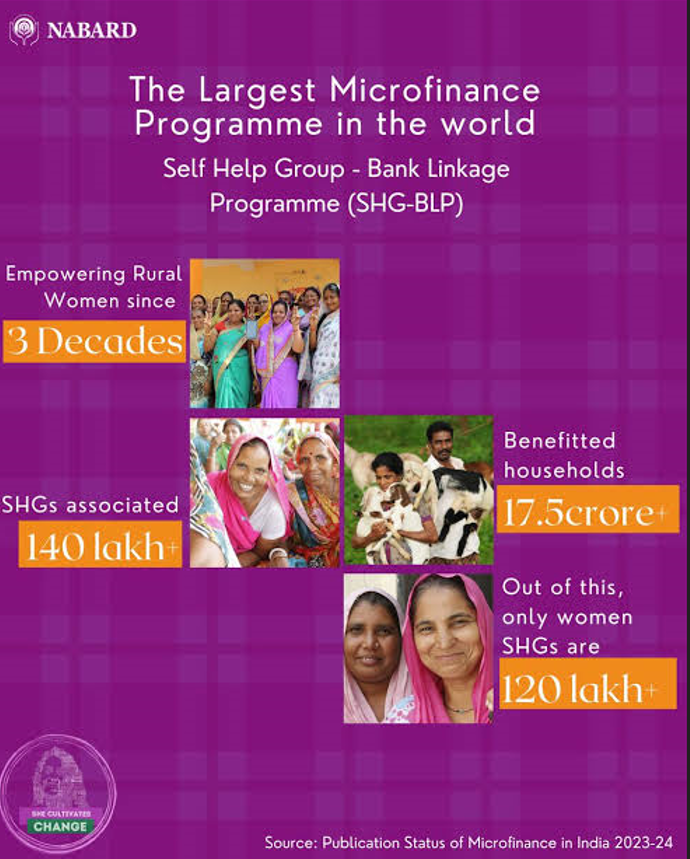
DR. SHAJI KRISHNAN V: Women’s economic empowerment remains one of the most powerful drivers of inclusive rural development. Over the last three decades, NABARD’s Self-Help Group–Bank Linkage Programme has emerged as one of India’s most successful financial inclusion initiatives, bringing millions of women into the formal financial system.
As of March 2026, more than 145 lakh SHGs were savings-linked with banks, of which nearly 90% were exclusive women SHGs. Outstanding bank credit to SHGs exceeded ₹3.33 lakh crore, reflecting both scale and sustainability.
The impact extends far beyond access to credit. SHGs have enabled women to develop financial literacy, leadership capabilities, repayment discipline, and collective bargaining power. They have reduced dependence on informal lenders while strengthening women’s participation in household decisions, local governance, and livelihood activities. Increasingly, SHGs are becoming platforms for enterprise creation rather than only thrift-and-credit groups.
Going forward, NABARD’s focus is on transforming the SHG movement into a more enterprise-oriented, digitally enabled, and market-linked ecosystem. Programmes such as m-Suwidha are supporting women-led enterprises through skill development, credit facilitation, and market access.
We are also strengthening market linkages through initiatives such as Gram Dukans, exhibitions, e-commerce enablement, and digital marketing platforms. Simultaneously, solutions like the Money Purse Application and upcoming platforms such as Jan Sethu and Sahakar Sethu will help deepen digital access and improve credit delivery.
Special attention is being given to ultra-poor women through the Graduated Rural Income Generation Programme (GRIP), which combines livelihood assets, capacity building, and financial inclusion support.
NABARD has been collaborating with DAY-NRLM under a strategic MoU on different fronts that include skilling, capacity building and livelihood promotion for rural women SHGs/ members. Among other initiatives that are being explored with NRLM are (i) a pilot for real-time CLF-VO-SHG banking transactions on LokOS, (ii) setting up a not-for-profit Corporate BC with 2 lakh SHG and cooperative members as BCs.
Thus, NABARD’s plan is to consolidate the SHG-BLP into a more enterprise-oriented, digitally enabled and market-linked model.
EDITOR: The newly launched GRIP targets extremely poor rural households with a combination of refundable grants and capacity-building support to transition them into formal economic activities. How is this approach fundamentally different from traditional poverty alleviation programmes, and what are your early learnings?
DR. SHAJI KRISHNAN V: One of the most persistent challenges in rural development is helping ultra-poor households transition sustainably from vulnerability to economic self-reliance. The Graduated Rural Income Generation Programme (GRIP) has been designed precisely to address this challenge.
Implemented across five states and covering 2,500 ultra-poor rural women, GRIP combines capacity building, livelihood support, enterprise development, and financial inclusion in a structured graduation framework.
Unlike traditional poverty alleviation programmes that often rely primarily on subsidies or direct credit, GRIP adopts a more holistic approach. Beneficiaries receive intensive training, mentoring, and productive assets valued at up to ₹15,000, enabling them to establish nano-enterprises and generate income immediately.
A distinctive feature of the programme is the Returnable Grant model. Instead of creating a repayment burden through conventional loans, beneficiaries are expected to return up to 50% of the asset value over time without interest. This helps instil financial discipline and accountability while preserving confidence and flexibility.
Early outcomes have been encouraging. As on 31 May 2026, all 2,500 beneficiaries have received productive assets and are actively running enterprises. Acceptance of the Returnable Grant concept has been strong, with around 72% of the expected amount already received from beneficiaries and many making repayments ahead of schedule.
The next stage will focus on linking these women entrepreneurs to formal banking channels using their performance-based ratings and transaction histories. Our objective is to create a sustainable pathway that enables ultra-poor households to graduate from vulnerability to entrepreneurship and formal financial inclusion.
EDITOR: In FY25, NABARD facilitated the first-ever cyber insurance cover for RRBs and cooperative banks. With rural financial services rapidly digitising, how do you assess the cybersecurity vulnerabilities of these institutions, and what is NABARD doing to build their digital resilience?
DR. SHAJI KRISHNAN V: As rural financial services become increasingly digital, cybersecurity is no longer merely a technology issue, it is a core institutional resilience and trust issue.
Regional Rural Banks (RRBs) and Cooperative Banks face a range of vulnerabilities, including legacy systems, limited specialist IT capacity, reliance on third-party service providers, and exposure to evolving threats such as phishing, ransomware, cyber frauds, and data breaches.
NABARD’s response has been comprehensive and proactive. A significant milestone was the facilitation of the first sector-wide cyber insurance programme for RRBs and Cooperative Banks through National Insurance Company. What began with coverage for 193 institutions, the scope has now expanded to 309 banks comprising 294 Rural Cooperative Banks, 14 RRBs and TAICO Bank with liability protection exceeding ₹2,500 crore, while substantially reducing insurance costs through collective procurement.
However, cyber resilience cannot be achieved through insurance alone. NABARD’s inspection processes include dedicated assessments of IT governance, information security, and cyber risk management. Regular capacity-building programmes for board members, senior management, and IT personnel help strengthen awareness and preparedness across institutions.
At the infrastructure level, NABARD has facilitated Core Banking Solutions for cooperative banks through a centrally managed ASP model, ensuring standardised security, better governance, and stronger operational controls.
Cyber resilience is further reinforced through periodic IS and IT audits, business continuity reviews, and monitoring of hosted infrastructure.
Our objective is to ensure that digital transformation in rural finance is secure, resilient, and trusted, enabling institutions to embrace technology confidently while safeguarding customer interests.
EDITOR: Under the Unnati Phase II programme, the PACS Accelerator Scheme is being expanded from 30 pilot cooperatives to 10,000 PACS. What unique value do Primary Agricultural Credit Societies bring to India’s rural credit landscape, and how will their digitalisation change the grassroots financial services delivery?
DR. SHAJI KRISHNAN V: Primary Agricultural Credit Societies (PACS) represent the foundation of India’s cooperative credit architecture and serve as the first point of contact with formal finance for over 13 crore farmers.
However, changing economic realities require PACS to evolve beyond their traditional role as credit intermediaries. Under the vision of ‘Sahakar Se Samriddhi’, NABARD is supporting their transformation into Multipurpose Service Centres capable of delivering a much wider range of financial and developmental services.
The PACS Accelerator Programme was launched to demonstrate how diversification into areas such as input supply, warehousing, processing, renewable energy, logistics, and community infrastructure can strengthen institutional viability while creating new sources of income and employment.
Based on the encouraging outcomes from the pilot phase, the programme is now being expanded to 10,000 PACS under Unnati Phase II. Digital tools, AI-enabled project preparation, dashboards, and technology-driven monitoring systems will support this scale-up.
At the national level, NABARD is coordinating with relevant ministries and agencies to align PACS diversification activities with different government schemes in renewable energy, agri-logistics, digital agriculture, also processing and rural enterprise promotion, etc.
Digitisation will be transformational. Computerised PACS will be able to offer faster loan processing, digital payments, DBT services, real-time monitoring, and seamless integration with banking and government platforms. In parallel, diversification into areas such as Common Service Centres, Jan Aushadhi Kendras, dairy, fisheries, and custom hiring centres will make PACS one-stop rural service hubs.
Our objective is to transform PACS from predominantly credit institutions into digitally enabled, member-centric rural business hubs capable of delivering a wide range of financial and developmental services at the grassroots.
EDITOR: On NABARD’s 44th Foundation Day, you launched the RuralTech CoLab portal – an open digital innovation platform for start-ups, research institutions, and technology firms. How will this platform transform the rural innovation ecosystem, and what kind of participation are you expecting from non-traditional stakeholders?

DR. SHAJI KRISHNAN V: Innovation will be a critical driver of rural transformation in the coming decades. The RuralTech CoLab Portal has been conceived as a national platform to connect India’s innovation ecosystem with real rural development challenges.
The platform enables NABARD to engage more systematically with FinTechs, AgriTechs, start-ups, technology firms, research institutions, and development partners to identify, co-create, pilot, and scale practical solutions for the rural economy.
The portal will be complemented by the RuralTech Innovation Sandbox, which will support challenge-led innovation, hackathons, rapid prototyping, and field testing. The emphasis is not simply on generating ideas but on creating solutions that are practical, validated, and scalable.
A key feature is the participation of non-traditional stakeholders as co-innovators rather than service providers. We expect stronger engagement from start-ups, academic institutions, technology companies, and innovators in areas such as digital agriculture, traceability, geospatial intelligence, artificial intelligence, and digital financial services.
The response from the ecosystem has already been encouraging, with 32 companies empanelled across strategic domains including FPO digital enablement, traceability solutions, drone-based monitoring, and AI-powered document generation.
Our objective is to create a pipeline of scalable, field-tested innovations that strengthen rural institutions, improve financial inclusion, accelerate digital agriculture, and support the transformation of rural India in line with the vision of Viksit Bharat 2047.