
Dr. Arvind Kumar*

The world is living through a triple planetary crisis, and it is doing so amid fragmented geopolitics, wars, geoeconomic rivalry and economic disruption that make every response harder and every delay costlier. That pressure lands hardest on the three systems that decide whether we can still steer: how we power economies, how we make things and how we move people and goods. The UN’s Emissions Gap Report 2026, released recently, says the chance of holding warming to 1.5°C without significant overshoot is gone, so the transition of energy, industry and transport is now where the size and duration of that overshoot will be decided. COP31 in Antalya next month puts these sectors first, because the emissions gap has become, as the UN Secretary-General put it, “a leadership gap.”
Nowhere is the disruption clearer than in the fuel that still runs the global economy. This year’s Middle East crisis showed how one conflict and one chokepoint can send prices soaring, and UNSG has noted that three-quarters of humanity lives in countries that import fossil fuels at prices they cannot predict. Speaking at London Climate Action Week, he said, “Energy independence cannot be built on fossil fuel dependence.” The same fragility runs through industry, where carbon-heavy supply chains face volatile input costs and new carbon-border rules, and through transport, where fuel-price swings are nudging households and fleets toward electricity. The renewable investment reached $2.2 trillion in 2025, double that going into fossil fuels, so the disruption is also the market’s verdict on where the future lies.
Bridging Climate Ambition and Action
That verdict is what COP31, tries to convert into outcomes, and it makes transition its first axis. Its Action Agenda, led by Türkiye with Australia presiding over negotiations, sets 2035 targets: electricity’s share of final energy demand rising from just over 20% to 35%, global circular material use in manufacturing rising from 6.9% to at least 15%, and building energy intensity falling 25%. Electrification is the thread tying energy, industry and transport together, since a clean grid matters only if factories and vehicles plug into it.
The report, titled The Point of Return, answers with numbers. Global emissions were 58.4 gigatonnes of CO2 equivalent in 2025, a dip of just 0.1 gigatonnes, with fossil CO2 still rising and G20 emissions, about 76% of the total, up 0.7%. Current policies point to 2.8°C this century, full delivery of national pledges to 2.6°C and net-zero targets to 2.1°C. To follow the “lowest possible” overshoot pathway, peaking at 1.7–1.8°C and returning to 1.5°C by 2100 at roughly even odds, emissions must fall 18% by 2030, and 69% by 2040 from 2025 levels. For our three sectors, that means tripling renewable electricity capacity and cutting coal power by at least 75% by 2035, then effectively ending coal power by 2040.
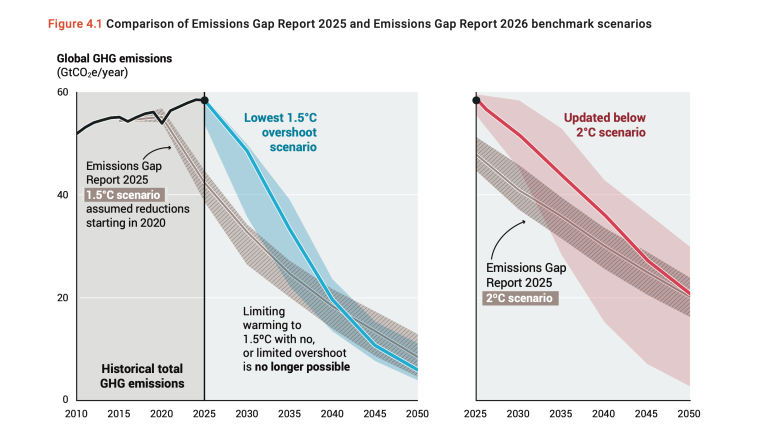
Yet the report is not only a warning. It finds that renewable electricity capacity has grown three times faster than expected since the Paris Agreement, with solar seven times faster, and that evaluations of more than 220 policies show electricity-sector measures cutting emissions by about 9% on average and carbon pricing by 5–13%. That momentum is visible in cheap solar and storage rewriting power markets, electric vehicles pulling transport onto the grid, circular materials and green hydrogen opening routes for hard-to-abate industry, and carbon markets pricing pollution.
India offers a live case of this steering. On energy, non-fossil capacity crossed 300 GW by July 2026, over 54% of installed capacity and led by about 165 GW of solar; a record 55.29 GW was added in 2025–26, and India ranks third globally in renewables. CREA’s analysis for Carbon Brief found coal-fired generation fell 3% in 2025, and preliminary data in the Emissions Gap Report, as AFP reported, show India’s emissions declining that year. Its 2035 NDC promises a 47% cut in emissions intensity from 2005 levels and 60% non-fossil capacity. In transport, EV penetration rose from 8.26% in 2025–26 to about 12% in 2026, with 17.89 lakh EVs sold, electric three-wheelers above 60% of their segment, and about 24,000 e-buses planned under PM E-DRIVE and PM e-Bus Sewa. In industry, the ₹19,744 crore National Green Hydrogen Mission targets 5 million tonnes a year by 2030, and the Carbon Credit Trading Scheme sets binding intensity targets for about 740 entities across nine sectors.
Stumbling Blocks
However the hiccups are also equally clear. Capacity is not generation: non-fossil sources supplied 29.2% of electricity in 2025–26, so grids, storage and transmission must catch up. CREA’s analysis points out that India still plans major expansions in coal power, petrochemicals and coal-based steel. The Climate Action Tracker argues that the 2035 NDC needs nothing beyond current policies, that the gap to a 1.5°C-compatible path doubles from 1.9 GtCO2e in 2030 to 3.9 in 2035, and that India makes its 60% target conditional on international support. Analysts of the draft carbon-market rules add that steel, cement and aluminium must cut intensity by only 2–5% by 2026–27, too little pressure for transformation. In transport, trucks are just 3% of road vehicles but 34% of road-transport CO2, a segment where electrification has barely begun.
Way Forward
These transitions must be done together, not sector by sector. Integration means planning clean power, electrified transport and industry, storage, transmission and charging as one system, so electric trucks, green hydrogen and renewables reinforce rather than wait for one another. Transversality means treating climate, nature and pollution as one problem, pairing coal and methane cuts with circular materials, cleaner air and a just transition that protects jobs. ESG means credible, comparable disclosure and finance: carbon prices and intensity targets that bite, transparent corporate energy use, including by data centres, and affordable capital for developing countries, a gap in the Action Agenda that critics have already noted. With COP31 weeks away, the report’s message to every big emitter is that leadership cannot be outsourced, and India, with its scale, renewable momentum and 2070 net-zero goal, is well placed to show what implementation looks like. Overshoot may now be unavoidable; surrender is not, and the next five years will show which way the world chooses.
*Editor, Focus Global Reporter